




Most electric go-kart batteries deliver 15 to 55 minutes of run time per charge, depending on chemistry and setup, while lifespan ranges from 300 cycles for lead-acid packs to 3,000 cycles for LiFePO4. That gap between “cheap and short-lived” and “pricier but built to last” is the whole story. How you charge, store, and drive your kart moves both numbers up or down more than most owners realize.
TL;DR:
- Lithium iron phosphate batteries typically last around 2,000 to 3,000 cycles, equating to about six to seven years of daily use, while lead-acid packs last only 300 to 800 cycles.
- Drive habits, rider weight, terrain, tire pressure, and ambient temperature can significantly reduce run time, often more than battery capacity itself.
- Proper maintenance, including matching the charger to the battery chemisty and storing lithium batteries at 40–60% charge, can extend the battery’s lifespan.
- A 48V 60Ah LiFePO4 pack delivers roughly 45 to 55 minutes under moderate conditions, but aggressive driving or hot weather can shorten this to 30–40 minutes.
- Focusing on charging discipline and maintenance is more important for longevity than simply selecting the largest battery, as improper charging can drastically reduce cycle life.
Table of Contents
- What Is Typical Go-Kart Battery Life Per Charge?
- Which Battery Chemistry Lasts Longest in a Go-Kart?
- What Shortens or Extends Run Time on a Single Charge?
- How to Maintain a Go-Kart Battery for Maximum Life
- How Do You Know When a Go-Kart Battery Needs Replacing?
- How Gokartsusa Helps You Choose and Care for the Right Battery
- An Editorial Take: Stop Chasing the Wrong Number
- Ready to Upgrade Your Kart’s Power?
- Sources
What Is Typical Go-Kart Battery Life Per Charge?
Run time comes down to three numbers: voltage, amp-hours, and how hard you push the throttle. A youth kart running a 24V or 36V pack with a modest amp-hour rating typically gives a kid 20 to 30 minutes of steady riding before the voltage sags enough to notice. Bump up to an adult recreational setup, and the math changes fast.
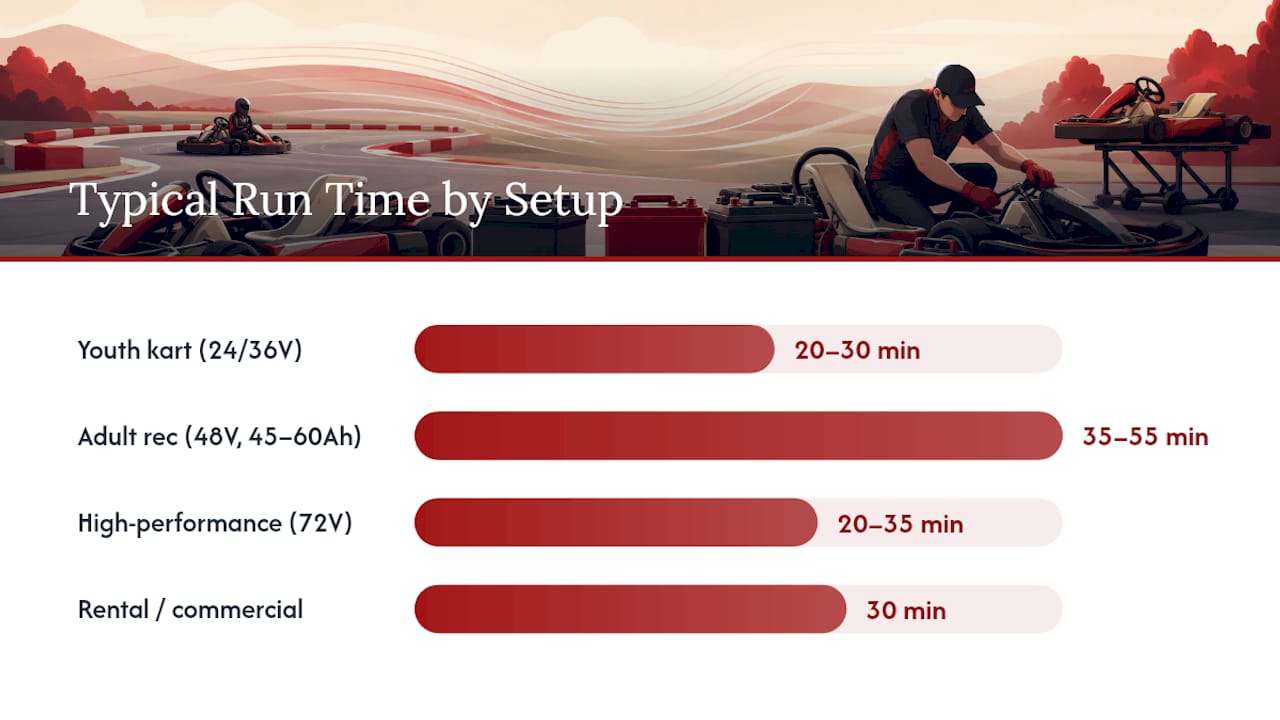
A 48V 60Ah LiFePO4 pack, one of the more common configurations in adult electric karts, delivers roughly 45 to 55 minutes of continuous track use under moderate conditions. Push a heavier rider, drive aggressively, or ride in hot weather, and that window shrinks to 30 to 40 minutes. Lead-acid setups in similar voltage classes rarely match that. They’re heavier per amp-hour and lose usable capacity faster as the pack drains, so a comparable lead-acid kart often lands closer to the lower end of the range.
Consumer guides across the powersports space generally report 15 to 40 minutes of run time for typical electric go-karts, and rental operations frequently design their fleets around 30-minute sessions to match that reality. Here’s how the common setups stack up:
- Youth kart, 24V/36V, small Ah pack: 20 to 30 minutes of casual riding
- Adult recreational, 48V 45 to 60Ah: 35 to 55 minutes depending on chemistry
- High-performance build, 72V: shorter run time per charge but far higher output, often 20 to 35 minutes under hard use
- Rental or commercial kart: tuned to a fixed 30-minute session by design
If you’re shopping and comparing spec sheets, don’t just look at voltage. A 72V pack with low amp-hours can run out faster than a 48V pack with higher capacity, even though the higher-voltage kart feels faster off the line.
Which Battery Chemistry Lasts Longest in a Go-Kart?
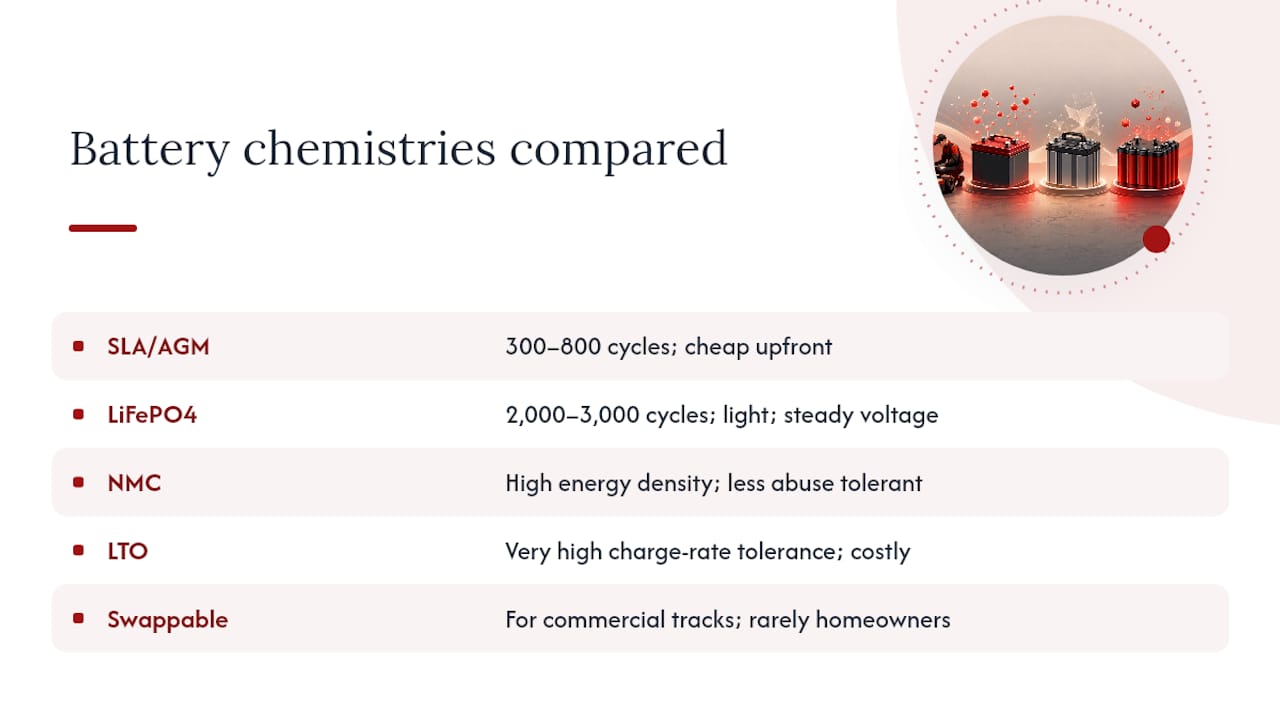
Chemistry decides most of what happens after the first year. Sealed lead-acid (SLA/AGM) is still common on entry-level and budget karts because it’s cheap and simple. Its downside shows up in the cycle count: most lead-acid packs are rated for 300 to 800 charge cycles before capacity drops enough to matter. For a kart ridden a few times a week, that can mean a replacement inside two years.
LiFePO4 (lithium iron phosphate) has become the standard upgrade path for good reason. It commonly runs 2,000 to 3,000 cycles, weighs a fraction of an equivalent lead-acid bank, and holds voltage more consistently as it discharges. That steadier voltage curve is part of why lithium karts feel like they have more power near the end of a session.
The trade-off math: a LiFePO4 pack rated for 2,500 cycles at daily use could last roughly six to seven years before hitting replacement territory, versus one to two years for lead-acid ridden at the same frequency.
Other chemistries show up in specific niches. NMC packs offer high energy density but tolerate abuse less gracefully than LiFePO4. LTO (lithium titanate) accepts very high charge rates for fast turnarounds, which is why some high-volume rental tracks use it despite the higher cost. Swappable battery systems, where operators keep charged spares ready to swap in under a minute, make sense mainly for commercial venues running back-to-back sessions. For a home owner, the operational cost of maintaining multiple charged packs rarely pencils out against just buying one good LiFePO4 setup and charging it properly.
Weigh upfront cost against total cost of ownership before you decide. Lead-acid saves money at checkout; lithium saves money over the life of the kart.
What Shortens or Extends Run Time on a Single Charge?
Some of these factors you control directly. Others you just need to plan around.
- Throttle habits and top speed. Constant full-throttle acceleration drains a pack noticeably faster than smooth, moderate driving. Controller tuning that limits peak amperage extends run time at the cost of top-end punch.
- Rider and kart weight. Every extra pound means more current draw to maintain speed, especially on inclines. A heavier driver can shave 10 to 15% off expected run time.
- Terrain and rolling resistance. Grass, gravel, and inclines all demand more current than flat pavement. Tire pressure matters too. Underinflated tires increase drag and quietly shorten every session.
- Ambient temperature. Cold weather reduces usable lithium capacity temporarily, while extreme heat accelerates long-term degradation. This is one of the most overlooked variables in battery lifespan, and a shaded charging area alone can add meaningful years to a pack.
- Wiring and connector condition. Loose terminals or worn wiring create resistance losses that show up as voltage sag under load, even when the battery itself is healthy.
Pro Tip: If you want more run time without buying a new pack, start with tire pressure and driving habits before assuming the battery is the problem. Those two factors are free to fix and often account for a bigger swing than people expect.
How to Maintain a Go-Kart Battery for Maximum Life
The battery management system, or BMS, built into most modern lithium packs is your first line of defense. It monitors individual cell voltages, prevents overcharging, and shuts the pack down before deep discharge causes permanent damage. A quality BMS is frequently the deciding factor between two identical-chemistry packs aging at very different rates, so it’s worth checking what’s built into any battery you buy or replace.
Charging habits matter just as much as the hardware. Use a charger matched to your battery’s chemistry and termination voltage. Lead-acid and lithium chargers are not interchangeable, and using the wrong one degrades cells fast. For lithium packs, commercial operators generally charge at 0.3C to 0.5C rather than pushing high-speed rates every session, which balances turnaround time against long-term cell health.
Build a simple weekly habit around these checks:
- Check resting voltage after a full charge and compare it to baseline
- Inspect terminals for corrosion or looseness before every ride
- Confirm the battery mount is secure. Vibration damage is a real and underrated failure cause
- Keep vents and connectors free of dirt and moisture
For storage, park lithium packs at 40 to 60% state of charge rather than full, and check voltage monthly during the off-season. Leaving any battery at 100% charge for weeks accelerates calendar aging. In cold climates, bring lithium packs indoors rather than letting them sit in a freezing garage, since charging a cold lithium cell can cause permanent capacity loss.
How Do You Know When a Go-Kart Battery Needs Replacing?
A pack rarely fails without warning signs. Here’s the cadence to follow:
- Run the baseline test. After a full charge, log resting voltage and time a standardized lap or run. Compare it against the numbers from when the battery was new.
- Watch for the 20 to 30% threshold. A runtime drop of roughly 20% or more compared to baseline usually signals a pack nearing replacement, even if it still holds a charge.
- Use a capacity or internal-resistance tester on any pack you suspect is degrading faster than normal. Rising internal resistance is often the earliest measurable sign of trouble.
- Replace immediately if you notice swelling, unusual heat during charging, or repeated BMS cutouts. These aren’t wear signs. They’re safety signs.
- Test formally every three to six months on karts ridden frequently, and log the results so you catch decline before it becomes a mid-ride failure.
A quick troubleshooting pass can rule out simpler culprits like loose wiring before you assume the battery itself is the problem.
How Gokartsusa Helps You Choose and Care for the Right Battery
We’ve spent years watching customers wrestle with the same question: how do I get more life out of this kart without guessing? Our storage guide and general maintenance resources walk owners through the same checks outlined above, tailored to the models we sell.
Gokartsusa carries electric go-karts, replacement batteries, chargers, and accessories built around common chemistries like lead-acid and LiFePO4. If you’re not sure which battery or charger fits your kart, support teams can help you match compatibility before you spend money on the wrong part.
An Editorial Take: Stop Chasing the Wrong Number
Most articles on this topic obsess over the biggest possible run-time figure, as if a longer single charge is the whole game. It isn’t. Cycle life and charging discipline decide how much money leaves your wallet over three years, and that number matters more than whether a session runs 35 minutes or 45.
The conventional advice, “just buy the biggest battery you can afford,” skips the part that actually saves owners money: matching charger to chemistry and keeping packs off the charger the moment they hit full. A $40 mismatched charger can quietly cut a $300 LiFePO4 pack’s life in half. Nobody warns buyers about that at checkout.
If you take one thing from this guide, prioritize charging discipline over chasing extra minutes. A well-charged lead-acid pack sometimes outlasts a poorly-charged lithium one, cycle-life numbers aside. Buy the right battery for your use case, then treat it the way its chemistry demands.
— Mario
Ready to Upgrade Your Kart’s Power?
A reliable source offers a complete selection of electric and gas-powered karts alongside batteries, chargers, and accessories built to match them, so you’re not guessing at compatibility after the fact.

If your current battery is nearing the end of its cycle life, or you’re ready for a kart built around a stronger lithium setup from day one, here’s where to start:
- Browse our gas-powered kart lineup if you’re ready to skip battery maintenance entirely
- Check compatible parts for lithium-powered models like the TrailMaster Blazer i200R
- Contact support teams with your current kart’s specs for battery and charger matching
Whether you’re replacing a tired lead-acid pack or shopping for your family’s first kart, help is available to find the right fit and get back on the track.
Sources
- Battery & Charging Guide for Adult Electric Go Karts — ANCHI Amusement
- Battery chemistry for your electric go-kart — Kart1 Distribution
- How Long Can An Electric Go-kart Run? — RiiRoo