




TL;DR:
- Safety gear for outdoor vehicles includes certified helmets, eye protection, gloves, boots, and body armor to prevent injuries. Upgrading to harness systems enhances safety during rollovers, and emergency accessories like fire extinguishers and first aid kits are essential for roadside safety. Proper fit, installation, and regular maintenance are critical for ensuring your protective gear offers maximum safety.
Safety gear for outdoor vehicles is defined as the collection of certified protective equipment, restraint systems, and emergency accessories that reduce injury risk for riders of ATVs, UTVs, go-karts, and similar recreational vehicles. The industry term for this category is “personal protective equipment” or PPE, though powersports riders commonly call it riding gear or off-road safety equipment. Whether you ride trails on weekends or race go-karts at a local track, the right protective gear for outdoor vehicles is the single most important investment you make before the engine starts. This guide covers every layer of protection, from certified helmets to harness systems, so you ride with confidence and come home safe.
What are the essential safety gear items for outdoor vehicles?
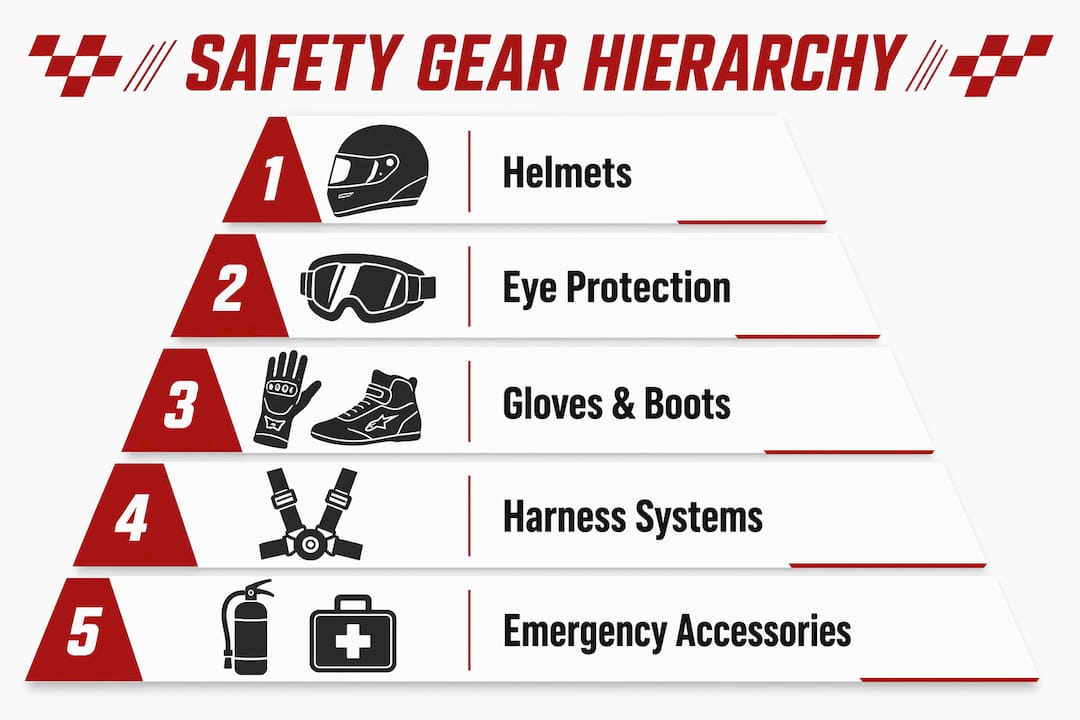
A baseline safety kit for ATVs and off-road vehicles includes a certified full-face helmet, dust-sealing eye protection, gloves, and off-road boots with ankle support. These four items address the most common injury zones: head, eyes, hands, and feet. Skipping any one of them is not a calculated risk. It is a gap in your armor.
Helmets
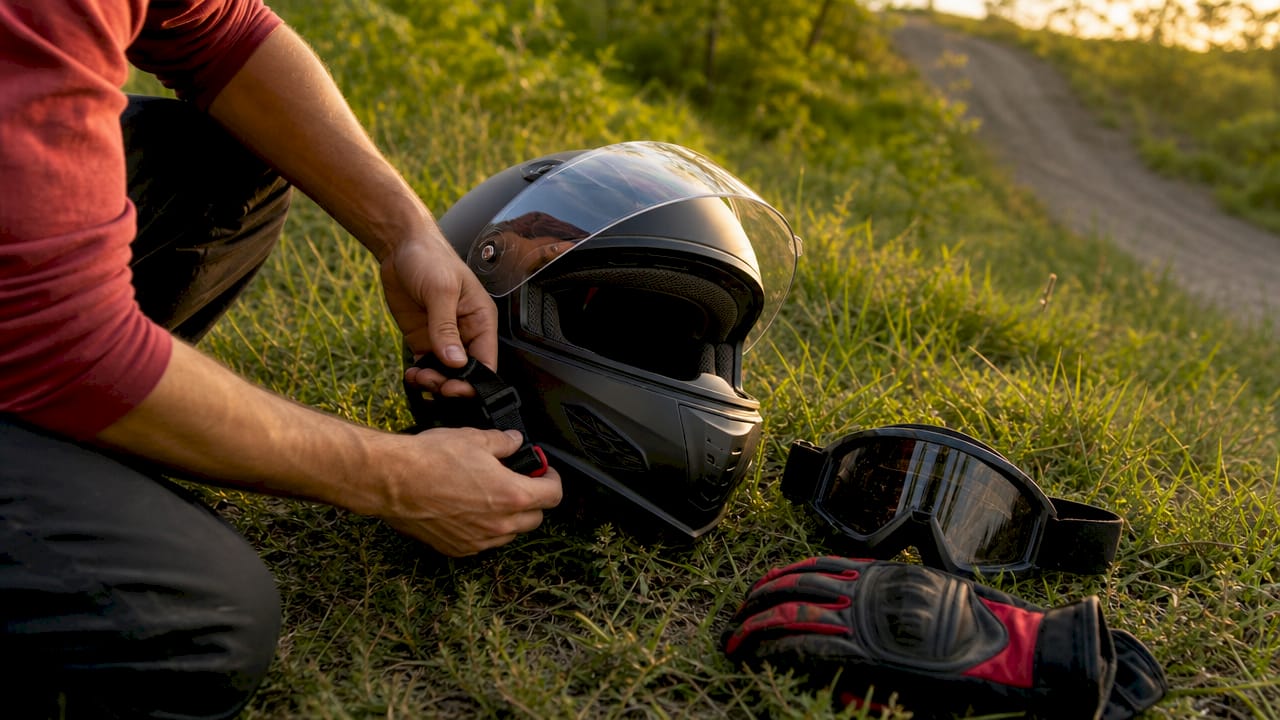
A full-face helmet is the foundation of any outdoor vehicle safety kit. Look for DOT certification as the US minimum standard. ECE 22.06, which became active in january 2022, adds oblique impact testing and is more rigorous than DOT. ECE 22.06 replaced the older ECE 22.05 standard, tightening requirements for rotational impact forces that cause brain injury. If you are buying a new helmet in 2026, prioritize ECE 22.06 certified models.
Eye protection
Dust-sealing goggles are critical for off-road riding because dust and debris impair vision and cause eye injuries. Look for foam-sealed frames and anti-fog coatings. Standard sunglasses do not seal against trail dust. Specialized off-road goggles are a non-negotiable part of your ATV safety kit. Protective eyewear designed for outdoor use also shields against UV exposure, which matters on long sunny rides.
Gloves, boots, and body armor
- Gloves: Reinforced riding gloves improve grip on handlebars and protect against abrasion in a fall. Look for knuckle guards and palm padding.
- Boots: Off-road boots with reinforced toes and ankle stability prevent the foot and ankle injuries that are common in ATV and go-kart crashes. Standard sneakers offer no lateral support.
- Body armor: Chest protectors, back protectors, elbow guards, and knee guards absorb impact energy. Motocross-style armor worn under or over a riding jersey is standard for ATV and UTV riders.
Pro Tip: Try on helmets and boots in person before buying. A helmet that shifts more than one inch in any direction during a firm shake does not fit correctly and will not protect you the way a snug fit does.
Seasonal comfort matters too. Mesh-lined armor works in summer heat. Insulated gloves and waterproof boots extend your riding season into fall and early spring without sacrificing protection.
How do restraint systems improve safety in UTVs?
A stock lap belt is the minimum restraint in most UTVs, but it leaves the upper body unrestrained during a rollover or hard impact. Upgrading to a 4-point or 5-point harness changes that picture entirely.
A 4-point harness adds two shoulder belts to the standard lap belt, holding the torso in place during side impacts and rollovers. A 5-point harness adds an anti-submarine strap between the legs. That strap prevents the rider from sliding forward and under the lap belt during hard frontal impacts, a movement called submarining. The 5-point system is required in many sanctioned racing events because submarining is a leading cause of serious abdominal and spinal injury.
| Harness type | Shoulder belts | Anti-submarine strap | Common use |
|---|---|---|---|
| Stock lap belt | No | No | Basic recreational UTVs |
| 4-point harness | Yes | No | Trail riding, light off-road |
| 5-point harness | Yes | Yes | Racing, extreme terrain |
Installation matters as much as the harness itself. Shoulder belts must mount to structural points at the correct height, and the anti-submarine strap must be routed precisely. Incorrect installation transfers load to the wrong points and can cause injury rather than prevent it. Always follow the manufacturer’s installation guide or have a qualified shop do the work.
SFI 16.1 is the certification standard for UTV and off-road harnesses. Harness webbing degrades over time from UV exposure and stress. Most manufacturers recommend replacing harnesses every two to three years or after any significant impact. Pair a 5-point harness with a head-and-neck restraint device for maximum protection at speed.
Pro Tip: After installing a harness, do a pull test on each strap before every ride. Webbing that feels stiff, frayed, or discolored needs replacement before you hit the trail.
What roadside safety and emergency accessories are vital for outdoor vehicle users?
Off-road vehicle safety gear does not stop at your body. Your vehicle needs emergency equipment too, and federal regulations set the floor for what you must carry.
Under 49 CFR 393.95(f), commercial vehicles must carry three bidirectional reflective triangles meeting FMVSS 125, or alternatives such as six fusees or three liquid-burning flares. While this rule targets commercial trucks, it reflects the minimum standard any outdoor vehicle operator should follow for trail and roadside visibility. Reflective triangles placed at 10, 100, and 300 feet from a stopped vehicle give approaching traffic the maximum warning distance.
Fire extinguishers and first aid kits round out your emergency kit. An ABC-rated extinguisher handles fuel, electrical, and ordinary combustible fires. Mount it within arm’s reach, not buried under gear in the cargo bed. A kit that takes two minutes to dig out fails the real-world test.
For first aid, use a modular trauma kit with clearly labeled pouches. Clear labeling reduces reaction time in field emergencies when stress is high and seconds count. Separate your tourniquet and wound-packing supplies from general first aid items so you find them instantly.
Additional emergency accessories worth carrying:
- A waterproof LED flashlight with spare batteries for night breakdowns or trail navigation.
- A whistle or signal mirror for signaling in areas without cell coverage.
- A tow strap rated for your vehicle’s weight, stored in a dedicated exterior pouch.
- A portable jump starter for electric-start ATVs and UTVs.
Mount all emergency gear in fixed, labeled positions. Loose gear shifts during off-road travel and becomes impossible to find when you need it most.
How to choose and maintain your safety gear for optimal protection
Choosing the right gear starts with certification, then fit, then maintenance. All three must be right for the gear to protect you.
- Check the certification label. For helmets, DOT is the US legal minimum. ECE 22.06 is the current global benchmark. SNELL M2020 is a third rigorous standard used in motorsports. Never buy a helmet without a visible certification label inside the shell.
- Test the fit before you buy. A snug helmet with minimal movement is the foundation of effective impact protection. The helmet should sit level, contact your head evenly, and not shift when you shake your head firmly. Boots should hold your ankle without cutting off circulation. Gloves should let you grip without bunching at the palm.
- Inspect gear before every season. Check helmet shells for cracks, liner compression, and strap fraying. Inspect harness webbing for UV fading, cuts, or stiffness. Replace any item that shows damage.
- Clean and store gear properly. Helmet liners are removable and machine washable in most modern helmets. Wipe down armor with a damp cloth and mild soap. Store all gear away from direct sunlight and heat, which degrade foam and webbing faster than riding does.
- Replace on schedule. Most helmet manufacturers recommend replacement every five years regardless of visible condition, because foam degrades internally. Replace harnesses every two to three years or immediately after a hard impact.
Pro Tip: Take a photo of your gear’s certification labels and store them in your phone. If you ever need to verify compliance for a track or event, you have the information on hand without digging through packaging.
How does safety gear differ across go-karts, ATVs, and UTVs?
The right off-road vehicle safety gear depends on the vehicle you ride. Go-karts, ATVs, and UTVs each have different speed ranges, seating positions, and crash dynamics that shape what you need.
Go-karts sit low to the ground and expose the driver to direct contact with barriers and other karts. A full-face helmet is mandatory at virtually every track. Driving gloves improve feel on the steering wheel. A rib protector vest is strongly recommended because kart impacts frequently transfer force to the ribcage. A driving suit made from fire-resistant material is required at competitive levels and smart at any level.
ATVs are open vehicles with no cage, so the rider is the only protection. The ATV safety checklist for 2026 emphasizes full-face helmets, goggles, gloves, boots, and body armor as non-negotiable. Chest and back protectors matter most because ATV rollovers throw the rider clear of the vehicle.
UTVs have a roll cage and seating for multiple occupants, which changes the gear equation. The cage provides structural protection, but it also means occupants stay inside during a rollover. That makes harness upgrades and helmet use inside the cab critical. Many UTV riders add powersports accessories like intercom systems and GPS mounts that support safety without replacing core protective gear.
| Vehicle | Priority gear | Key difference |
|---|---|---|
| Go-kart | Helmet, rib protector, driving suit | Low-speed, high-contact environment |
| ATV | Helmet, goggles, body armor, boots | Open vehicle, rollover ejection risk |
| UTV | Harness upgrade, helmet, cage padding | Enclosed cab, occupant retention priority |
Terrain also shapes your gear choices. Rocky mountain trails demand more ankle and knee protection than flat desert runs. High-speed desert riding calls for a higher-rated helmet and neck brace. Match your gear to your terrain, not just your vehicle.
Key takeaways
The most effective safety gear for outdoor vehicles combines a certified full-face helmet, dust-sealing goggles, reinforced gloves, off-road boots, body armor, and a properly installed restraint system matched to your specific vehicle type.
| Point | Details |
|---|---|
| Helmet certification matters | Choose ECE 22.06 or DOT certified helmets and replace them every five years. |
| Fit is as critical as certification | A helmet that shifts during a shake does not protect you, regardless of its rating. |
| Upgrade UTV restraints | A 5-point harness prevents submarining and is the standard for serious off-road use. |
| Emergency gear needs to be accessible | Mount extinguishers and first aid kits within reach, not buried in cargo. |
| Match gear to your vehicle | Go-karts, ATVs, and UTVs each require different protective priorities. |
What I have learned after years on the trail
The gear mistake most riders make
Most riders focus on buying gear and stop there. The real mistake is buying gear that does not fit, then assuming it works. I have seen riders show up with brand-new helmets that wobble on their heads and harnesses that were never properly torqued to the cage. Both are worse than useless because they create a false sense of security.
Fit and installation are where protection actually lives. A $400 helmet that fits perfectly outperforms a $700 helmet worn loose every single time. The same logic applies to harnesses. I have watched riders install 5-point harnesses with the shoulder belts angled too far forward, which means the load transfers to the collarbone instead of the shoulder. That is an injury waiting to happen.
The other thing I tell every rider is to treat emergency gear with the same seriousness as riding gear. Your ABC extinguisher and trauma kit are not box-checking exercises. They are the tools that buy you time until help arrives. Pack them where you can reach them in 10 seconds with one hand. Practice opening your first aid kit before you need it.
Comfort and protection are not opposites. Modern body armor is lighter and more breathable than it was five years ago. There is no reason to skip a chest protector because it feels bulky. Try a few brands, find one that moves with you, and wear it every ride. The adventure is better when you are not managing an injury.
— Mario
Gear up with Gokartsusa before your next ride
Gokartsusa carries certified helmets, harnesses, and protective accessories built for the powersports lifestyle. Whether you are outfitting a first-time rider or upgrading your trail kit, the selection covers go-karts, ATVs, and UTVs with gear that meets current safety standards.

For families introducing younger riders to the sport, the Mini Sport Kids ATV 110cc is a strong starting point. It features a parental remote start and kill switch, giving adults direct control while kids build confidence. Pair it with a properly fitted youth helmet and boots, and you have a setup that prioritizes safety from the first ride. Visit Gokartsusa to find compatible safety accessories for kids and get your crew trail-ready.
FAQ
What is the minimum safety gear for ATV riding?
A certified full-face helmet, dust-sealing goggles, reinforced gloves, and off-road boots with ankle support form the baseline kit for ATV riding. Body armor covering the chest, back, elbows, and knees adds critical protection for trail and off-road conditions.
What is the difference between DOT and ECE 22.06 helmet certifications?
DOT is the US legal minimum for helmet certification, while ECE 22.06 adds oblique impact testing and has been the updated international standard since january 2022. ECE 22.06 is more rigorous and is the preferred standard for serious off-road and powersports riders.
Do I need a harness upgrade for recreational UTV riding?
A stock lap belt is legal for recreational use, but a 4-point or 5-point harness significantly reduces injury risk during rollovers and hard impacts. A 5-point harness is the best choice for rough terrain because it prevents the rider from submarining under the lap belt.
What gear do I need for off-roading in a go-kart?
Go-kart riders need a full-face helmet, driving gloves, a rib protector vest, and a driving suit for competitive or high-speed use. Most tracks require a DOT or Snell-certified helmet as a minimum condition of entry.
How often should I replace my off-road safety gear?
Helmets should be replaced every five years or immediately after any significant impact. Harness webbing typically needs replacement every two to three years, especially if it shows UV fading, fraying, or stiffness from repeated stress.