




Vehicle payload capacity is the maximum weight your vehicle can safely carry at one time, including every passenger, every piece of cargo, and every accessory added after the factory. The formula is straightforward: payload = GVWR (Gross Vehicle Weight Rating) minus curb weight. According to Geotab’s payload capacity guide, subtracting curb weight from GVWR is the standard method used across the industry, and it’s the same math your manufacturer used when they stamped the placard on your driver-side doorjamb.
- GVWR is the maximum total weight your vehicle is engineered to handle, including itself.
- Curb weight is the weight of the vehicle fully fueled and ready to drive, with no passengers or cargo.
- Payload is what’s left over — the weight budget you have for people and gear.
Safety callout: Never exceed the payload number on your vehicle’s doorjamb placard. Overloading affects braking distance, handling, and suspension integrity — and it can void your insurance coverage in an accident.
Key Takeaways
Vehicle payload capacity is GVWR minus curb weight — and every passenger, piece of gear, and aftermarket accessory counts against that number.
| Point | Details |
|---|---|
| Payload formula | Subtract curb weight from GVWR; the result is your total weight budget for passengers and cargo. |
| Check the placard first | The driver-side doorjamb placard is the authoritative source for your vehicle’s payload limit. |
| Tongue weight counts | When towing, subtract tongue weight (roughly 10–20% of trailer weight) from your payload budget. |
| Options reduce payload | Factory options like AWD and aftermarket accessories increase curb weight and shrink usable payload. |
| Gokartsusa lists specs | Product pages at Gokartsusa include weight limits so buyers can verify payload fit before purchasing. |
Table of Contents
- What does payload actually include?
- How does payload capacity differ from towing capacity?
- Key hauling terms every driver should know
- How to calculate your vehicle’s payload capacity
- Where to find your vehicle’s official payload number
- Approximate payload ranges by vehicle type
- Why staying within payload capacity keeps you safe
- Can you increase your vehicle’s payload capacity?
- How to load your vehicle for safe payload distribution
- Payload guidance for ATVs, UTVs, go-karts, and mini bikes
- The payload mistake most drivers make only once
- Gokartsusa has the specs you need before you buy
- Sources
What does payload actually include?
Here’s where most drivers get tripped up. Cars that payload is the total weight of passengers and cargo inside the vehicle — not just what’s in the bed or cargo area. Every person who climbs in, every bag tossed in the trunk, every toolbox bolted to the frame after purchase, and every filled water jug counts against your payload budget.
Fuel is part of curb weight, so a full tank doesn’t reduce your payload. But a portable fuel container you throw in the bed? That’s payload.
Common misconceptions worth clearing up:
- “Payload only means the truck bed.” Wrong. Every seat, every row, every storage compartment counts.
- “Towing weight and payload are the same thing.” They are not — more on that in the next section.
- “Aftermarket accessories don’t affect payload.” They do, because bolt-on accessories add to the vehicle’s effective loaded weight. A steel bumper, a roof rack, or a toolbox all count against your budget.
- “The payload number online matches my truck.” Not always. Cars.com notes that factory options like AWD, a third-row seat, or larger wheels increase curb weight and reduce the usable payload for that specific vehicle compared with the base-model spec.
A quick real-world check: five adults averaging typical weight each equals a large portion of the payload before you add any bags. On a compact SUV with a payload around typical ratings, that leaves less space for luggage, a stroller, and a cooler. The math gets tight fast.
How does payload capacity differ from towing capacity?
These two numbers measure completely different things, and confusing them is one of the most common mistakes drivers make when shopping for a truck or SUV.
Payload capacity is what your vehicle carries inside itself — passengers, cargo, and anything physically on the vehicle. Towing capacity is the maximum weight your vehicle can pull on a trailer behind it. A truck might tow 10,000 lbs but only carry 1,500 lbs of payload. Those numbers do not add together.
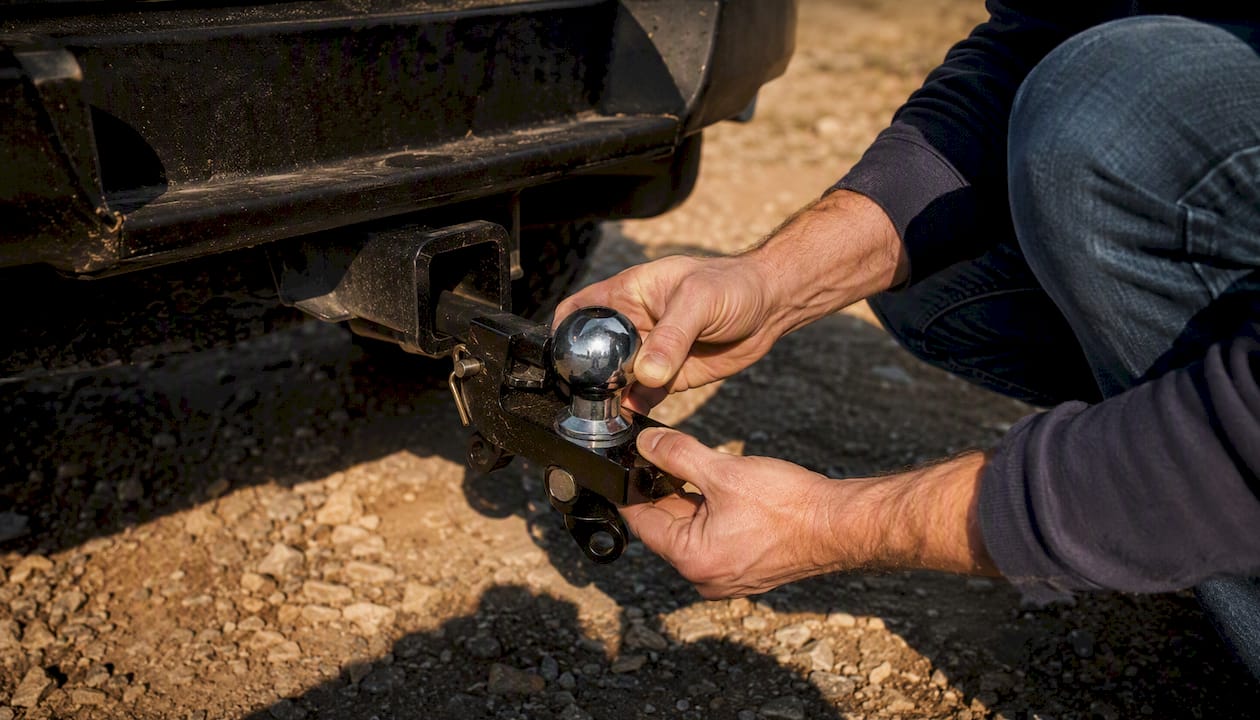
The connection between the two is tongue weight. When you hitch a trailer, the front portion of the trailer pushes down on your hitch ball. That downward force counts against your GVWR, which means it eats into your payload budget. Geotab recommends including tongue weight in payload calculations when towing, and a conservative planning figure is 20% of trailer weight as tongue weight.
Think of it this way: a 5,000-lb trailer with a 1,000-lb tongue weight leaves 1,000 lbs less payload available for passengers and cargo in the cab.
Key safety distinctions:
- Exceeding towing capacity strains the drivetrain and transmission.
- Exceeding payload capacity degrades braking, steering, and suspension.
- Both limits can be violated simultaneously on a heavily loaded tow rig.
- Always check your trailer towing capacity alongside payload before any haul.
Key hauling terms every driver should know
Understanding the spec sheet starts with knowing what each term actually means. Here are the five you’ll encounter most often:
| Term | Plain-language definition | Example |
|---|---|---|
| GVWR | Maximum allowable total weight of the vehicle, including itself, passengers, cargo, and fuel | A light-duty pickup might carry a GVWR of 7,000 lbs |
| Curb weight | The vehicle’s weight fully fueled, with no passengers or cargo | That same truck might weigh 5,200 lbs at the curb |
| Payload | GVWR minus curb weight; the weight budget for people and gear | 7,000 − 5,200 = 1,800 lbs available |
| GCWR / GCVWR | Gross Combined Weight Rating; maximum weight of the vehicle plus a loaded trailer | Relevant when towing; separate from payload |
| GAWR | Gross Axle Weight Rating; maximum load each axle can handle | Exceeding front or rear GAWR causes axle and tire damage |
| Tongue weight | Downward force the trailer hitch exerts on the vehicle | Typically 10–20% of trailer weight per Geotab |
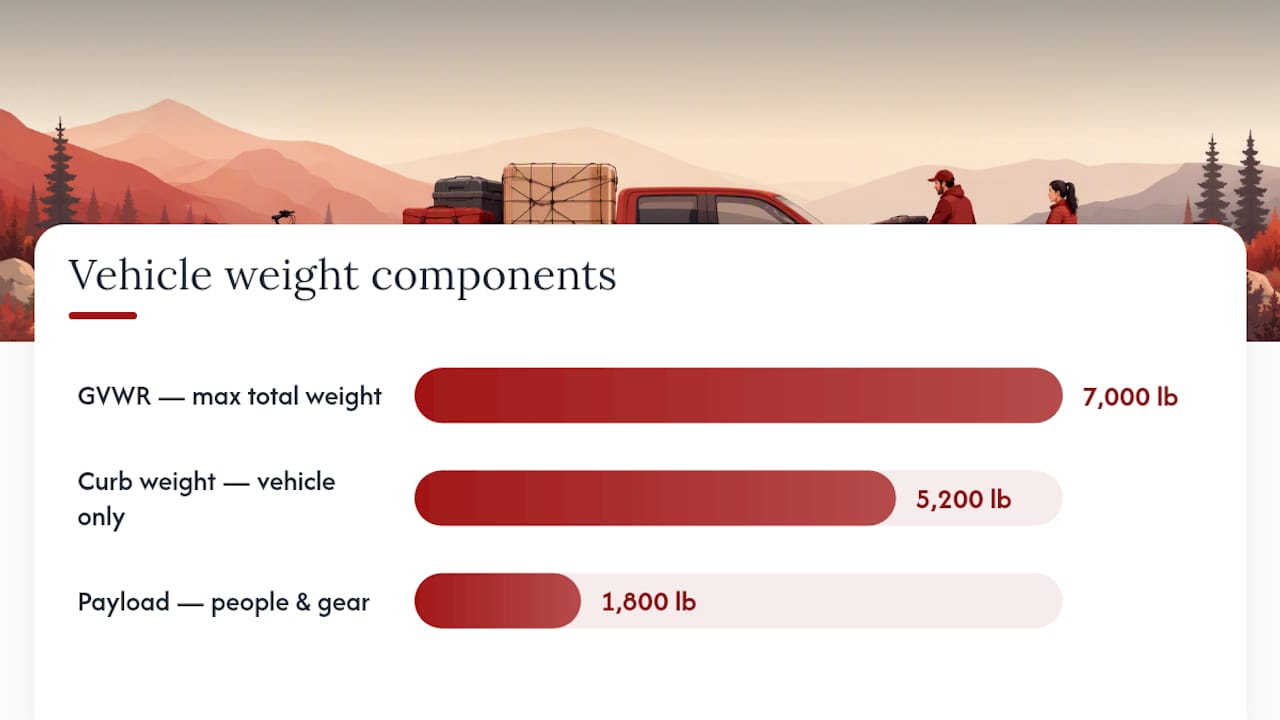
GVWR and curb weight are the two numbers that produce your payload figure. GCWR and GAWR are separate limits you must also respect — staying within GVWR doesn’t automatically mean you’re within GAWR on a single axle.
How to calculate your vehicle’s payload capacity
The math takes about two minutes. Here’s the process step by step.
- Find your GVWR. Look at the “Tire and Loading Information” placard on the driver-side doorjamb. It’s usually a white or yellow sticker. The GVWR is also in your owner’s manual and on the manufacturer’s spec page.
- Determine your curb weight. Check the owner’s manual or manufacturer’s website for your specific trim and configuration. If you’ve added aftermarket accessories, add their weight to the published curb weight. J.D. Power recommends weighing the vehicle at a public scale when the exact curb weight is uncertain — don’t rely solely on a marketing brochure.
- Subtract. Payload = GVWR − curb weight.
- Account for tongue weight if towing. Subtract the trailer’s tongue weight from your payload result to find your remaining budget for cab passengers and cargo.
Worked example:
- GVWR: a typical mid-weight rating
- Curb weight (with aftermarket roof rack added): a measured weight including accessories
- Base payload: difference between GVWR and curb weight
- Tongue weight of trailer estimated at about 20% of trailer weight
- Remaining payload for passengers and cargo calculated accordingly
Pre-trip payload checklist:
- Confirm GVWR from the doorjamb placard, not a website listing.
- Use your specific trim’s curb weight, not the base-model spec.
- Add the weight of any aftermarket accessories to curb weight.
- Include all passengers and their gear in your payload count.
- Subtract tongue weight if towing.
Pro Tip: Write your payload math on a card and keep it in the glove box. When you add seasonal gear — a snowplow, a roof box, a bike rack — recalculate before your first trip.
Where to find your vehicle’s official payload number
The most authoritative source is always the vehicle itself. Kelley Blue Book’s payload guide confirms that the factory “Tire and Loading Information” placard on the driver-side doorjamb is the definitive reference. It typically reads: “The combined weight of occupants and cargo should never exceed XXX lbs.” That number is your payload limit, set by the manufacturer for your specific vehicle as built.
Other reliable sources:
- Owner’s manual: Payload and GVWR are listed in the specifications section.
- Manufacturer support pages: Ford’s owner support page is a good example of how OEMs explain payload and direct you to the right numbers for your model.
- Window sticker (Monroney label): Lists GVWR for new vehicles at the point of sale.
- VIN-based lookup tools: Several manufacturer and third-party sites let you enter your VIN to pull exact specs for your build.
If the doorjamb placard is missing or damaged, contact your dealer with your VIN. They can pull the original build sheet and confirm the correct GVWR and payload rating. Never estimate from a generic spec sheet — trim level, options, and factory-installed equipment all affect the real number.
Approximate payload ranges by vehicle type
These figures are general ballparks. Always check your specific vehicle’s placard before loading.
- Passenger cars: roughly 800–1,000 lbs for most sedans and hatchbacks.
- Compact SUVs: typically 1,000–1,200 lbs, though popular crossovers with AWD and third rows often land toward the lower end.
- Full-size SUVs: generally 1,200–1,600 lbs depending on trim and drivetrain.
- Half-ton pickups (1500-series): commonly in the 1,500–2,000 lbs range, though specific configurations vary widely. A base two-wheel-drive model will carry more than a crew-cab, four-wheel-drive version with the same GVWR because the heavier trim has a higher curb weight.
- Heavy-duty pickups (2500/3500-series): can reach 3,000–4,000 lbs or more depending on configuration.
- Small cargo vans: often 1,500–2,500 lbs, with commercial variants higher.
Callout: Factory options matter more than most buyers realize. Cars.com notes that features like AWD, a moonroof, or larger wheels increase curb weight and reduce usable payload compared with a base model — sometimes by several hundred pounds on the same nameplate.
Why staying within payload capacity keeps you safe
Overloading isn’t just a mechanical inconvenience. It changes how your vehicle behaves in ways that matter most when something goes wrong.
Safety impacts:
- Braking distance increases because the vehicle carries more momentum than the brakes were designed to stop.
- Steering becomes heavier and less responsive, especially in emergency maneuvers.
- Rollover risk rises as the center of gravity shifts upward with a heavy load.
- Tire blowout risk increases when tires carry weight beyond their load index rating.
Mechanical wear:
- Brakes wear faster under repeated heavy-load stops. Upgrading to quality brake components designed for towing and load stress can extend service life when you regularly work near your payload limit.
- Suspension components — springs, shocks, and bushings — degrade faster under chronic overload.
- Drivetrain stress increases, particularly on automatic transmissions and differentials.
Legal and insurance risk:
The FMCSA regulates commercial vehicle weight limits on federal highways, and the FHWA sets bridge weight limits that apply to all vehicles. For personal vehicles, an overloaded truck involved in an accident can complicate liability claims and may give an insurer grounds to dispute coverage. AAA consistently advises drivers to treat the payload placard as a hard limit, not a suggestion. Proper outdoor vehicle maintenance habits, including regular checks of suspension and brake condition, help catch wear before it becomes a safety issue.
Can you increase your vehicle’s payload capacity?
The honest answer: not really, and not safely through aftermarket claims. Your GVWR is a structural engineering limit set by the manufacturer. You cannot legally increase it without a manufacturer-authorized modification, which is rare and typically reserved for commercial upfits.
What you can do is manage your load more intelligently:
- Move excess weight to a trailer. This is the most practical solution. Just remember to account for tongue weight against your remaining payload. Review towing capacity guidance before hitching up.
- Offload nonessential items. That spare set of tools, the camping gear you haven’t used in months — remove it before a heavy haul.
- Choose a higher-capacity vehicle. If you consistently need more than your current vehicle allows, a heavier-duty trim or a different model is the right answer.
- Use professional hauling services for loads that genuinely exceed what your vehicle can handle.
Avoid overinflating tires to “compensate” for a heavy load. It doesn’t increase payload capacity — it changes the contact patch, reduces grip, and increases blowout risk. Similarly, be skeptical of aftermarket products claiming to raise your GVWR. Check your GAWR and tire load ratings independently; replacing tires with a lower load index than the original equipment effectively reduces your safe payload capability, as Kelley Blue Book cautions.
Pro Tip: Before any heavy haul, check the load index on your tires against the original equipment spec. A tire swap that looks like an upgrade can quietly reduce your safe carrying capacity.
How to load your vehicle for safe payload distribution
Getting the weight right is only half the job. Where you put it matters just as much.
- Place heavy items low and centered. A high center of gravity increases rollover risk, especially in turns and emergency maneuvers.
- Balance side-to-side. Uneven lateral weight shifts the vehicle’s handling and can cause pull or instability.
- Position roughly 60% of movable cargo forward of the rear axle. This keeps the rear from squatting and maintains front-axle steering response.
- Secure everything with ratchet straps and anchor points. Loose cargo shifts under braking and can exceed local axle weight limits even when total payload is within spec.
- Check tire pressures after loading. Cold inflation pressure should match the placard spec for a loaded vehicle — your doorjamb placard often lists separate front and rear pressures for loaded conditions.
- Walk around the vehicle and check mirror angles before driving. A loaded vehicle sits lower; your sight lines change, and so does your stopping distance.
Common mistakes: stacking all the weight at the very rear of a pickup bed, ignoring the weight of passengers when calculating remaining cargo capacity, and skipping the tie-down step on “short trips.” Recreational vehicle safety guidance reinforces that proper load distribution is as important as staying within the total weight limit.
Pro Tip: After loading, drive slowly in a parking lot before hitting the road. You’ll feel immediately if something is off — a pull to one side, a heavy rear end, or sluggish steering are all signals to stop and redistribute.
Payload guidance for ATVs, UTVs, go-karts, and mini bikes
Small powersports vehicles have payload limits too, and the consequences of ignoring them are more immediate than on a full-size truck. Kelley Blue Book notes that small vehicles’ suspension and center of gravity are tightly matched to their payload specs, so even modest extra weight can significantly change handling. A go-kart or ATV engineered for a 150-lb rider behaves very differently with a 200-lb rider plus gear.
Spec checklist for powersports vehicles:
- Locate the spec plate or product listing for your vehicle’s maximum rider weight and cargo allowance.
- Include the rider’s gear — helmet, boots, protective gear — in the weight calculation. Full riding gear can add 10–15 lbs.
- Check whether the spec lists a single-rider limit or a combined passenger-and-cargo limit.
- For UTVs with a cargo bed, treat the bed’s rated capacity as a hard limit, not a target.
A practical example: a youth ATV rated for a maximum rider weight of 130 lbs with a 10-lb gear estimate leaves a 120-lb rider at the limit before adding anything else. Choosing a model with a higher weight rating — or transporting extra items using an approved trailer rather than strapping them to the vehicle — is the right call. Review how to transport recreational vehicles for safe options when your powersports vehicle’s payload won’t cover the load.
Always follow the manufacturer’s stated limits. No aftermarket modification safely changes the structural rating of a small recreational vehicle.
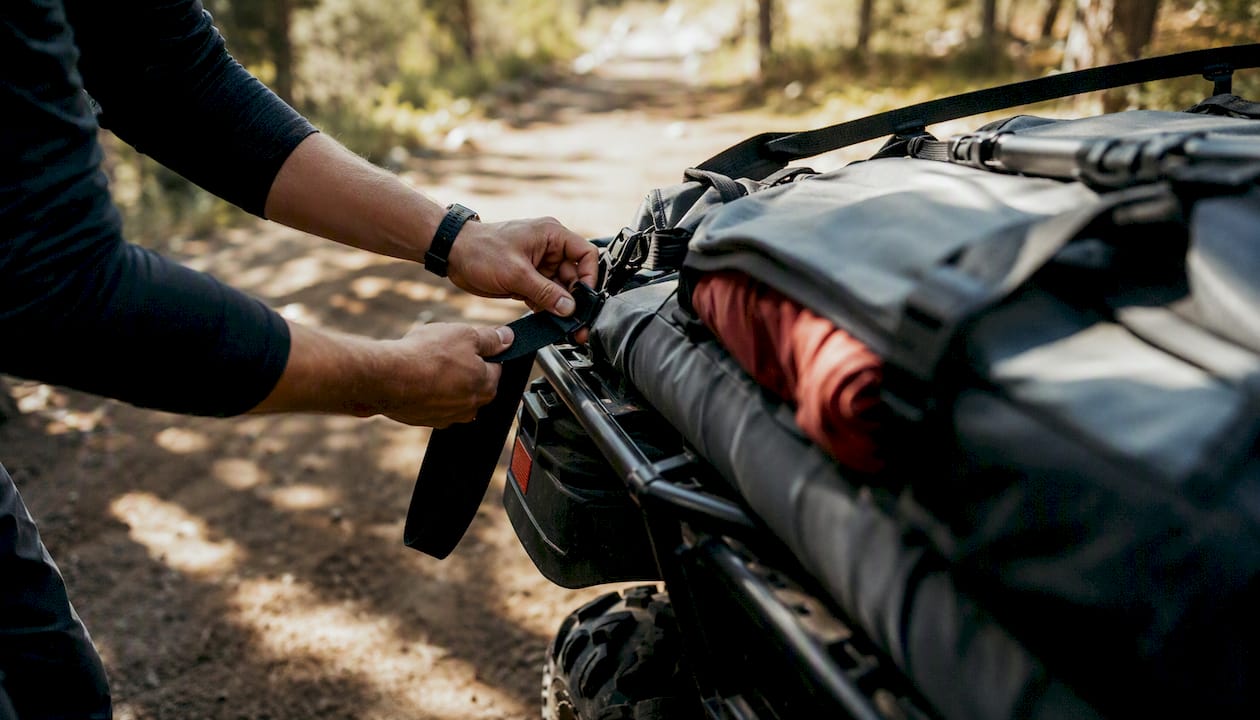
Pro Tip: When buying a powersports vehicle for a growing rider, check the weight rating with room to grow — not just the rider’s current weight. A model that fits today may be at its limit within a season.
The payload mistake most drivers make only once
Most overloading incidents don’t happen because drivers are reckless. They happen because drivers assume the truck bed is the only thing that counts, or because they load the vehicle the same way they always have without recalculating after adding a new accessory or a heavier seasonal kit.
The pattern looks like this: a driver adds a steel utility box to the bed, keeps hauling the same crew and gear as before, and notices nothing until the brakes feel soft on a downhill or a tire blows on the highway. By then, the vehicle has been running over its limit for months.
Two habits prevent this almost entirely. First, recalculate your payload every time you make a significant change to the vehicle — a new accessory, a different tire, a seasonal equipment swap. Second, record that math somewhere physical: a card in the glove box, a note in the owner’s manual sleeve. The calculation takes five minutes and it’s the kind of thing you’ll be glad you did when you’re standing at a trailhead trying to remember whether you’re within limits.
Gokartsusa has the specs you need before you buy
Every powersports vehicle on Gokartsusa’s site comes with detailed product specs — including weight limits and rider capacity guidelines — so you can do your payload math before the vehicle arrives at your door. Whether you’re looking at a Sport Kart for kids, a gas-powered mini bike, or a Mini Sport Kids ATV, each product page lists the manufacturer’s weight guidance so you can match the vehicle to the rider and the mission.

If you have a payload question about a specific model, Gokartsusa’s support team is ready to help you find the right fit. Check the product spec sheets, compare models side by side, and reach out before you order. Always follow the manufacturer’s placard limits once the vehicle is in your hands.
Sources
- Cars
- What Is Payload: A Complete Guide - Kelley Blue Book
- How To Determine Your Vehicle’s Payload | J.D. Power
- What is the payload capacity? | Ford Owner Support