




TL;DR:
- Off-road suspension travel is the vertical movement of a wheel from full droop to full bump, affecting terrain contact. Usable travel depends on system components and geometry, not shock length alone. Proper measurements and system upgrades are essential for optimal off-road traction and safety.
Off-road suspension travel is the vertical distance a wheel moves from full droop (maximum extension) to full bump (maximum compression), measured in inches or millimeters. That range determines how well your tires stay planted on broken terrain. Passenger cars typically manage moderate suspension travel suitable for everyday roads; dedicated off-road builds have significantly greater travel for rough terrain. Usable wheel travel, not shock stroke, is the number that actually matters on the trail.
- Daily driver / light use: Stock suspension handles paved roads and mild gravel without any modification.
- Adventure / overlanding: Target moderate usable travel for serious exploration without sacrificing on-road manners.
- Rock crawling / desert racing: Aim for extended suspension travel to keep all four tires working on extreme terrain.
Table of Contents
- What Is Off-Road Suspension Travel, and How Do the Three Main Setups Differ?
- What Actually Determines How Much Usable Travel You Get?
- How Do You Measure Suspension Travel at Home?
- How Does Suspension Travel Affect Traction, Handling, and Daily Drivability?
- What Do You Need to Change When Upgrading Suspension Travel?
- What Travel Range Is Right for Your Driving Style?
- Key Takeaways
- The Number That Actually Wins on the Trail
- Useful Sources and Further Reading
What Is Off-Road Suspension Travel, and How Do the Three Main Setups Differ?
The powersports world groups suspension setups into three broad categories. Understanding where each one lands numerically helps you self-classify your rig or evaluate a lift kit before you spend a dollar.
| Setup | Typical Usable Travel | Track Width Change | Common Use |
|---|---|---|---|
| Stock-width | Typical travel suitable for daily driving and mild trails | None | Daily driving, mild trails |
| Mid-travel | Moderate travel with a slight increase in track width | Slight (a small increase per side) | Overlanding, moderate trails |
| Long-travel | Long travel with a significant increase in track width | Significant (a notable increase per side) | Desert racing, serious rock crawling |
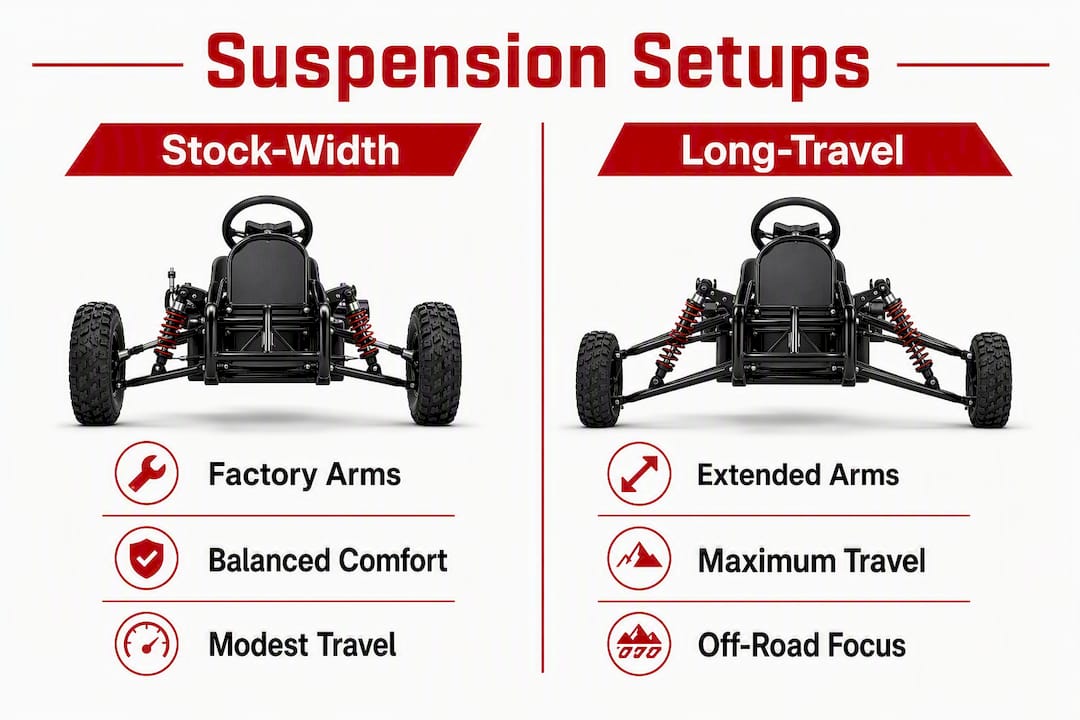
Stock-width setups use factory control arms and mounting points. They are tuned for a balance of on-road comfort and light off-road capability. Most factory SUVs and trucks fall here, and the geometry stays within OEM alignment specs.
Mid-travel kits swap in longer upper and lower control arms, add extended shocks, and sometimes relocate mounting brackets. The modest track-width increase rarely causes clearance headaches, and the ride quality improvement on rough roads is immediately noticeable. This is the sweet spot for most overlanders and weekend trail riders.
Long-travel setups are a different animal. Extended A-arms push the wheels outward by several inches, requiring longer axle shafts, rerouted brake lines, and often custom fabrication. SUVs and pickups built for extreme use regularly exceed 12–15 inches, and trophy trucks can push well past that. The freedom those numbers deliver on open desert is real, but the complexity and cost are equally real.
What Actually Determines How Much Usable Travel You Get?
Suspension travel is a system-level property. Every component in the chain sets a limit, and the most restrictive one wins.
The primary mechanical players are control arms (A-arms), coil or leaf springs, shock absorbers (stroke length), bump stops, limit straps, track width, axle shafts, and brake and steering line lengths. Change one without addressing the others and you will hit a hard limit before the wheel reaches its theoretical maximum. Solid axles generally deliver excellent articulation and durability; independent suspensions offer a smoother on-road ride but can restrict articulation in extreme terrain.
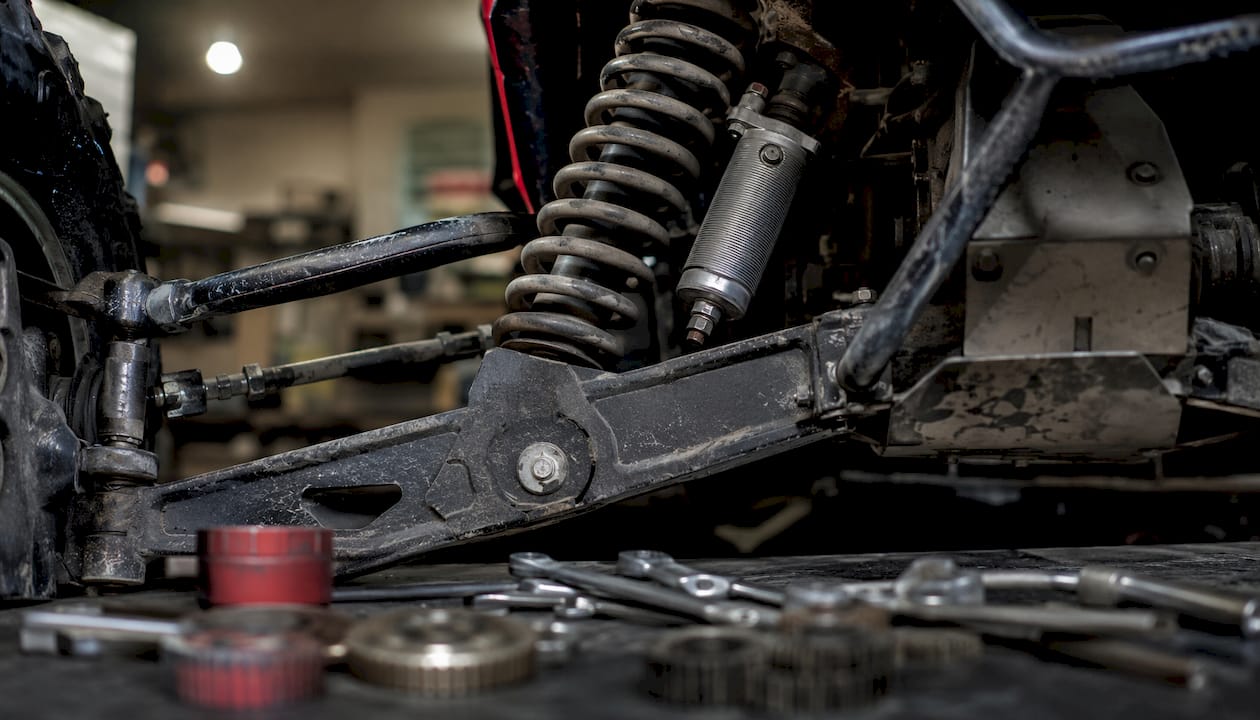
Suspension geometry adds another layer. Control arm length, pivot locations, and instant center position all shift as the wheel moves through its stroke. A longer arm increases travel potential but also changes camber gain, caster, and toe through the arc. If those alignment values swing too far, you get tire wear, handling instability, or binding before the suspension reaches full bump or droop.
Limit straps prevent over-extension at full droop; bump stops guard against violent bottoming at full compression. Both are safety elements, not afterthoughts. A build without properly sized limit straps risks torn bushings, damaged shock seals, and springs ejected from their seats.
Pro Tip: A longer shock does not automatically mean more usable wheel travel. If the control arm geometry or bump stops intervene before the shock reaches its stroke limit, that extra shaft length is wasted. Usable travel is set by the first physical limit the suspension hits, not by the shock’s advertised stroke.
How Do You Measure Suspension Travel at Home?
The method is straightforward: measure the wheel center’s position at full droop, then at full bump, and subtract. The practical workflow requires a floor jack, jack stands, a tape measure, and a fixed chassis reference point.
- Park on level ground and mark a fixed reference point on the chassis directly above the wheel center (a piece of tape works fine).
- Lift the vehicle and support the frame on jack stands so the suspension hangs freely at full droop. Never work under a vehicle supported only by a floor jack.
- Measure droop: Record the vertical distance from your chassis reference point down to the wheel center. This is your droop measurement.
- Compress to full bump: Use the floor jack under the lower control arm to push the suspension to full compression (until the bump stop contacts or the wheel stops moving).
- Measure bump: Record the vertical distance from the same chassis reference point to the wheel center again.
- Calculate usable travel: Subtract the bump measurement from the droop measurement. The result is your total usable wheel travel.
A few pitfalls trip up even experienced builders. Measuring shock shaft stroke instead of wheel center movement is the most common mistake; those two numbers are rarely equal because of motion ratios in the linkage. Limit straps and bump stops can also mask the suspension’s true geometric limits, so note whether either contacted before the wheel stopped moving. Finally, static measurements do not capture dynamic behavior under load and speed, so treat your result as a baseline, not an absolute ceiling.
How Does Suspension Travel Affect Traction, Handling, and Daily Drivability?
More usable travel generally improves articulation and traction off-road. It can reduce on-road stability and increase body motion. That trade-off is worth understanding before you commit to an upgrade.
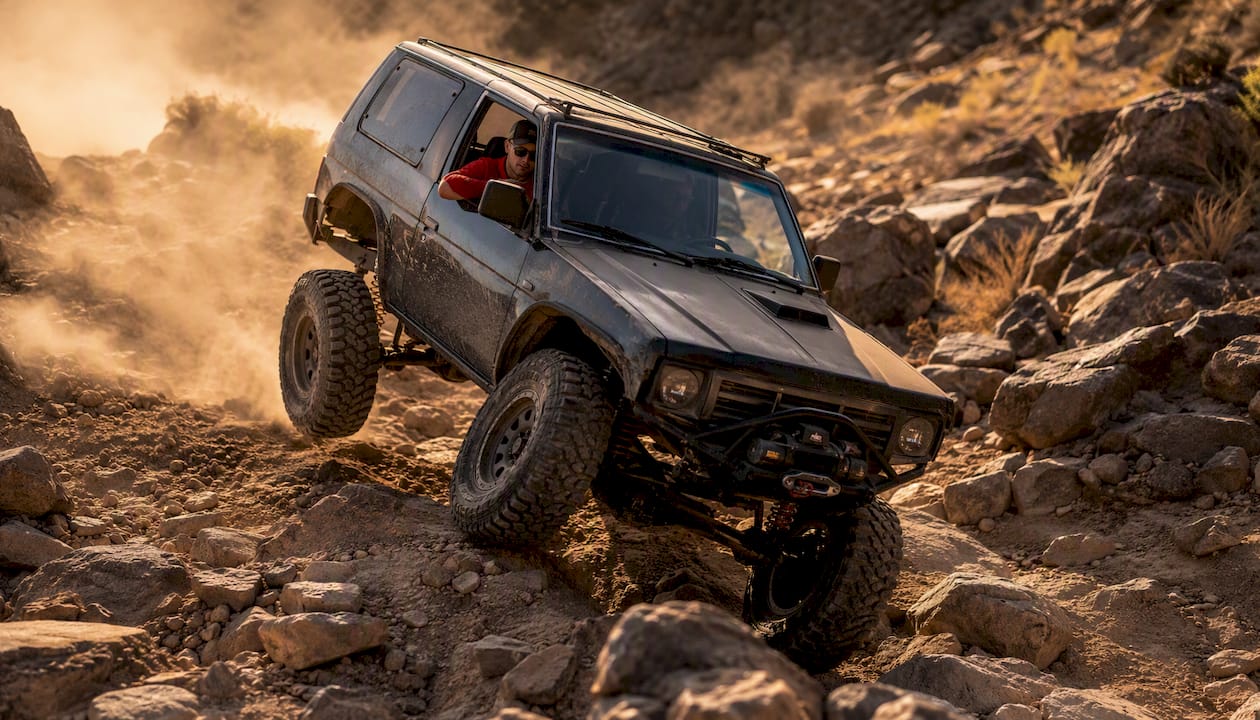
Off-road, droop is the hero. When one wheel drops into a rut or over a ledge, droop travel keeps the tire in contact with the ground instead of lifting it into the air. A tire in the air contributes zero traction. This is why articulation, the ability to flex one corner down while the opposite lifts, matters more than the raw travel number on a spec sheet. Bump travel typically accounts for a majority of total travel in passenger vehicles, with droop making up the remainder. Off-road builds often rebalance that split toward more droop to maximize tire contact.
On-road, the same extra travel introduces more body roll, altered steering geometry through the stroke, and sometimes a wider track that affects lane positioning. For a dedicated trail rig that rarely sees the highway, those penalties are acceptable. For a daily driver that hits the trail on weekends, they deserve serious thought.
Cost and complexity scale with travel ambitions. A quality mid-travel kit for a popular truck platform typically runs several hundred to a few thousand dollars in parts alone, plus alignment and labor. A full long-travel conversion with custom fabrication, extended axles, and rerouted lines can run well into five figures. Understanding how suspension systems affect performance helps you budget realistically before the build begins.
What Do You Need to Change When Upgrading Suspension Travel?
A shock swap alone is not a travel upgrade. Treating it as one is the most expensive mistake in off-road building.
Here is the full checklist for a safe travel increase:
- Control arms: Longer arms are required to achieve additional travel without binding or extreme camber change.
- Axle shafts: Long-travel setups push the wheels outward; stock-length axles will bind or snap.
- Brake and steering lines: Extended travel requires longer, rerouted lines to prevent stretching or tearing at full droop.
- Limit straps: Sized to stop droop before the shock over-extends or the axle shaft reaches its angle limit.
- Bump stops: Repositioned or upgraded to match the new bump travel limit and protect the chassis.
- Wheel and tire fitment: Wider track and more travel change clearance requirements; verify fender and frame clearance through the full stroke.
- Shock valving: A shock valved for stock travel will not perform correctly with significantly more wheel movement; revalving or replacement is usually necessary.
Partial upgrades cause specific failure modes. Longer shocks without longer control arms create binding that tears bushings and bends arms. Unaddressed axle angles at full droop snap CV joints. Brake lines that are too short pull loose at full extension. These are not hypothetical risks; they are common outcomes of rushed builds.
When the upgrade involves geometry changes, custom fabrication, or driveline modifications, hire a professional. Welding new control arm mounts to a frame requires precision that a floor jack and a drill cannot provide. For readers exploring ATV suspension geometry at a smaller scale, the same principles apply: every component in the system must be matched to the new travel target. Wider SXS builds also affect accessory routing; rock light placement in SXS builds is one practical example of how a track-width change ripples through the whole vehicle.
What Travel Range Is Right for Your Driving Style?
Match your usable wheel travel target to how you actually drive, not to the biggest number you can fit under the fenders.
| Driving Style | Recommended Usable Travel | Notes |
|---|---|---|
| Daily driver | Moderate travel setups | Stock or mild lift; preserves on-road manners |
| Light trail / overlanding | Moderate travel setups | Mid-travel sweet spot for most enthusiasts |
| Technical trail | Extended travel setups | Requires geometry upgrades; significant articulation gain |
| Rock crawling | Long travel setups | Full geometry overhaul; droop bias preferred |
| Desert racing | The longest travel setups | Long-travel with high-speed shock valving; professional build |
The 8–10 inch range suits most adventure and light-to-moderate off-road use without meaningfully degrading on-road driving. Rock crawlers targeting 10–12+ inches gain the articulation needed to keep tires planted on ledges and loose rock. Desert racers need the upper end of the range to absorb high-speed hits that would bottom a trail rig instantly.
Two factors shift these recommendations. Vehicle weight matters: a heavier platform needs stiffer springs to use its travel effectively, or the suspension will sag into bump travel under load and leave little droop available. Solid-axle rigs articulate differently than independent-front-suspension trucks, so the same numeric travel produces different real-world traction depending on the platform. Know your axle configuration before you set a travel target.
Key Takeaways
Suspension travel is the total vertical wheel movement from full droop to full bump, measured in inches or millimeters, and usable travel, not shock stroke, is what determines real off-road traction.
| Point | Details |
|---|---|
| Measure wheel movement, not shock stroke | Use the jack-stand method to record actual wheel center movement from full droop to full bump. |
| Match travel to your use case | Target moderate travel for overlanding, more extended travel for rock crawling, and the longest travel setups for desert racing. |
| Budget for the full system | Longer shocks alone are not a travel upgrade; control arms, axles, lines, and bump stops must all be addressed. |
| Droop matters more than raw numbers | Articulation and droop distribution predict off-road traction better than headline travel figures. |
| Passenger cars vs. off-road builds | Passenger cars average 3–5 in of travel; dedicated off-road vehicles can exceed 12–15 in. |
The Number That Actually Wins on the Trail
There is a pattern worth calling out directly: enthusiasts obsess over headline travel numbers while the suspension that actually performs on the trail is the one with the most usable droop, properly sized limit straps, and geometry that stays in check through the full stroke.
The builds that disappoint are almost always the ones where someone bolted on longer shocks, called it done, and then hit the bump stops six inches before the shock reached its limit. The extra stroke was never usable. The money was spent, the geometry was compromised, and the traction did not improve.
Measure your vehicle’s current usable travel before you shop for anything. That single step changes the conversation from “how much travel can I get?” to “how much usable travel do I need for where I actually ride?” Those are very different questions, and the second one has a much cheaper, more satisfying answer. When you are ready to explore the right powersports platform for your adventure, Gokartsusa is here as your trail guide and pit crew, with vehicles and resources built for riders who take their freedom seriously.
Useful Sources and Further Reading
The following sources informed this article and are worth bookmarking for deeper research:
- What Is Suspension Travel? (MaxTrac Suspension) — detailed breakdown of bump vs. droop, measurement methods, and travel ranges.
- What Is Suspension Travel? (Off-Road Engineering) — concise technical definition of how travel is measured at the axle center.
- Off-Road Suspension 101 (Red Dot Engineering) — system-level explainer covering springs, dampers, and speed-dependent suspension demands.
- Suspension Travel on Wikipedia — reference entry covering limit straps, bump stops, and standard terminology.
- Vehicle Suspension Explained — Gokartsusa — the brand’s own primer for enthusiasts who want a broader foundation before planning upgrades.
- Off-Road Terms Every Enthusiast Should Know — Gokartsusa — quick-reference glossary for terminology used throughout this article.
- Go-Kart Suspension: Performance and Safety Guide — Gokartsusa — applies suspension principles to smaller powersports vehicles available on the site.
For major travel upgrades involving fabrication, driveline changes, or geometry rework, consult a qualified off-road suspension shop before purchasing parts. Safe builds start with accurate measurements and honest conversations about use-case requirements.

Ready to put these principles into motion? Gokartsusa carries gas off-road go-karts and kids ATVs with parental controls built for riders who want real off-road capability from day one. Free shipping nationwide, and our team is ready to help you find the right ride for your terrain.