




TL;DR:
- A suspension system connects a vehicle’s wheels to its frame and ensures passenger comfort, tire contact, and stability. Regular inspection and maintenance of shocks, bushings, and springs are essential for safety and handling, especially on recreational vehicles like go-karts and ATVs. Proper suspension health improves control, safety, and riding experience more than performance upgrades on worn components.
A suspension system is defined as the network of springs, shock absorbers, and linkages that connects a vehicle’s wheels to its frame. The role of suspension systems covers three non-negotiable functions: passenger comfort, tire-road contact, and vehicle stability during acceleration, braking, and cornering. Every handling improvement, every safe stop, and every smooth ride traces back to how well that system performs. Whether you’re tuning a sport kart or maintaining a family ATV, understanding what your suspension does is the foundation of every smart decision you make on the machine.
What are the critical components of a suspension system?
A suspension system works because each component handles a specific job, and they all depend on each other. Fail one part, and the whole system suffers.
The six core components are:
- Springs: Store kinetic energy from road impacts and absorb the initial shock of bumps, potholes, and uneven terrain.
- Shock absorbers: Convert that stored energy into heat, dissipating it so the wheel returns to the road smoothly instead of bouncing.
- Struts: Combine a spring and shock absorber into one structural unit, common in front-wheel-drive and lightweight vehicles.
- Control arms: Connect the wheel hub to the vehicle frame and guide wheel movement through its range of motion.
- Bushings: Rubber or polyurethane cushions at pivot points that absorb vibration and reduce metal-on-metal wear.
- Linkages and sway bars: Transfer load between left and right wheels to limit body roll during cornering.
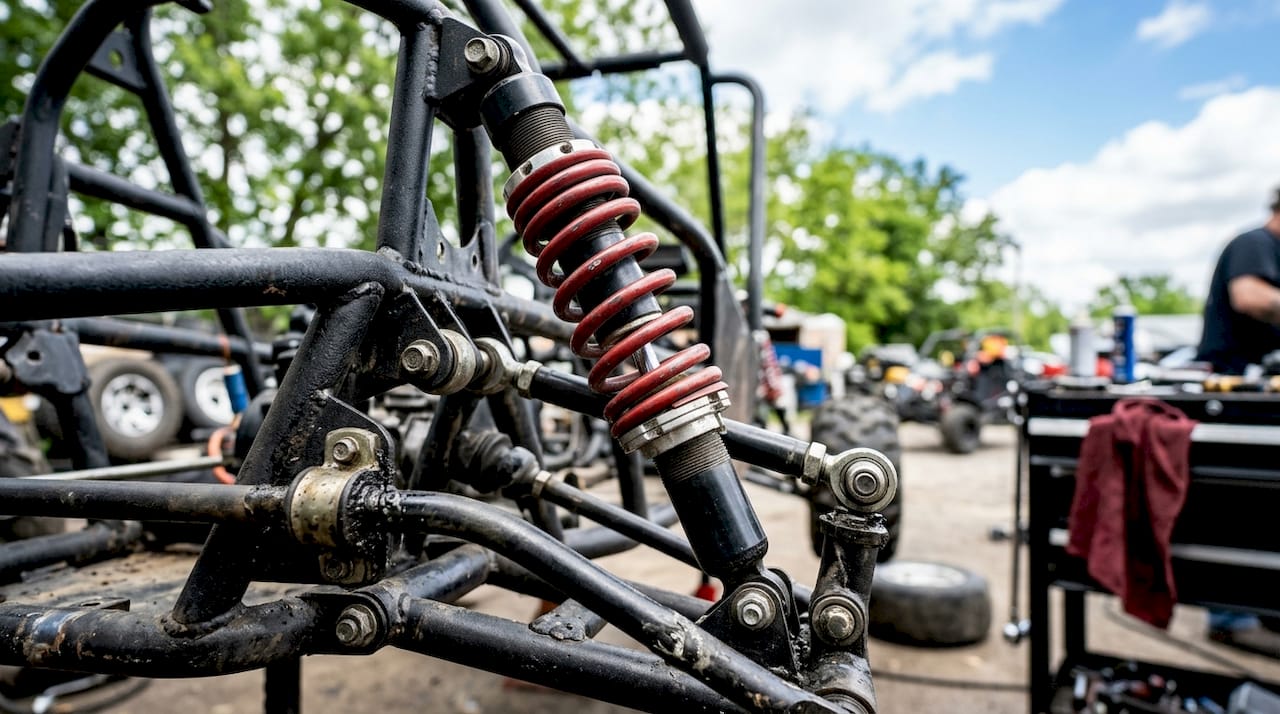
Springs and shock absorbers are a team, not interchangeable parts. Springs absorb the hit; shock absorbers control the rebound. Without the shock absorber, a spring would keep bouncing the wheel long after the impact, breaking tire contact with the road.
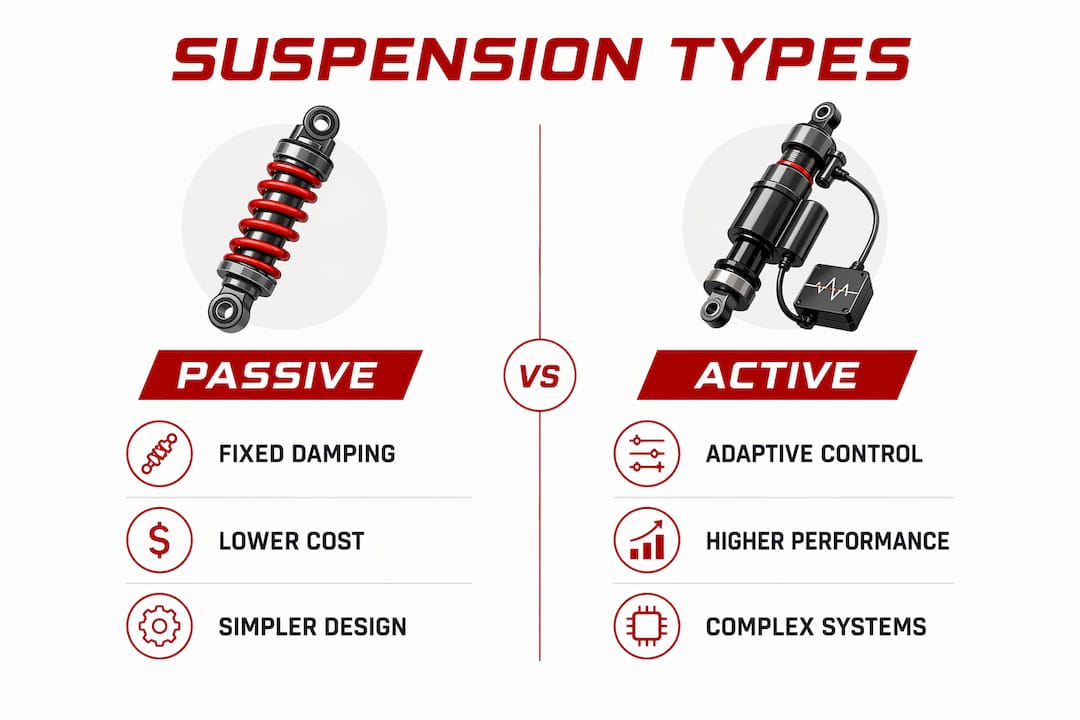
Semi-active and active suspension systems add electronic control to this equation. Semi-active and active systems improve comfort and dynamic performance, but they introduce higher cost, greater complexity, and more potential failure points. Most recreational and performance vehicles favor passive or semi-independent setups for their reliability and simpler maintenance.
Pro Tip: When replacing a shock absorber, always replace both units on the same axle. Mismatched shocks create uneven damping, which pulls the vehicle to one side under braking.
Why is suspension essential for handling, safety, and comfort?
Suspension is not a comfort feature. It is a primary safety system.
“The suspension system acts as the anchor for all safety systems: brakes, steering, and tires depend on effective suspension function.” — Interstate Auto Care
Here is what that means in practice. When you brake hard, weight shifts forward. When you corner, it shifts sideways. The suspension controls weight transfer, preventing excessive roll, dive, and squat that would otherwise reduce tire contact and compromise steering response. A vehicle with worn suspension does not just ride rough. It brakes longer, steers less accurately, and handles emergencies poorly.
The three ways suspension directly affects safety:
- Traction: Tires only grip the road when they stay in contact with it. Suspension keeps that contact consistent across bumps, dips, and surface changes.
- Steering accuracy: Control arms and linkages translate steering input into wheel movement. Worn bushings introduce play, making steering feel vague and slow to respond.
- Braking distance: Anti-lock braking systems and electronic stability control both depend on consistent tire contact. A degraded suspension undermines both systems before any dashboard light appears.
Passenger comfort is the visible benefit of good suspension. Safety is the invisible one. Most drivers notice the rough ride long before they realize their braking distance has increased or their emergency handling has degraded.
How do suspension system types compare in performance and design?
Suspension tuning balances ride quality and road holding, and optimizing one almost always compromises the other. That engineering reality shapes every suspension design decision.
| Suspension type | Ride comfort | Handling performance | Cost | Complexity |
|---|---|---|---|---|
| Passive (fixed damping) | Moderate | Moderate | Low | Low |
| Semi-independent | Good | Good | Moderate | Moderate |
| Semi-active (adjustable damping) | High | High | High | High |
| Active (fully controlled) | Very high | Very high | Very high | Very high |
Passive suspensions use fixed spring rates and damping values. They are tuned at the factory for a specific balance and stay there. This makes them predictable, affordable, and easy to service. The trade-off is that the same setup that feels comfortable on a smooth road may feel harsh on a rutted trail.
Semi-independent suspensions, like the torsion beam rear axle common in lightweight vehicles, offer a middle ground. They allow some independent wheel movement without the full cost and complexity of a double-wishbone or multi-link setup. Most recreational vehicles and entry-level sport karts use this approach.
Semi-active and active systems use sensors and actuators to adjust damping in real time. The performance gains are real, but so are the repair bills. For most enthusiasts and DIYers, the reliability and simplicity of a well-maintained passive system outperforms a neglected active one every time.
Pro Tip: Before spending money on suspension upgrades, check how wheels affect suspension performance. Wheel weight and offset directly influence how your suspension responds. A lighter wheel reduces unsprung mass and improves suspension reaction speed without touching a single suspension component.
What are the signs of suspension wear and how do you maintain it?
Worn shocks cause tire bounce, uneven tire wear, and cascading failures in alignment and steering components. The problem is that these failures develop slowly and quietly.
Common warning signs
- Uneven tire wear: Cupping or scalloping on the tire tread means the wheel is bouncing instead of rolling smoothly.
- Excessive bouncing: If the vehicle continues to bounce after hitting a bump, the shock absorbers are no longer controlling rebound.
- Drifting or pulling: The vehicle pulls to one side during straight-line driving or braking, often caused by worn control arm bushings or uneven spring rates.
- Nose diving under braking: The front end dips sharply when you brake, indicating front shock absorbers have lost damping capacity.
- Clunking or knocking sounds: Metal-on-metal noise over bumps points to worn bushings, loose control arm bolts, or a failed strut mount.
- Visible sagging: One corner of the vehicle sits lower than the others, usually caused by a broken or fatigued spring.
Recommended maintenance intervals
Shocks and struts last between 50,000 and 100,000 miles, with inspections advised every 12,000 to 15,000 miles. That service life assumes normal use. Off-road riding, heavy loads, and aggressive driving shorten it significantly.
| Component | Typical service life | Inspection interval |
|---|---|---|
| Shock absorbers | 50,000–100,000 miles | Every 12,000–15,000 miles |
| Bushings | 60,000–100,000 miles | Every 15,000 miles |
| Springs | 100,000+ miles | Annually or after hard impacts |
| Strut mounts | 60,000–80,000 miles | Every 15,000 miles |
No dashboard light alerts you to suspension degradation. Manual inspection is the only reliable early warning system. A quick visual check every 12,000 to 15,000 miles catches worn bushings, leaking shocks, and cracked springs before they cascade into bigger failures.
Restoring factory suspension health delivers more real-world handling improvement than most aftermarket upgrades. A fresh set of shocks and new bushings on a worn vehicle transforms handling more than a performance spring kit installed on degraded components.
Pro Tip: For a quick DIY check, push down hard on each corner of the vehicle and release. The vehicle should rebound once and settle. If it bounces two or more times, the shock absorbers need replacement.
How do suspension systems affect go-karts and ATVs?
In recreational vehicles like go-karts and ATVs, suspension is vital for rider comfort and vehicle control, adapting to off-road and lightweight dynamics that street vehicle suspensions are never designed for. The physics are the same, but the priorities shift.
Lightweight vehicles have less mass to dampen impacts naturally. That means the suspension does proportionally more work on every bump, root, and rut. A go-kart or ATV with worn suspension transmits far more shock to the rider than a heavier vehicle would under the same conditions.
Key suspension considerations for recreational vehicles:
- Go-karts often use independent front suspension with a solid rear axle. The front handles steering precision; the rear manages power transfer and stability. Understanding both is critical for go-kart suspension performance.
- ATVs typically use independent double-wishbone front suspension and either independent or solid-axle rear setups. Off-road use demands higher suspension travel and more durable bushings than street applications.
- Spring rate selection matters more on lightweight vehicles because small changes in spring stiffness produce large changes in ride behavior.
- Maintenance frequency should increase with off-road use. Dirt, mud, and impacts accelerate bushing wear and shock absorber fatigue faster than paved surfaces.
The go-kart parts guide from Gokartsusa covers suspension components in detail for riders who want to maintain or customize their setup with confidence.
Key Takeaways
A suspension system’s primary job is to keep tires in contact with the road, and every safety and handling benefit flows directly from how well it achieves that.
| Point | Details |
|---|---|
| Three core functions | Suspension delivers passenger comfort, tire-road contact, and vehicle stability simultaneously. |
| Springs and shocks work together | Springs absorb impacts; shock absorbers control rebound. Both must be healthy to maintain tire contact. |
| Inspection interval | Inspect shocks and struts every 12,000–15,000 miles. No dashboard light warns you of wear. |
| Restore before upgrading | Replacing worn factory components improves handling more than adding performance parts to a degraded system. |
| Recreational vehicles need more attention | Go-karts and ATVs face harder suspension demands per pound of vehicle weight than street vehicles. |
Why I think most enthusiasts underestimate their suspension
Most riders I talk to focus on power. They want more horsepower, a better exhaust, a faster throttle response. Suspension is the last thing on the list until something goes wrong. That is exactly backwards.
I have seen go-karts with fresh engines and worn-out shocks that handled worse than a stock machine with healthy suspension. The engine gets the vehicle moving. The suspension decides whether you stay in control when it matters. Braking, cornering, emergency avoidance — all of it runs through the suspension before it reaches the tires.
The other mistake I see constantly is treating suspension as a one-time replacement job. You swap the shocks at 80,000 miles and consider it done. But bushings wear faster than shocks on rough terrain. Control arm bolts loosen over time. Spring rates change as metal fatigues. Suspension health is a continuous process, not a single service event.
My honest advice: inspect your suspension every season if you ride off-road. Do the bounce test at every oil change. And before you spend a dollar on performance parts, make sure your factory suspension is in the condition it was designed to be in. The adventure is a lot more fun when the machine underneath you is working the way it should.
— Mario
Gokartsusa has the right machines for riders who care about the ride
If suspension performance matters to you, the vehicle you choose has to back it up. Gokartsusa carries a lineup of sport karts, mini bikes, and ATVs built with quality suspension components that hold up to real riding conditions.

The Sport Kart Kids Gas Go Kart is a strong starting point for families who want a machine that handles confidently on varied terrain. For riders who want two-wheel freedom, the Gas Powered Mini Bike delivers a smooth, controlled ride with suspension tuned for younger riders. And for off-road adventure, the Mini Sport Kids ATV brings independent suspension and parental safety controls together in one capable package. Every machine at Gokartsusa is chosen with the rider’s comfort and safety in mind, because that is what the adventure deserves.
FAQ
What is a suspension system on a vehicle?
A suspension system is the set of springs, shock absorbers, control arms, and linkages that connects a vehicle’s wheels to its frame. Its three core functions are passenger comfort, maintaining tire-road contact, and vehicle stability.
How does a suspension system work?
Springs absorb the energy from road impacts, and shock absorbers convert that energy into heat to control wheel rebound. Together, they keep the tire pressed against the road surface through bumps and uneven terrain.
What are the main suspension system types?
The four main types are passive, semi-independent, semi-active, and active. Passive systems use fixed damping and are the most common in recreational vehicles due to their reliability and low maintenance cost.
How often should suspension components be inspected?
Shocks and struts should be inspected every 12,000 to 15,000 miles, with a typical service life of 50,000 to 100,000 miles. Off-road use shortens that interval significantly.
Why does suspension matter for go-karts and ATVs?
Lightweight recreational vehicles like go-karts and ATVs rely on suspension to absorb impacts that their low mass cannot naturally dampen. Worn suspension on these vehicles transfers shock directly to the rider and reduces steering and braking control.