




TL;DR:
- Most kids’ go-karts are designed for specific weight ranges based on their category and construction. Checking the manufacturer’s label and track rules before riding prevents fit and safety issues. Parents should verify weight capacities, fit, and safety certifications to ensure a safe and comfortable ride for their children.
Most kids’ go-karts are built for riders within weight ranges that vary by kart type. Toddler and pedal models typically have lower weight capacities. Smaller battery-powered electric karts for young children have moderate weight limits, while youth and junior models accommodate heavier weights. Commercial rental and adult karts at tracks support the highest weights in their categories. Before your child ever sits in a seat, check the manufacturer’s label and the track’s posted rules. That single step prevents most go-kart fit problems.
Two safety standards you’ll see on certified children’s ride-on products are ASTM F963 and CPSIA, both enforced by the U.S. Consumer Product Safety Commission (CPSC). Products carrying those certifications have been tested against declared weight capacities. Gokartsusa lists weight capacity, age range, and motor specs directly on every product page, so you always have the numbers before you buy.
Quick reference for the ranges parents encounter most often:
- Toddler/pedal models: ~50–55 lbs
- Child electric/ride-on karts: 90–120 lbs
- Youth/junior karts: 120–160 lbs
- Adult/rental karts (commercial tracks): up to ~300 lbs
Table of Contents
- What are the typical kids go-kart weight limits by kart type?
- Why do manufacturers and tracks set weight limits?
- How do manufacturers and commercial tracks enforce weight and height rules?
- How can you confirm a kart actually fits your child?
- What should you do if your child is over or under the stated limit?
- What should parents prioritize when buying a kids go-kart?
- Key Takeaways
- Weight limits matter more than most parents realize
- Ready to find the right kart for your child?
- Useful sources for parents
What are the typical kids go-kart weight limits by kart type?
The weight a go-kart can safely carry is set by its frame, motor, battery, and braking system. Those components scale up as the kart category grows, which is why the ranges differ so sharply from one type to the next. Understanding go-kart size and age helps you match your child to the right category from the start.
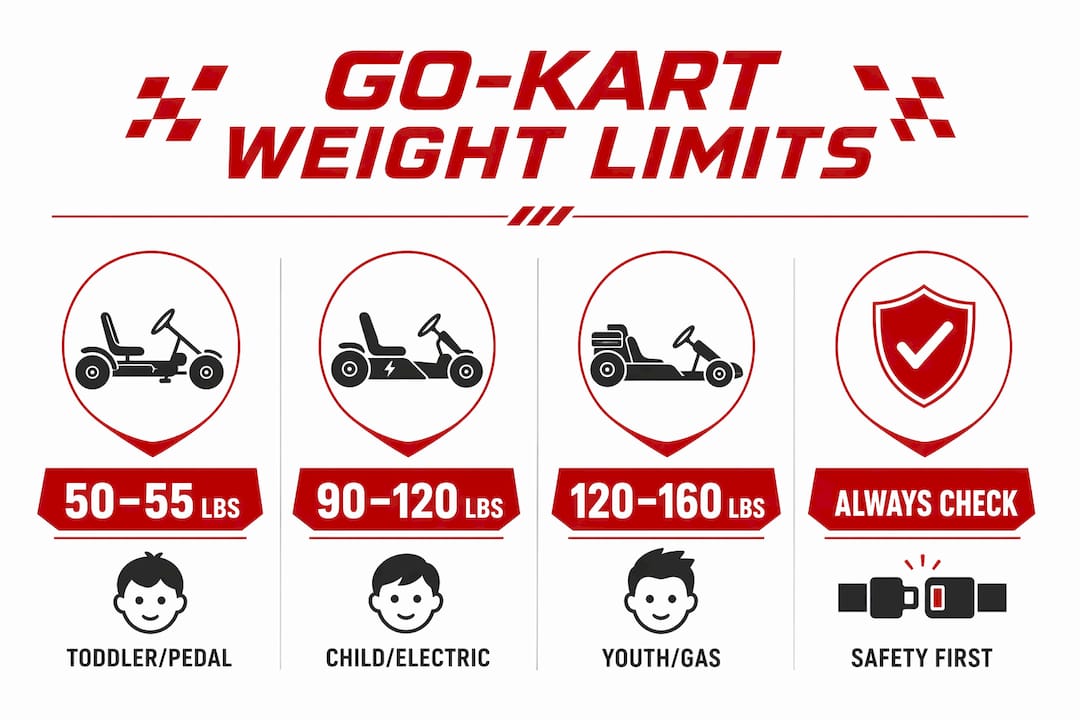
| Kart Category | Typical Weight Range | Common Power Source | Who It Fits |
|---|---|---|---|
| Toddler/pedal | 50–55 lbs | Pedal or small 6V battery | Ages 2–5 |
| Child electric/ride-on | 90–120 lbs | 12V battery | Ages 4–8 |
| Youth/junior | 120–160 lbs | Electric or small gas | Ages 6–12 |
| Adult/rental (commercial) | up to ~300 lbs | Gas engine | Teens and adults |
Child go-karts typically handle 90–120 lbs, and youth models stretch to 120–160 lbs, with motor power and frame construction driving those upper limits. At the lower end, toddler electric models can be as light as 50 lbs capacity, while larger kids’ electrics approach 130 lbs. Retail listings confirm that maximum loads for children’s ride-ons commonly fall in the 50–135 lb range, so there is no single universal standard. Always verify the spec sheet for the exact model you are considering.
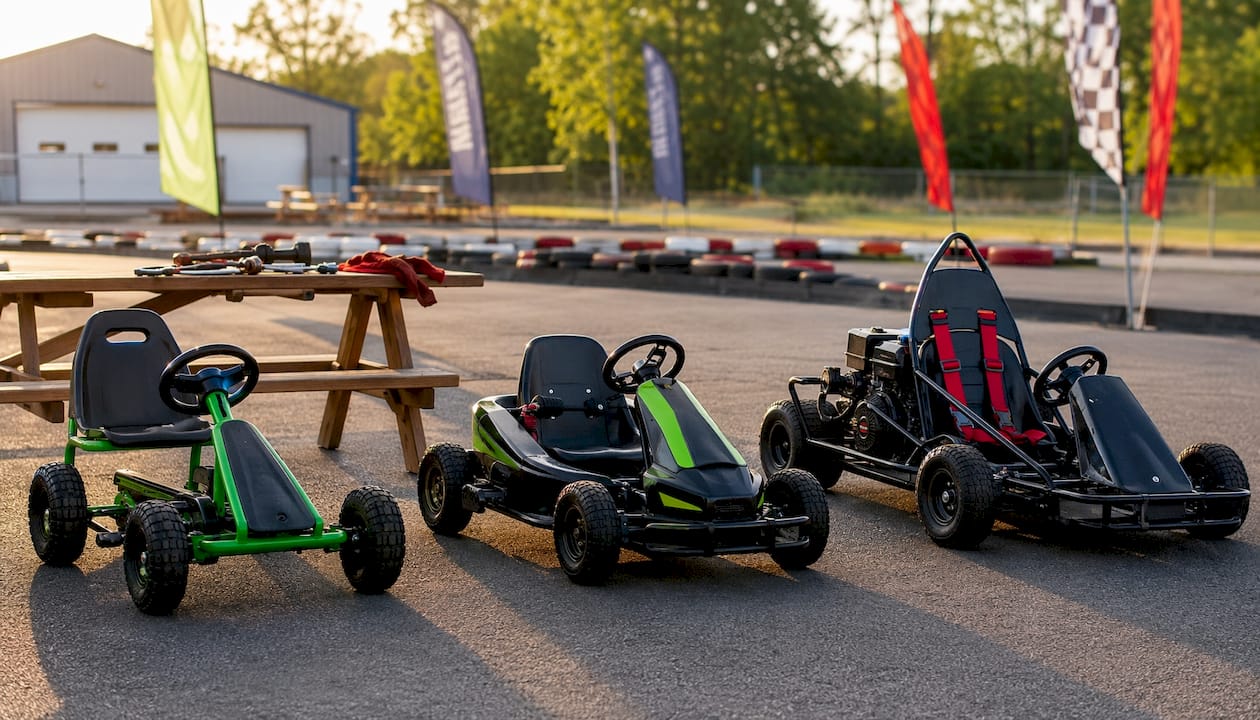
One practical tip: if your child is near the top of an age band, buy the next capacity up. A kart rated to 160 lbs gives a 90-lb child room to grow without forcing an early upgrade.
Pro Tip: When comparing two models in the same age range, choose the one with the higher declared weight capacity. It usually signals a heavier-duty frame and motor, both of which contribute to longer product life and safer riding as your child grows.
Why do manufacturers and tracks set weight limits?
Weight limits are not arbitrary. They exist because every mechanical component on a go-kart, from the motor to the brake pads to the chassis welds, is engineered to a specific load. Push past that load and the physics change fast.
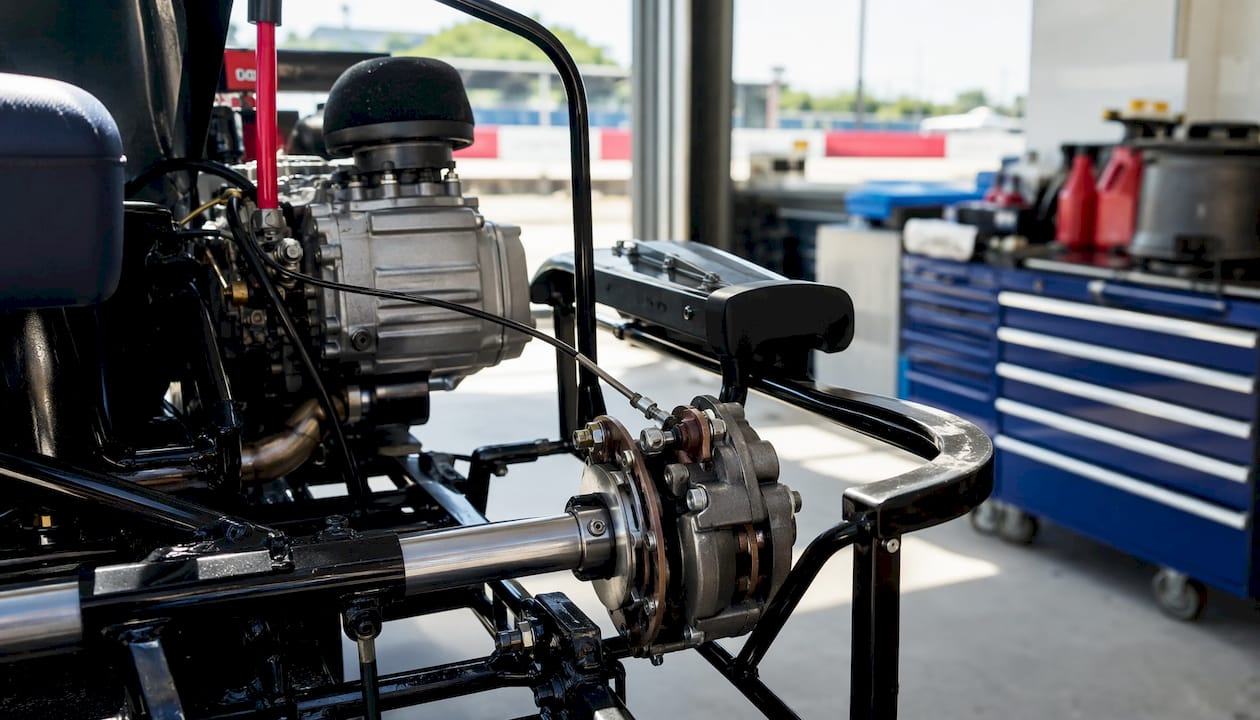
Excess weight slows acceleration, extends stopping distances, and puts extra stress on the motor. A child who is 20 lbs over the rated limit will notice sluggish throttle response and a kart that feels heavy in corners. More critically, the brakes may not stop the kart in the distance the manufacturer designed for. That gap between expected and actual stopping distance is where accidents happen.
Structural integrity is the other concern. Go-kart frames are sized to the declared capacity. Overloading can stress welds and mounting points over time, creating failure risks that are invisible until something breaks. Harness and seatbelt systems are also calibrated to a weight range. A child who is too heavy for the harness geometry may not be held securely in a sudden stop or tip.
Observable warning signs that a kart is carrying too much weight:
- Sluggish or delayed acceleration from a standing start
- Longer-than-normal stopping distances or spongy brake feel
- Chassis bottoming out on bumps or uneven ground
- Motor running hotter than usual or cutting out under load
- Steering that feels heavy or unresponsive
Any of these signs during a ride means the child should stop immediately and the weight spec should be rechecked. For a deeper look at how these factors connect, Gokartsusa’s go-kart safety guide for parents covers the mechanical reasoning in plain language.
How do manufacturers and commercial tracks enforce weight and height rules?
There are two distinct sources of limits parents need to track: the product manufacturer’s spec and the track or venue’s own operating rules. They are not always the same number, and both apply.
Manufacturers publish declared weight capacity, recommended age, and sometimes a minimum height on the product label and in the owner’s manual. Those numbers are engineering limits. Tracks add a second layer of rules based on their specific kart fleet, insurance requirements, and staff training. A commercial venue’s rules may include a minimum height (many require at least 48 inches for junior karts), a maximum weight for each kart class, and a competency check before a child is cleared to ride alone.
Track operators commonly use height sticks at the entrance, harness fit checks at the kart, and manager discretion when a case is borderline. Adult rental karts at many venues carry a maximum weight around 300 lbs and a height ceiling near 6’7". Junior kart cutoffs are lower on both ends. Staff can and do refuse seating when a child does not meet fit standards, even if weight alone looks acceptable. That is not a policy failure; it is the system working correctly.
For parents planning a track visit, Gokartsusa’s guide on go-karting safety for families explains what to expect from venue check-in procedures and how to prepare your child.
Pro Tip: Before heading to a commercial track, call ahead or check the venue’s website for its specific height and weight requirements. Bring your child’s current measurements. A five-minute phone call prevents a disappointing trip if your child is borderline on height or weight for the kart class you planned to use.
How can you confirm a kart actually fits your child?
A weight spec is a ceiling, not a guarantee of fit. A child can be within the weight limit and still be too small to reach the pedals or too large for the harness to close properly. Run through these checks before any ride, whether at home or at a track.
- Pedal reach: Your child should be able to press the pedal fully with a slight bend in the knee. Fully extended legs mean the seat needs to move forward; if the knee is deeply bent, move it back.
- Seat clearance: There should be a few inches of clearance between the top of the helmet and any overhead bar or canopy. No contact at all is the goal.
- Harness engagement: Every buckle clicks securely. Pull each strap after buckling. There should be no slack you can gather in a fist.
- Helmet fit: The helmet sits level, does not rock forward or backward, and the chin strap is snug with no more than two fingers of space under it.
- Line of sight: Your child can see clearly over the steering wheel without craning their neck. If they are peering through the wheel rather than over it, the kart is too large.
- Chassis clearance: With your child seated, the underside of the frame should clear the ground by a visible margin. If the chassis is nearly touching, the combined weight of child plus kart is at or past the design limit.
For helmet selection alongside kart safety, kids’ helmet fit guidance is a useful reference when you are choosing protective gear.
Pro Tip: Measure your child’s weight and seated height (floor to top of head while sitting) and write both numbers down. Keep them in your phone. You will need them when comparing kart specs online and when checking in at a commercial track.
What should you do if your child is over or under the stated limit?
Never exceed the manufacturer’s stated weight limit. That is the short answer, and there is no safe workaround.
If your child is over the limit for a particular model, the right move is to step up to a higher-capacity kart. A youth go-kart rated to 160 lbs handles a heavier child far more safely than a child model pushed past its 120-lb ceiling. For older or larger kids who have outgrown junior karts entirely, a gas-powered option like Gokartsusa’s Sport Kart Kids Gas Go Kart (ages 8 and up, 2.5hp 4-stroke) offers the frame and power to match their size. Alternatively, a gas-powered mini bike for ages 12 and up gives growing riders a different kind of thrill with appropriate capacity built in.
If your child is under the minimum weight or too small for the kart’s harness and pedal geometry, the answer is equally clear: choose a smaller model. Pedal go-karts and age-appropriate ride-on toys are the right starting point. Supervised practice in a flat, controlled area on a properly sized kart builds the skills and confidence that make the step up to a powered model safer when the time comes.
A note on improvised fixes: adding padding to a seat or using ballast to meet a minimum weight is not recommended unless the manufacturer explicitly approves it in the owner’s manual. These modifications change the weight distribution and handling in ways the kart was not designed for, and they can void the warranty.
What should parents prioritize when buying a kids go-kart?
The right kart starts with the right spec. Weight capacity, adjustability, and safety features are the three things that matter most, and they should be confirmed before price enters the conversation.
Here is the checklist Gokartsusa recommends parents work through when comparing models:
- Declared weight capacity: Confirm it matches your child’s current weight with room to grow.
- Adjustable seat and steering column: A kart your child can grow into saves money and keeps the fit correct over time.
- Harness type and quality: A five-point harness is the gold standard for younger riders. Check that it adjusts to your child’s torso size.
- Brake system: Disc brakes stop more reliably than drum brakes, especially at higher speeds. Confirm the brake type in the spec sheet.
- Motor or engine specs: Battery voltage (for electric) or engine displacement (for gas) should match the child’s weight and the terrain you plan to use.
- Frame construction: Steel frames handle rough terrain better than plastic chassis. Check the material and weld quality in product photos.
- Replacement parts availability: A kart you cannot get parts for becomes a safety risk the moment something wears out.
- Warranty length and support: A manufacturer that backs its product with a real warranty is signaling confidence in the build quality.
Safety certifications matter too. Products carrying ASTM F963 and CPSIA certifications have been independently tested against their declared weight and age specifications. Look for those marks on the product label or spec sheet.
Gokartsusa’s safe buying guide for kids’ go-karts walks through each of these criteria in detail, and the safe go-kart features checklist covers the seven must-have safety features to look for in 2026. Keep your proof of purchase and the owner’s manual together in a safe place. Both are required for warranty claims, and the manual is your first reference when something feels off during a ride.
Pro Tip: If you are buying a gas-powered kart for a child who is 8 or older, ask the seller for the engine’s recommended rider weight range, not just the maximum. Some engines are tuned for lighter riders and will underperform or wear faster with a heavier child, even within the stated limit.
Key Takeaways
Kids’ go-kart weight limits range from about 50 lbs for toddler models to 160 lbs for youth karts, and checking the manufacturer’s spec before every ride is the single most important safety step a parent can take.
| Point | Details |
|---|---|
| Weight ranges by category | Toddler/pedal: 50–55 lbs; child electric: 90–120 lbs; youth/junior: 120–160 lbs; adult/rental: up to ~300 lbs. |
| Always check the manual | The owner’s manual and product label carry the declared weight capacity, age range, and seat adjustment guidance. |
| Fit means more than weight | Pedal reach, harness engagement, helmet fit, and chassis clearance must all pass before a child rides. |
| Buy for growth | Choose a model with a higher capacity within the age band so your child does not outgrow it in one season. |
| Gokartsusa’s Sport Kart | The Sport Kart Kids Gas Go Kart (ages 8+, 2.5hp 4-stroke) is a higher-capacity option built for older, larger kids. |
Weight limits matter more than most parents realize
The conventional wisdom is that weight limits are just a liability disclaimer. They are not. Every number on that label reflects a real engineering decision: the motor winding gauge, the brake pad compound, the frame tube diameter. When a child rides a kart that is sized correctly, the whole system works together. When they ride one that is too small, the brakes are the first thing to suffer, and brakes are the last thing you want to compromise.
What I find parents underestimate most is how quickly a child can move through kart categories. A child who fits a 120-lb electric kart today may outgrow it in a single season of growth. Buying at the top of the weight range for the current category, or stepping up to the next category early, is almost always the smarter call. The kart lasts longer, the ride stays safe, and you are not back shopping in eight months.
Gokartsusa’s product pages list weight capacity, age range, and motor specs clearly, which makes it straightforward to match a model to your child’s current size and where they are headed. Use those numbers. They are there for a reason.
Ready to find the right kart for your child?
Gokartsusa carries a full lineup of kids’ and youth go-karts, each with clearly listed weight capacities, safety certifications, and adjustable features built for growing riders. Free shipping and real post-sale support mean you are not on your own after the order arrives.

For older kids who have outgrown smaller electric models, the Sport Kart Kids Gas Go Kart (ages 8 and up, 2.5hp 4-stroke engine) is a proven step up with the frame and power to match. Browse the full kids’ kart lineup at Gokartsusa and filter by age and weight capacity to find the model that fits your child today and has room for where they are headed.
Useful sources for parents
The most reliable answers on weight limits come from primary documents, not general web searches. Here is where to look:
- Owner’s manual: The single most authoritative source for your specific kart. It lists declared weight capacity, recommended age, seat adjustment range, and maintenance intervals.
- Product spec sheet / label: Found on the kart itself and on the retailer’s product page. Cross-check the label against the online listing before you buy.
- Track or venue operator rules: Posted at the venue and often available on the venue’s website. Rules cover weight, height, age, and competency requirements for each kart class.
- CPSC (U.S. Consumer Product Safety Commission): The federal body that enforces CPSIA standards for children’s products. Visit cpsc.gov for recall notices and safety standards.
- ASTM F963: The U.S. standard for toy safety, including ride-on vehicles. Products certified to this standard have been tested against their declared specifications.
- Gokartsusa safety guides: The kids’ go-kart safety checklist and the go-kart racing class registration guide cover fit checks, venue requirements, and what to bring to a track visit.
- Gokartsusa product pages: Each listing at gokartsusa.biz includes weight capacity, age range, motor specs, and available safety certifications.
Keep the owner’s manual and your proof of purchase together. Both are required for warranty claims, and the manual is your fastest reference when a question comes up at the track.
This article is general information for parents and guardians, not professional safety or legal advice. Always confirm current weight limits and rules with the manufacturer’s manual and the venue operator for your child’s specific situation.