




TL;DR:
- Vehicle suspension absorbs impact forces from road irregularities to maintain tire contact and vehicle control. Worn bushings and shock absorbers cause handling issues and unsafe bouncing; regular inspection prevents safety risks. Advanced suspension technologies use electronic controls to improve ride quality and handling in modern vehicles.
Vehicle suspension is defined as the system of springs, shock absorbers, and linkages that connects a vehicle’s wheels to its frame, managing forces from road irregularities to maintain tire contact, ride comfort, and steering control. What is vehicle suspension at its core? It is your vehicle’s energy management network. Every bump, pothole, and rough trail sends kinetic energy upward through the wheels. The suspension system absorbs that energy, dissipates it as heat, and keeps your tires planted on the ground. Without it, every road imperfection would transfer directly into the frame, making the vehicle dangerous and nearly impossible to control.
What are the main components of a vehicle suspension system?
A vehicle suspension system is a complex network of springs, shock absorbers, and linkages, and each component plays a distinct mechanical role. Understanding what each part does helps you diagnose problems faster and make smarter maintenance decisions.
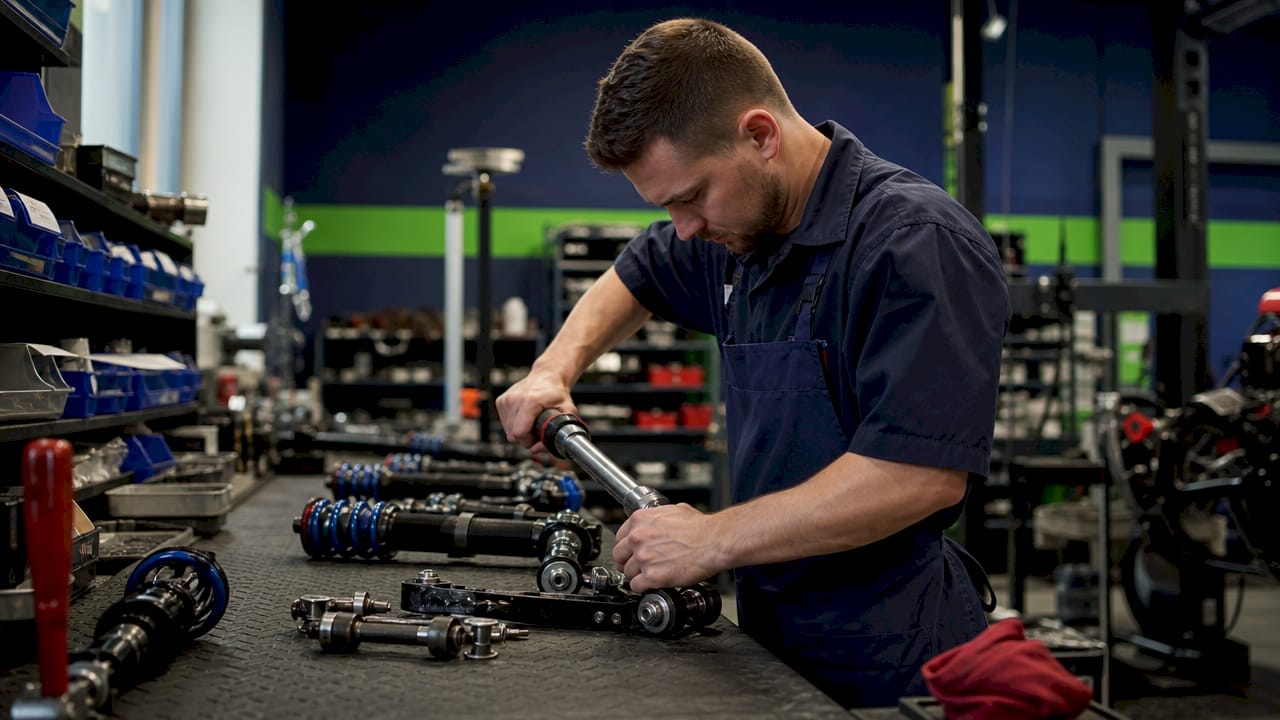
Springs store and release energy. When a wheel hits a bump, the spring compresses to absorb the impact, then extends to return the wheel to its original position. Coil springs are the most common type, found on most modern cars and go-karts. Leaf springs, stacked layers of curved steel, appear on trucks and heavier vehicles where load capacity matters more than ride refinement.
Shock absorbers (also called dampers) do the work most people overlook. Springs store energy, but shock absorbers convert it to heat, preventing the vehicle from bouncing repeatedly after a bump. A spring alone would cause the vehicle to oscillate up and down for several seconds after every impact. The damper stops that oscillation almost immediately.
Linkages, bushings, ball joints, and anti-roll bars maintain the geometry of the suspension. They control the angle and position of the wheels relative to the road surface. Anti-roll bars reduce body lean during cornering by transferring force between the left and right wheels.
- Coil springs: lightweight, tunable, common on cars and powersports vehicles
- Leaf springs: heavy-duty, simple, used on trucks and utility vehicles
- Shock absorbers: convert kinetic energy to heat, control oscillation
- Bushings and ball joints: maintain wheel alignment and steering precision
- Anti-roll bars: reduce body roll during cornering
Pro Tip: Worn bushings and ball joints cause vague, wandering steering even when your springs and shocks are in perfect condition. Small geometry components critically affect handling stability, so inspect them every time you check your shocks.
How does a vehicle suspension system work to improve driving dynamics?
The suspension system works by isolating wheel motion from body motion. When a wheel encounters a road irregularity, the suspension allows the wheel to move independently while the vehicle body stays relatively level and stable. That separation is what makes the difference between a controlled ride and a jarring, dangerous one.
The process follows a clear sequence:
- Impact absorption. A wheel strikes a bump. The spring compresses, storing the kinetic energy from the impact.
- Energy dissipation. The shock absorber converts that stored kinetic energy into heat, releasing it gradually rather than bouncing the vehicle.
- Wheel return. The spring extends, pushing the wheel back toward the road surface to restore tire contact.
- Geometry maintenance. Linkages and joints keep the wheel at the correct angle throughout the entire movement, preserving steering accuracy.
- Stability restoration. The anti-roll bar and dampers work together to level the body and prepare the suspension for the next input.
Maintaining tire contact is the most critical function in this sequence. A tire that loses contact with the road cannot generate braking force, steering response, or acceleration traction. The suspension keeps tires planted on the road surface, which is why suspension health directly determines how quickly and safely a vehicle can stop or change direction.
The relationship between tires and suspension is inseparable. You can learn more about how tire grip and suspension interact to affect overall vehicle performance, especially on off-road terrain where both systems face constant stress.
What are the main types of vehicle suspension systems?
Suspension systems are classified into three primary architectures: dependent, semi-independent, and independent. Each architecture handles wheel movement differently, and each suits different vehicle types and performance goals.
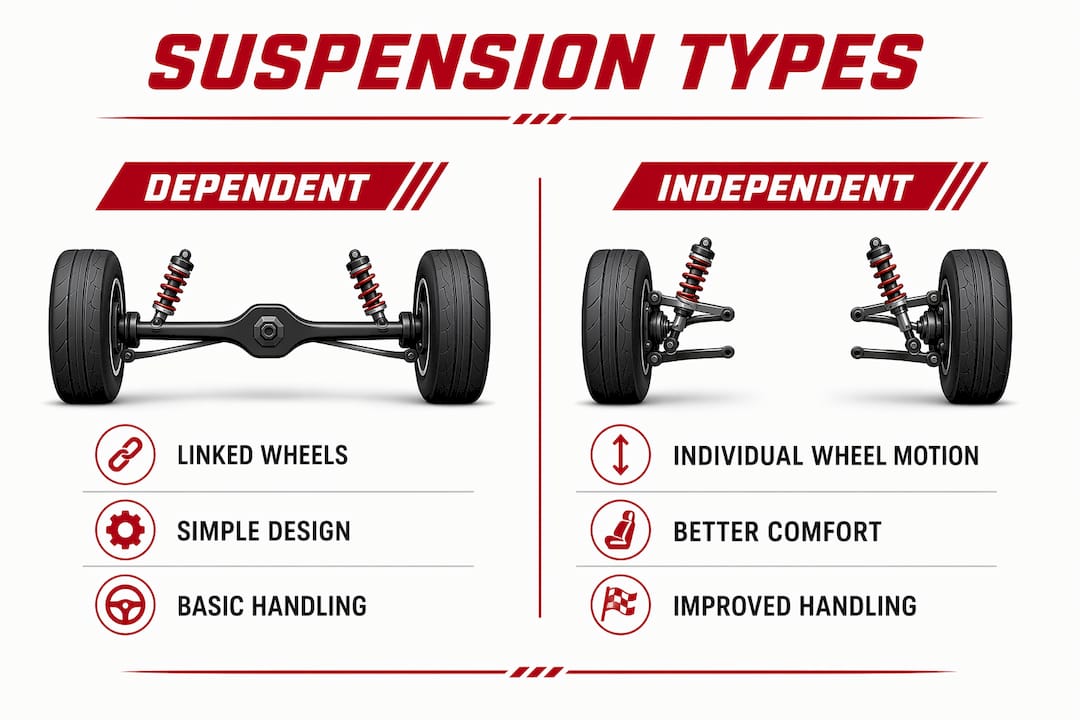
Dependent suspension links the left and right wheels on the same axle. When one wheel hits a bump, the other wheel is affected. This setup is simple, durable, and common on trucks and off-road vehicles where load capacity and ground clearance matter most.
Independent suspension allows each wheel to move without affecting the other. This produces better ride quality and handling on paved roads. MacPherson struts, the most widely used independent design, combine the spring and damper into a single unit to save space and reduce weight. Multi-link suspension uses multiple arms to control wheel movement with greater precision, common on performance cars and sport UTVs.
Semi-independent suspension, such as the torsion beam design, falls between the two. The wheels can move somewhat independently, but a connecting beam limits full independence. This design is cost-effective and common on compact cars.
Beyond architecture, suspension systems are also classified by their control technology:
| Type | Control method | Best application |
|---|---|---|
| Passive | Springs and dampers only | Standard cars, entry-level powersports |
| Semi-active | Electronically adjustable dampers | Sport sedans, performance ATVs |
| Active | Actuators replace or supplement springs | Luxury vehicles, race applications |
| Electromagnetic | Linear motors generate and absorb force | Advanced research and premium vehicles |
Passive suspension is the most common and requires no electronic input. Semi-active systems adjust damping stiffness electronically based on road conditions. Active systems go further, using actuators to control wheel movement directly. Air suspension offers adjustable ride height and stiffness, making it popular on luxury vehicles and some off-road builds.
For a deeper look at how these classifications apply to powersports, the go-kart suspension guide from Gokartsusa covers dependent and independent setups in practical detail.
Why is vehicle suspension critical for safety, performance, and comfort?
Suspension failure compromises steering geometry and tire contact, leading directly to loss of vehicle control and increased stopping distances. This is not a gradual inconvenience. A blown shock absorber or broken ball joint can make a vehicle nearly impossible to steer safely, especially at speed or on uneven terrain.
The safety risks from neglected suspension include:
- Loss of steering control during cornering
- Increased stopping distances due to reduced tire contact
- Uneven and accelerated tire wear
- Body roll that destabilizes the vehicle during sudden maneuvers
- Wheel shimmy or vibration that masks other mechanical problems
Comfort and performance pull in opposite directions in suspension design. Stiffer suspension setups improve handling but reduce ride comfort, while softer setups absorb bumps better but allow more body movement during cornering. Every suspension design is a compromise between these two goals. Automotive engineers call this the “challenge of compromise,” and it shapes every decision from spring rate selection to damper tuning.
One of the most common DIY misunderstandings involves bounciness. Poor shock absorbers cause bouncing, not worn springs. Springs store and release energy, but dampers control how quickly that energy dissipates. When dampers wear out, the vehicle bounces repeatedly after every bump because nothing is stopping the spring from oscillating.
Pro Tip: Push down firmly on each corner of your vehicle and release. If the corner bounces more than once before settling, the shock absorber on that corner needs replacement. This simple bounce test for suspension takes 30 seconds and can catch a failing damper before it becomes a safety issue.
What are advanced and emerging suspension technologies?
Active and electromagnetic suspensions use sensors and electronic controls to adapt stiffness and damping in real time, improving both ride quality and handling simultaneously. This is the technology that breaks the traditional comfort-versus-performance trade-off.
In an active system, sensors monitor road surface, vehicle speed, body movement, and steering input dozens of times per second. The system adjusts damping forces before the driver even feels the bump. Electromagnetic suspension takes this further by using linear motors that can both absorb energy from road impacts and generate electricity from that energy, recovering it rather than wasting it as heat.
Intelligent suspension systems are becoming more common in modern automotive and powersports vehicles. What began as a luxury feature on high-end sedans is now appearing in performance UTVs and sport ATVs. The TrailMaster Challenger 300EX is one example of a powersports vehicle that brings sophisticated suspension engineering to recreational riders.
Suspension design continues to evolve as engineers use sensor data to close the gap between comfort and road-holding performance. Future systems will likely combine mechanical, electronic, and predictive AI controls to anticipate road conditions before impact rather than simply reacting to them.
Key Takeaways
Vehicle suspension is the energy management system that keeps tires on the road, controls body motion, and determines both the safety and feel of every vehicle you ride.
| Point | Details |
|---|---|
| Core function | Suspension absorbs road energy and dissipates it as heat to maintain tire contact and stability. |
| Springs vs. dampers | Springs store energy; shock absorbers convert it to heat. Bouncing means damper failure, not spring failure. |
| Geometry matters | Worn bushings and ball joints destroy handling even when springs and shocks are in good condition. |
| Type selection | Dependent suits off-road loads; independent suits performance and comfort on paved surfaces. |
| Proactive maintenance | The bounce test at each corner detects failing shock absorbers before they become a safety risk. |
Why suspension knowledge changed how I ride
Most riders treat suspension as a background system, something they only think about when something breaks. That mindset is the single biggest mistake I see among enthusiasts and new DIYers. Suspension is not a static part. It is a dynamic energy dissipation system that works constantly, and understanding it changes how you ride, how you maintain your vehicle, and how you spend your money on upgrades.
The most common expensive mistake I see is riders upgrading to stiffer springs or premium shocks while ignoring worn bushings and ball joints. The result is a vehicle that feels worse after the upgrade, not better. The geometry is off, the new components cannot do their job, and the rider blames the parts instead of the real problem. Geometry components are cheap. Replacing them before upgrading anything else is the move that actually transforms how a vehicle handles.
Hands-on experience is the fastest teacher here. The bounce test, checking for play in ball joints, and listening for clunks over rough terrain will teach you more in one afternoon than hours of reading. Suspension knowledge is not just about fixing problems. It is about understanding what your vehicle is telling you before a problem becomes dangerous.
— Mario
Gokartsusa vehicles built for riders who understand the ride
At Gokartsusa, we know that understanding your suspension makes you a better rider and a smarter buyer. That knowledge is exactly why our vehicles are built with suspension systems that match the demands of real riders, whether you are a kid hitting the trails for the first time or an adult pushing performance on rough terrain.

The Sport Kart Kids Gas Go Kart delivers a 2.5hp 4-stroke engine with suspension tuned for young riders who need control and confidence on varied surfaces. For two-wheel adventure, the Gas Powered Mini Bike offers a 3.5hp automatic 4-stroke with ride quality built for ages 12 and up. Both vehicles reflect the same commitment to reliability and performance that drives everything we build at Gokartsusa. Browse our full lineup and find the ride that fits your adventure.
FAQ
What is vehicle suspension in simple terms?
Vehicle suspension is the system of springs, shock absorbers, and linkages that connects a vehicle’s wheels to its frame, absorbing road impacts and keeping tires in contact with the ground for safe, controlled driving.
What are the main types of vehicle suspension?
The three primary types are dependent, semi-independent, and independent suspension. Common designs include MacPherson struts, multi-link systems, torsion beams, and air suspension, each suited to different vehicle types and performance needs.
How does suspension affect braking and steering?
Suspension keeps tires planted on the road surface. When suspension fails, tires lose contact with the road, which directly increases stopping distances and reduces steering response, making the vehicle dangerous to control.
Why does my vehicle bounce after hitting a bump?
Bouncing after a bump is caused by worn shock absorbers, not worn springs. Dampers convert kinetic energy to heat to stop oscillation. When they fail, the spring continues to cycle up and down without control.
How often should suspension components be inspected?
Suspension components should be inspected at least once a year or after any significant off-road use. The bounce test at each corner and a visual check of bushings and ball joints for play or cracking are the fastest ways to catch problems early.