




TL;DR:
- A live axle system connects both rear wheels via a rigid shaft, providing durability and low maintenance for off-road and budget vehicles. This design enhances traction and handles heavy loads but increases unsprung weight, causing harsher rides and limited handling finesse. It remains popular among hobbyists for its simplicity, cost-effectiveness, and suitability for rough terrain.
A live axle system is a dependent suspension design where a single rigid shaft connects both rear wheels and transmits engine power to them simultaneously. For go-kart and mini bike hobbyists, that means one thing above all else: rugged simplicity. If you ride off-road, run a budget build, or want a machine that shrugs off abuse and stays easy to fix, a live axle is a strong choice. If smooth on-road handling and tight cornering are your priorities, the trade-offs are real and worth knowing before you buy.
The live axle is also called a solid axle or beam axle. A dead axle, by contrast, connects two wheels but carries no drive power. The distinction matters when you are reading spec sheets or shopping for parts.
Table of Contents
- What is a live axle system and how does it transmit power?
- Why hobbyists love the advantages of a live axle
- What are the drawbacks you should expect?
- When should you choose a live axle for your build or purchase?
- How to maintain a live axle and fix common problems
- Live axle vs. independent suspension: a practical side-by-side
- Pre-ride safety checklist for live-axle vehicles
- Key Takeaways
- Why live axles still make sense for most hobbyists
- Ready to ride? Find live-axle go-karts and mini bikes at Gokartsusa
- Sources and further reading
What is a live axle system and how does it transmit power?
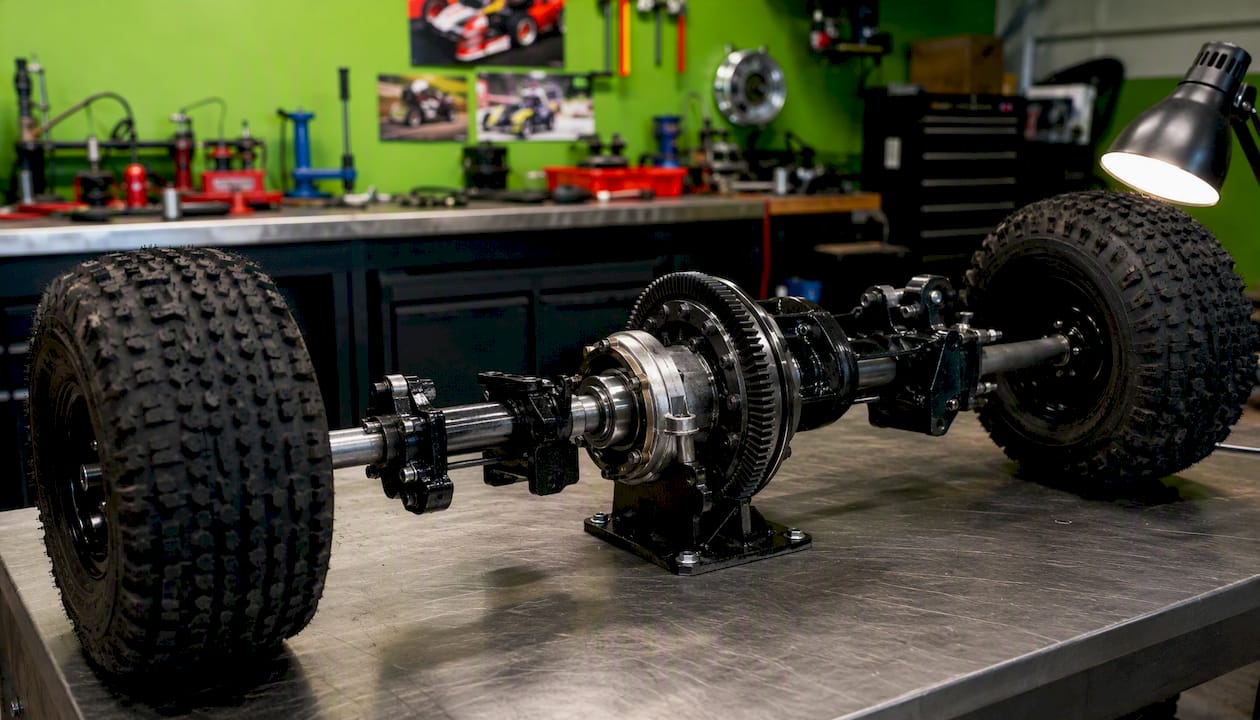
Power flows from the engine, through the drivetrain, and into the axle shaft itself. Because the shaft is rigid, both wheels spin at the same speed. On many entry-level go-karts, there is no differential at all: the solid rotating axle connects both rear wheels directly, and the whole assembly turns as one unit. On larger vehicles like ATVs or some mini bikes, a differential sits inside the axle housing and allows slight speed differences between wheels during turns, while the housing itself still moves as a single beam.
The axle housing is located by springs or links attached to the chassis. In a Hotchkiss drive layout, leaf springs both support the axle and react to the torque the engine sends through it. What moves together in a live axle setup:
- The axle shaft or shafts
- The differential housing (when present)
- The brake drums or rotors mounted to the axle
- The wheels themselves
What stays fixed to the chassis and does not move with the axle: the engine, frame, and body. That separation is the whole point of any suspension, live or independent.
Pro Tip: On a solid-axle go-kart, even a small misalignment between the bearing hangers will cause the axle to bind as it rotates. Before your first ride on a new kart, spin the rear axle by hand with the engine off. It should turn freely with no tight spots.
Why hobbyists love the advantages of a live axle
The appeal is straightforward: fewer parts, lower cost, and a drivetrain that handles serious punishment. Solid axles remain common in heavy-duty and off-road applications precisely because they handle large loads without complex engineering. For a hobbyist building or buying a budget kart, that durability is a genuine advantage.
Key benefits for small recreational vehicles:
- Mechanical simplicity: No CV joints, no independent knuckles, no complex geometry to maintain. Fewer failure points means fewer repairs.
- High torque transfer: The rigid connection puts power to the ground efficiently. Drag racing applications favor live axles for exactly this reason.
- Low cost: Manufacturing and replacement parts cost less than independent suspension components.
- Compact packaging: The axle occupies minimal interior space, which matters on small-frame go-karts and mini bikes.
- Off-road traction: Both wheels push simultaneously, which helps on loose dirt, grass, and gravel.
Pro Tip: For off-road kid’s karts and youth ATVs, the live axle’s durability advantage is especially valuable. Kids are hard on equipment. A solid axle survives the kind of repeated impacts that would stress a more complex independent setup.
What are the drawbacks you should expect?
The same rigid connection that makes a live axle tough creates real handling costs. Unsprung weight increases because the differential, axle shafts, and housing all move with the wheels rather than staying fixed to the chassis. Greater unsprung mass transmits larger forces to the frame over bumps and reduces the suspension’s ability to keep tires planted on uneven ground.
On go-karts specifically, forcing both rear wheels to spin at the same speed causes inner-wheel drag during tight cornering on high-grip surfaces. The inside tire scrubs instead of rolling cleanly, which accelerates wear and pushes the kart wide. Drifting and low-traction surfaces mask this problem; a smooth asphalt track exposes it quickly.
Common drawbacks at a glance:
- Increased unsprung weight: Harsher ride on rough terrain; slower suspension response compared to independent systems
- Inner-wheel drag: Tire scrub and handling push during tight turns
- Axle wrap and wheel hop: Under high torque, leaf springs in a Hotchkiss drive layout can wind up and snap back, causing violent wheel hop
- Camber change: The whole axle tilts when the suspension compresses, affecting grip
Mitigation options include traction bars to limit axle wrap, stiffer spring packs, and careful tire selection for the surface you ride most.
When should you choose a live axle for your build or purchase?
Use this checklist to match your riding style to the right axle type.
Choose a live axle if you:
- Ride primarily off-road (dirt, grass, gravel, trails)
- Want a low-maintenance machine that is easy to service yourself
- Are buying for a child or beginner who needs a durable, forgiving vehicle
- Are building or buying on a budget
- Want strong straight-line acceleration or drag-style launches
- Ride in low-traction or drifting conditions where inner-wheel drag is not a problem
Consider independent suspension instead if you:
- Ride mostly on paved roads or smooth tracks where cornering grip matters
- Prioritize on-road ride comfort over durability
- Need precise high-speed handling
- Frequently navigate tight technical turns on high-grip surfaces
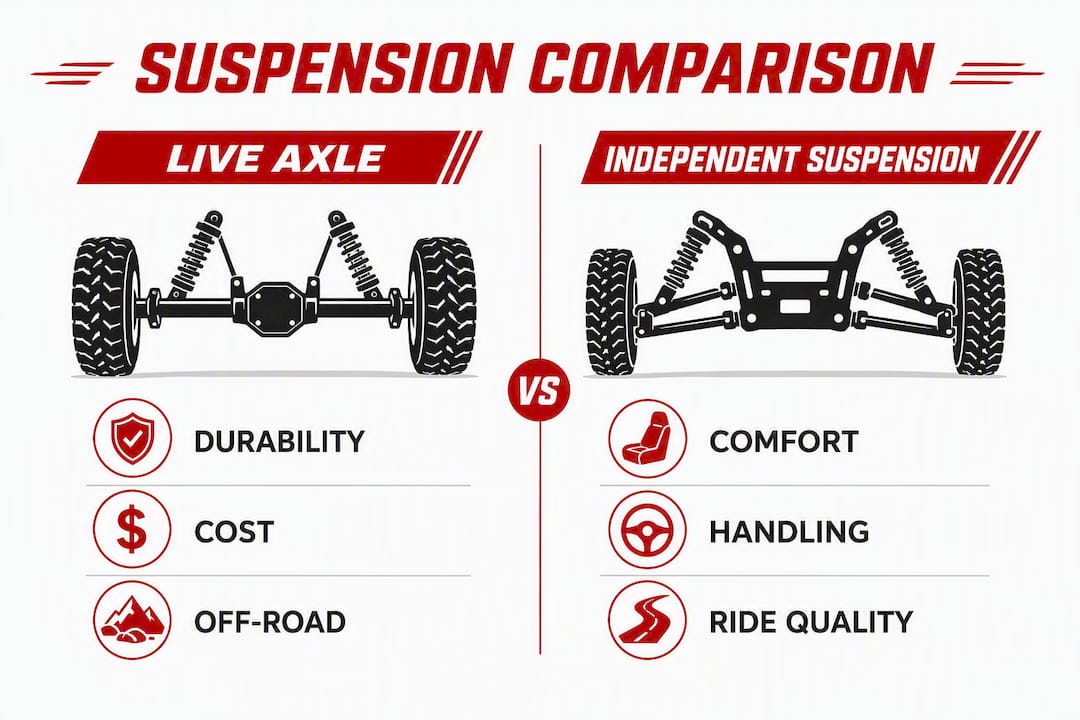
The short version: live axle wins on ruggedness, cost, and off-road traction. Independent suspension wins on ride quality and cornering finesse. Most recreational go-karts and entry-level mini bikes land squarely in live-axle territory. For performance-focused suspension trade-offs, the gap between the two designs becomes more significant at higher speeds.
How to maintain a live axle and fix common problems
Staying ahead of wear on a live axle comes down to three things: bearing condition, chain alignment, and axle runout. Misalignment or incorrect chain tension on a rotating live axle causes binding that robs power and accelerates bearing failure.
Step-by-step maintenance routine:
- Check bearing play. Grab each rear wheel and try to rock it side to side. Any noticeable play means the bearing needs replacement.
- Inspect axle runout. With the kart on a stand, spin the axle slowly and watch for wobble at the center. More than minimal runout indicates a bent shaft.
- Verify chain tension. The chain should have roughly 1/4 inch of vertical play at the midpoint. Too tight causes binding; too loose risks derailment.
- Check axle alignment. Confirm the axle sits square in the bearing hangers. A shifted hanger causes the chain to run at an angle and wear unevenly.
- Torque U-bolts and bearing hangers. Loose hardware allows the axle to shift under load.
- Inspect for axle wrap signs. On leaf-sprung vehicles, look for scuff marks on the spring pack or frame contact points that suggest the axle is rotating under torque.
| Symptom | Likely Cause | Fix |
|---|---|---|
| Wheel hop on hard launches | Axle wrap (spring wind-up) | Add traction bar; stiffen spring pack |
| Engine bogs under load | Bearing binding or chain misalignment | Re-index bearings; realign chain |
| Uneven rear tire wear | Inner-wheel drag or axle runout | Check runout; adjust alignment |
| Vibration at speed | Bent axle shaft | Measure runout; replace shaft |
Pro Tip: Axle wrap angles within a small moderate range are generally acceptable under normal riding loads. If you are running high-torque launches and see wheel hop, the wrap is exceeding that range. A bolt-on traction bar is the fastest fix and costs far less than a bent axle or damaged U-joint.
Live axle vs. independent suspension: a practical side-by-side
The choice between a live axle and independent suspension is really a question of what you value most in a recreational vehicle.
| Attribute | Live axle | Independent suspension |
|---|---|---|
| Ride comfort | Firmer; harsher on rough terrain | Smoother; each wheel moves independently |
| Cornering handling | Inner-wheel drag; less precise | Better grip; cleaner cornering |
| Robustness | High; fewer failure points | Moderate; more components to wear |
| Cost to maintain | Low; simple parts | Higher; more complex geometry |
| Off-road traction | Strong; both wheels push together | Variable; depends on design |
| Best use case | Off-road, budget builds, youth karts | On-road, performance tracks, comfort rides |
For a deeper look at how suspension systems affect performance across different vehicle types, the differences become even clearer at higher speeds and on technical terrain.
Pre-ride safety checklist for live-axle vehicles
Run through these checks before every ride. They take under five minutes and catch the failures that live-axle designs are most prone to.
- Bearing play: Rock each rear wheel. No play should be detectable.
- Axle mounting bolts: Confirm all bearing hanger bolts and U-bolts are tight.
- Chain tension: Verify 1/4 inch of play; check for kinks or dry links.
- Brake function: Test both brakes at low speed before heading out.
- Tire condition: Look for uneven wear on the inside edges, which signals inner-wheel drag or alignment issues.
- Axle runout: Spin the axle by hand and watch for wobble.
Pro Tip: A dry or kinked chain is one of the earliest signs of axle binding on a solid-axle kart. If the chain shows uneven wear on one side, check bearing hanger alignment before the next ride. Catching it early prevents a much costlier bearing replacement.
Key Takeaways
A live axle system is the right choice for most recreational go-karts and mini bikes when durability, low cost, and off-road traction matter more than on-road ride comfort or tight-corner handling.
| Point | Details |
|---|---|
| Core definition | A rigid shaft connecting and driving both wheels simultaneously as a dependent suspension unit. |
| Top advantages | Mechanical simplicity, low cost, strong torque transfer, and rugged off-road durability. |
| Top trade-offs | Increased unsprung weight, inner-wheel drag during tight turns, and axle wrap under high torque. |
| Primary maintenance priority | Check bearing play, chain tension, and axle alignment before every ride to prevent binding. |
| Gokartsusa recommendation | Browse Gokartsusa’s live-axle go-karts, mini bikes, and ATVs for models matched to your riding style and budget. |
Why live axles still make sense for most hobbyists
Most of the powersports world has moved toward independent suspension for road cars, and that shift makes sense for vehicles that spend their lives on pavement. But for the go-karts, mini bikes, and youth ATVs that Gokartsusa sells, the live axle is not a compromise. It is a deliberate design choice that matches the way these machines actually get used.
The argument against live axles usually centers on ride quality and cornering. Both are fair criticisms on a smooth track at speed. But the riders buying entry-level off-road karts and budget mini bikes are not chasing lap times on a manicured circuit. They are riding trails, backyard tracks, and open fields where the axle’s durability and traction advantages show up every single ride. A kid who hits a root at full throttle needs a drivetrain that absorbs the hit and keeps going, not one that requires a geometry check afterward.
The maintenance angle is equally underrated. A solid axle is something a motivated hobbyist can inspect, adjust, and repair with basic tools. That accessibility keeps riders on the trail instead of waiting for a shop appointment. For anyone new to powersports, that simplicity builds confidence and mechanical knowledge at the same time.
Ready to ride? Find live-axle go-karts and mini bikes at Gokartsusa
Gokartsusa carries a full lineup of live-axle go-karts, mini bikes, and ATVs built for the kind of riding this article describes: off-road adventures, budget-friendly family fun, and durable machines that hold up to real use. The Sport Kart Kids Gas Go Kart is a strong starting point for younger riders who want off-road capability with a simple, reliable drivetrain. For mini bike fans, the Gas Powered Mini Bike delivers that same low-maintenance reliability in a classic package. Gokartsusa also stocks replacement bearings, chains, and axle hardware so you can keep your machine running without hunting down parts from multiple suppliers.

Check the product pages for full spec details, and reach out to the Gokartsusa team with any questions about which drivetrain setup fits your riding style. Free shipping and seasonal promotions make it a great time to get rolling.
Sources and further reading
- Beam axle / Live axle — Wikipedia
- Madabout Kitcars — Live axle explained
- FIRGELLI — Live axle and Hotchkiss drive
- Capital One Auto Navigator — What is a solid axle?
- Dragzine — Axles 101 for drag racing
- Flowracers — Live axle on a go-kart
- HP Academy — Live axle and wheel alignment
- Autozine — Suspension technical school
- Gokartsusa — Vehicle suspension explained