




An ATV’s role on a camping trip is to act as a mobile basecamp: a machine that extends your reach into remote terrain, hauls your family’s full gear load, and supplies on-demand power when the grid is miles behind you. That single capability changes everything about what a camping trip can include.
- Remote access: U.S. OHV trail systems managed by the Bureau of Land Management and National Forest Service open terrain that no car can reach.
- Gear hauling: Rear racks, soft cargo bags, and tow trailers let you carry far more than any backpack ever could.
- On-demand power: A 12V output or portable power station charged from your ATV keeps devices, lights, and camp systems running.
Table of Contents
- What roles does an ATV actually fill on a camping trip?
- What permits and campgrounds do you need for OHV camping?
- How do you plan logistics, fuel, and costs for an ATV camping trip?
- How do you pack light and haul smart for ATV camping?
- How do you prep your ATV and use it as a power source at camp?
- What campsite and trail etiquette should ATV campers follow?
- Two printable checklists for your next ATV camping trip
- Key Takeaways
- The real trade-off most families miss
- Ready to gear up? Gokartsusa has your family covered
What roles does an ATV actually fill on a camping trip?
The ATV camping benefits go well beyond simple transportation. Here is what the machine actually does once you leave the trailhead:
- Remote site access: ATVs reach dispersed campsites on BLM land, forest roads, and OHV-designated trails that are closed to standard vehicles.
- Expanded hauling: ATV/UTV camping expands how much gear you can bring and provides power for electronics and campsite lighting, a clear advantage over backpacking or canoe camping.
- Day-riding hub: Park at a base camp and use the ATV for daily trail loops, fishing access, or supply runs without breaking camp.
- Family mobility: Multi-seat UTVs can carry multiple riders; a party of single-seat ATVs can bring a whole group to the same remote site.
- Safety and rescue: A loaded ATV can carry a hurt rider or retrieve gear in terrain where a truck cannot follow.
ATVs are not appropriate everywhere. Sensitive wetlands, wilderness-designated areas, and any trail marked “non-motorized” are off-limits. Riding in those zones causes real damage and carries real fines.
What permits and campgrounds do you need for OHV camping?
Legal access varies by land manager. National Forests, BLM districts, state parks, and county systems each set their own OHV rules, and those rules change by season. Riders must verify local regulations and obtain required OHV permits before loading the trailer.
- Check the specific land management agency’s website (fs.usda.gov for National Forests, blm.gov for BLM land) or call the local ranger station.
- Look for green OHV-open diamond markers at trailheads; a brown hiker symbol means motorized vehicles are prohibited.
- Permit fees vary widely by state and district. Budget for a day-use or annual OHV permit in addition to campsite fees.
- Prioritize campgrounds with direct trail access, designated OHV parking pads, and proximity to fuel or maintenance services. OHV-trail-system campgrounds often allow riding directly from your campsite onto the trail network, which cuts daily logistics and maximizes ride time.
Pro Tip: Confirm seasonal restrictions at least two weeks before departure. Spring snowmelt and fall fire closures can shut trails with little notice, and a phone call to the ranger station takes five minutes.
“You’d be surprised how often folks head to the trail they want to camp on only to find that it’s for bicycles and hikers only.” — SuperATV Off-Road Atlas
Familiarize yourself with off-road trail terminology before you read a trailhead sign under pressure.
How do you plan logistics, fuel, and costs for an ATV camping trip?
Trailering vs. riding in
Trailer your ATV when the campground is more than a comfortable day’s ride away or when road conditions between home and the trailhead are not OHV-legal. Ride directly from a campground when the site sits on a connected trail network, which reduces repeated trailering and gives you more saddle time each day.
Fuel planning
Heavy loads and technical terrain increase fuel consumption noticeably. Carry extra fuel in secure, dedicated mounts positioned near the center of gravity. Loose cans shift weight unpredictably and raise spillage risk. Overshoot your fuel estimate by at least a couple of gallons to cover detours or slow trail sections.
Typical weekend timeline
- Day 1, morning: Load trailer, run pre-trip inspection, depart early.
- Day 1, afternoon: Arrive, set up camp, short shakedown ride.
- Day 2: Full trail loop, refuel at midpoint if planned, return to camp by late afternoon.
- Day 3: Pack out, final inspection, depart.
Illustrative cost ranges
| Cost Item | Typical Range (U.S.) |
|---|---|
| OHV day-use permit | varying fees per day |
| Campsite fee (OHV-friendly) | varying fees per night |
| Fuel reserve (extra fuel) | varying cost |
| Spare parts / minor maintenance | variable cost |
Ranges are illustrative. Actual costs vary by state, land manager, and season. Match trails to your skill level and pre-book campsites during peak season.
Overloading your ATV raises the center of gravity, degrades handling on technical terrain, and increases fuel burn. Stay within the manufacturer’s rated payload.
How do you pack light and haul smart for ATV camping?
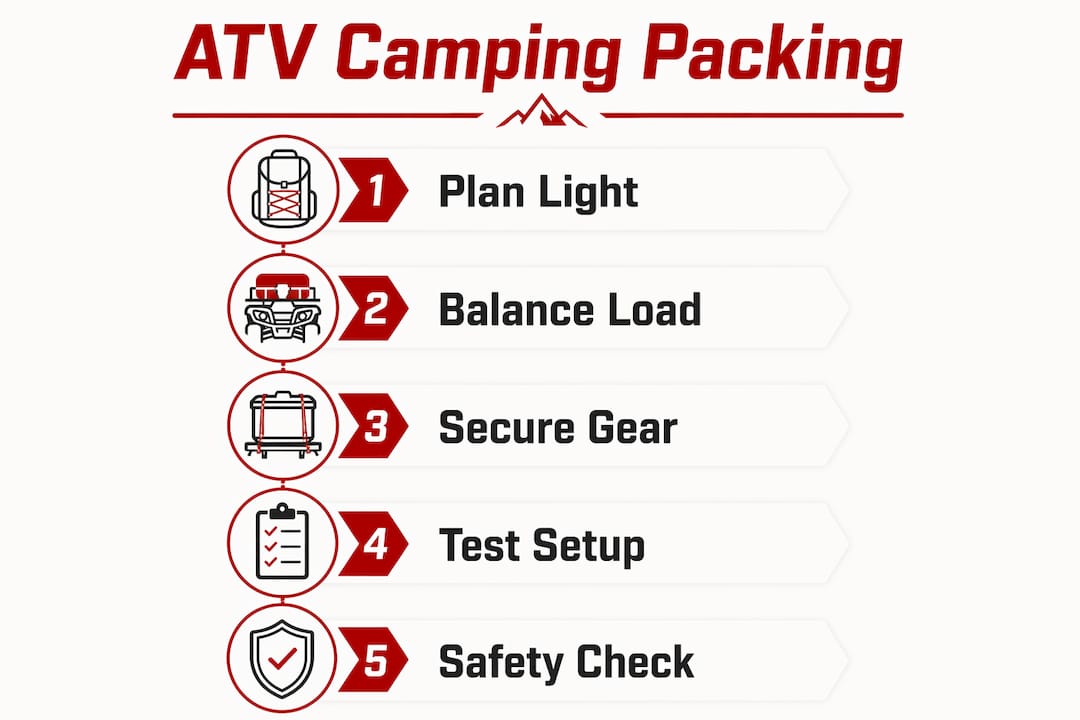
The guiding principle is purposeful minimalism: modular, lightweight systems that carry only what is necessary while keeping the ATV agile. A compact tent or hammock, a high-BTU camp stove, and modular storage bags beat a full car-camping kit every time.
Hauling methods:
- Rear rack: Best for dense, heavy items strapped low and centered.
- Soft-sided cargo bags: Conform to rack shape, reduce wind resistance, and protect gear from mud.
- Tow trailer: Adds significant capacity for multi-day family trips; keep tongue weight balanced.
Family packing checklist:
- Sleep: compact tent or hammock with rain fly, temperature-rated sleeping bag, sleeping pad
- Cooking: high-BTU portable stove, lightweight cookware, reusable utensils, water filter
- Safety: first aid kit, emergency poncho, fire starter, tow strap, multi-tool
- Tools: spark plug, tire repair kit, basic hand tools
- Food and water: three liters of water per person per day plus one liter for cooking; dense trail food
- Kids: insect repellent, extra layers, LED lantern
Pro Tip: Modularize fuel and water into separate, labeled containers mounted on opposite sides of the rack. Balanced weight prevents load shift on off-camber trails, and you will know at a glance how much of each you have left.
How do you prep your ATV and use it as a power source at camp?
A solid pre-trip inspection catches problems at home, not 40 miles from the trailhead. Run through this before every trip:
- Tires: pressure, tread depth, sidewall condition
- Fluids: engine oil, coolant, brake fluid
- Belts and drive components: check for cracking or fraying
- Fasteners: tighten rack bolts, footpegs, and skid plates
- Battery: full charge, clean terminals
- Lights: headlights, brake lights, and any auxiliary lighting
- Recovery gear: winch function, tow strap condition, shackles
Tool and spare list to carry: spark plug, tire repair kit, basic hand tools, tow strap, portable jump starter, and a Leatherman-style multi-tool.
For on-demand power at camp, most ATVs provide a 12V accessory output sufficient for charging phones and running LED camp lights. A small portable power station charged from that output extends capacity for longer stays. Avoid running accessories while the engine is off for extended periods; it drains the battery faster than most riders expect.
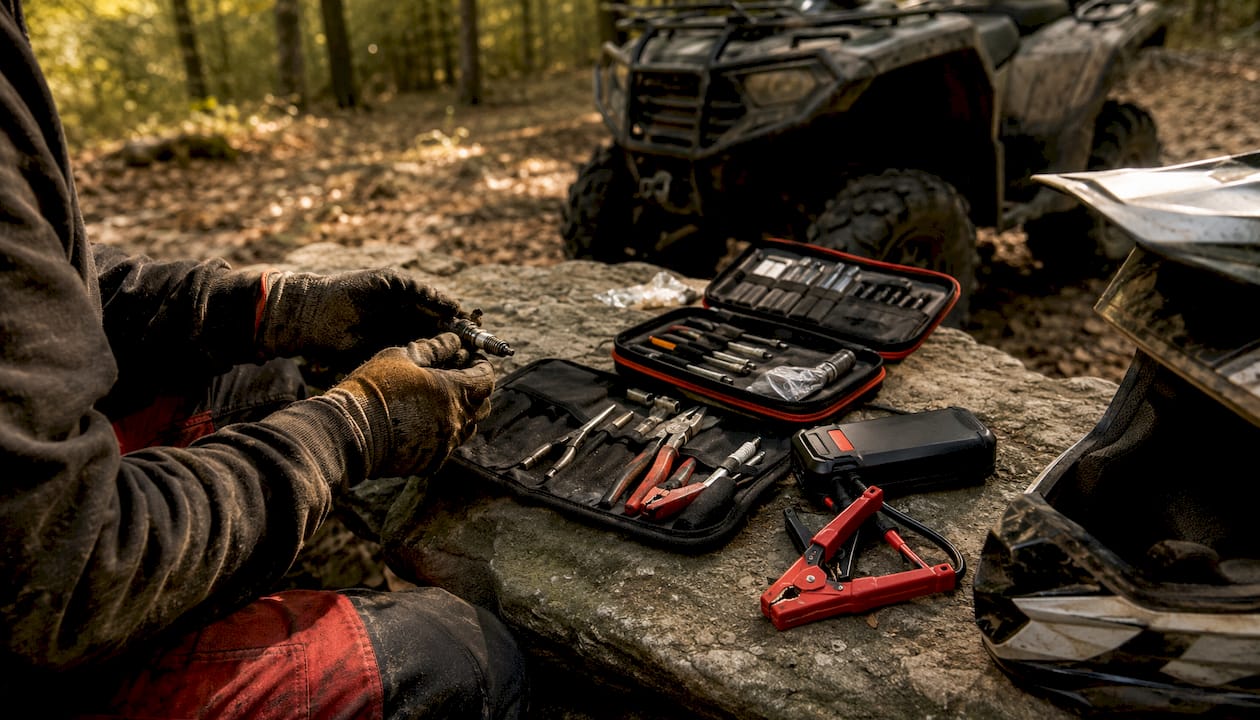
Weight distribution affects handling significantly on loaded machines. Mount fuel and heavy gear as close to the center of gravity as possible.
Pro Tip: Run a full dress rehearsal at home: set up the tent, pack and unpack every cargo bag, and test the stove. Discovering a fit problem in your driveway beats discovering it in the dark after a long ride.
What campsite and trail etiquette should ATV campers follow?
Campsite layout
Park your ATV away from sleeping areas to reduce noise and fume exposure. Store food in sealed containers well away from the vehicle and sleeping zone. Keep your charging station and tool kit in one designated spot so nothing gets left on the trail.
Riding etiquette
Slow down near other campsites. Noise carries farther in open terrain than most riders realize. Match your trail choice to your actual skill level, not your aspirational one. Choosing trails that match rider skill is one of the most cited planning failures among first-time ATV campers.
Environmental impact
ATVs compact soil and disturb root systems when ridden off designated paths. Wet soil is especially vulnerable: a single pass can create erosion channels that last years. Wildlife disturbance peaks during dawn and dusk, exactly when many riders head out. Stay on marked trails, avoid stream crossings unless a designated ford exists, and cut the engine when wildlife is near.
Do not:
- Ride off-trail in sensitive meadows or near water sources
- Leave camp waste or food scraps near the ATV
- Use ATVs as high-theft targets by leaving them unlocked and unattended in high-traffic areas
Pro Tip: Stage all food, trash, and scented items in sealed hard containers stored at least 200 feet from your sleeping area. This reduces both animal attractants and the soil compaction that comes from repeated foot traffic to a poorly placed food cache.
“Stay on designated trails. One shortcut across a meadow can undo years of restoration work.” — Leave No Trace principles for motorized users
Two printable checklists for your next ATV camping trip
Pre-trip ATV safety checklist
- [ ] Tire pressure and tread checked
- [ ] Engine oil, coolant, and brake fluid topped off
- [ ] Drive belt inspected for wear
- [ ] All rack and cargo bolts tightened
- [ ] Battery fully charged, terminals clean
- [ ] Headlights and brake lights functional
- [ ] Winch and tow strap ready
- [ ] Spare spark plug and tire repair kit packed
- [ ] OHV permit and trail map downloaded
Family packing checklist
- [ ] Compact tent or hammock with rain fly
- [ ] Temperature-rated sleeping bag and pad
- [ ] High-BTU portable stove and fuel
- [ ] Lightweight cookware and utensils
- [ ] Water supply (3+ liters per person per day) and filter
- [ ] First aid kit and emergency poncho
- [ ] Fire starter and LED lantern
- [ ] Insect repellent and extra layers for kids
- [ ] Tow strap, multi-tool, and basic hand tools
- [ ] Sealed food containers and trash bags
Print both lists and do a full dress rehearsal at home before departure. Setting up your gear once in daylight reveals fit problems, missing items, and packing inefficiencies that would otherwise surface at the worst possible moment.
Key Takeaways
ATVs function best on camping trips when treated as a mobile basecamp: plan access legally, pack minimally, and prep the vehicle thoroughly before you leave the driveway.
| Point | Details |
|---|---|
| Confirm legal access first | Verify OHV permits and trail status with the land management agency before booking any campsite. |
| Pack with minimalism in mind | Modular, lightweight systems keep the ATV agile and reduce load-shift risk on technical terrain. |
| Fuel and weight management | Carry extra fuel in secure, centered mounts; overloading raises the center of gravity and increases consumption. |
| Pre-trip prep prevents breakdowns | A full inspection and home dress rehearsal catch problems before you are 40 miles from the trailhead. |
| Gokartsusa for family-ready ATVs | Gokartsusa stocks kid-sized ATVs, safety gear, and accessories purpose-built for family camping adventures. |
The real trade-off most families miss
Most buyers focus on engine size and speed when choosing an ATV for camping. The families who get the most out of their trips focus on something different: cargo capacity, weight balance, and whether the machine fits the youngest rider in the group.
From watching families outfit ATVs for camping, the most common regret is buying a machine that is either too large for kids to ride confidently or too small to haul a realistic family gear load. The sweet spot for most families is a youth-sized ATV for the kids paired with an adult machine that can tow a small trailer. That combination handles the access problem and the hauling problem simultaneously, without asking a ten-year-old to manage a 400cc machine on a technical trail.
Safety training matters as much as the machine itself. Riders who complete an ATV safety course before their first trail trip make better decisions under pressure. Gokartsusa’s ATV safety resources and the family riding guide are worth reading before you finalize any purchase.
Ready to gear up? Gokartsusa has your family covered
Gokartsusa gives families a direct path from “we want to try ATV camping” to “we’re loaded and ready to ride.” The Mini Sport Kids ATV with 110cc engine and parental remote start/kill is built exactly for the scenario this article describes: a capable, confidence-building machine for younger riders that parents can monitor from camp. For families evaluating youth options across ride types, the Demon Kids Gas Dirt Bike offers a lightweight trail-capable alternative.

Gokartsusa ships nationwide with free shipping on qualifying orders, financing options for families watching the budget, and a product catalog that covers ATVs, safety gear, and accessories in one place. Browse the full lineup and find the right fit for your crew at gokartsusa.biz.