




An off-road park membership is a paid or registered relationship that grants you access to trails while making you a partner in keeping them open. It works because parks need dues, volunteer hours, and rule-followers to survive, and riders need somewhere legal and well-maintained to ride. Three pillars hold the whole system up:
- Access — unlimited or discounted entry, faster gate check-in, and sometimes camping.
- Community — member events, private forums, and a network of fellow riders.
- Stewardship — dues, volunteer hours, and advocacy that keep trails legally open.
Parks like Famous Reading Outdoors and Hot Springs Off-Road Park publish exactly how this works, and groups tracked by RidersWest show how membership dues fund the maintenance crews and government partnerships that keep gates unlocked.
Key Takeaways
A membership functions as an access-and-stewardship contract: riders trade dues, waivers, and volunteer commitments for discounted or unlimited trail entry and a real say in keeping that land open.
| Point | Details |
|---|---|
| Membership equals access plus duty | Dues and volunteer hours fund maintenance and secure long-term land access, not just cheaper gate fees. |
| Verify discount vs. unlimited | Confirm whether a tier waives fees entirely or just reduces them before you buy. |
| Check vehicle eligibility first | Engine size, sound limits, and age rules vary by park and can void your membership’s value. |
| Budget with a break-even calculation | Multiply your average day-pass cost by expected visits to see if a season pass actually saves money. |
| Match your vehicle to the rules | Gokartsusa’s youth ATVs and off-road karts are built to fit common park eligibility requirements for young or new riders. |
Table of Contents
- What Do You Typically Get With an Off-Road Park Membership?
- What Are the Real Benefits of Joining an Off-Road Park?
- What Responsibilities Come With Membership?
- How Are Membership Tiers and Pricing Usually Structured?
- How Do You Join and What Happens on Your First Visit?
- How Do You Pick the Right Membership and Spot Red Flags?
- How Do Real Parks Structure Their Memberships?
- Why Memberships Matter More Than Most Riders Realize
- Get the Right Rig Before You Buy That Membership
- Where to Verify Membership Terms and Stewardship Programs
- Frequently Asked Questions
- Sources
What Do You Typically Get With an Off-Road Park Membership?
Most memberships bundle the same core pieces, even if the branding differs from park to park. You’ll usually see unlimited or discounted daily passes, a digital waiver you complete once instead of every visit, and clear rules on guest or passenger fees. Many packages layer in camping access, merchandise or food discounts, and invitations to member-only events or private online forums, a perk MERUS Adventure Club leans on heavily to build a sense of belonging around its unlimited-access tier.
- Unlimited or discounted day-use entry
- Digital waivers and e-permits
- Guest and passenger policies
- Camping or storage access on some tiers
- Merchandise, food, or lodging discounts
- Member-only events and private forums
Digital waivers do more than save paper. Complete one at signup and the park can issue an e-permit that speeds up gate check-in, which matters a lot on a busy Saturday when forty trucks are lined up at the entrance.
Pro Tip: Before you buy, read the fine print on vehicle eligibility, passenger fees, blackout dates, and whether special events are included or sold separately. A membership that looks like a deal on the homepage can get expensive fast if every add-on costs extra.
What Are the Real Benefits of Joining an Off-Road Park?
The math is simple once you know your riding frequency. If day passes cost a moderate amount and you ride twice a month, an annual membership priced reasonably often pays for itself by summer. Hot Springs Off-Road Park’s tiered structure, where Gold members get unlimited day-use access while Silver members get discounted passes, is a good real-world illustration of how the savings scale with how often you actually show up.
Beyond the dollars, the non-financial perks are what keep riders renewing year after year:
- Skip the day-pass line with a scanned e-pass or member card
- Access to member-only events, group rides, and private forums
- Priority or included camping at parks that bundle it in
- A built-in network of riders who know the terrain and the rules
The distinction that trips up first-time buyers is discount versus unlimited access. Some “memberships” only knock a few dollars off the gate fee. Others erase it completely. Know which one you’re buying before you swipe your card.
What Responsibilities Come With Membership?
A membership card isn’t just a discount ticket. It’s an agreement to hold up your end of a safety and stewardship bargain, and most parks spell that out clearly in their terms.
Expect to sign and honor a liability waiver, follow posted speed and safety rules, and stick to whatever vehicle eligibility list the park publishes (engine size, sound limits, roll cage requirements, and so on). Camping members typically face site restrictions too, like quiet hours or designated RV zones. If you’re new to trail conduct, our trail riding etiquette guide covers the unwritten rules most parks expect you to already know.

Stewardship is the other half of the deal. Many operators build volunteer hours or trail maintenance days into their membership terms, not as busywork but because membership tracking and volunteer records feed directly into operating plans that parks submit to land managers for grants, insurance, and expansion approval.
On insurance: your membership dues typically help the park maintain its own liability coverage, but that doesn’t mean you’re covered for damage to your own vehicle or gear. Confirm what’s excluded before you assume you’re protected.
- Complete and keep your waiver current
- Follow posted safety and vehicle rules
- Show up for stewardship or volunteer commitments if required
- Respect camping and site-specific restrictions
Pro Tip: If you plan to store your rig or park an RV onsite long-term, ask whether the club needs to be listed as an additional insured on your policy. It’s a five-minute phone call that can save you a denied claim later.
How Are Membership Tiers and Pricing Usually Structured?
Tier names vary, but the pattern repeats across the industry. A free or basic tier usually just requires a signed waiver plus discounted day-use pricing. Mid tiers, often labeled Silver or similar, knock more off the gate fee but still charge something per visit. Premium tiers, whether they’re called Gold, VIP, or all-access, tend to include unlimited entry and extras like camping or event discounts.
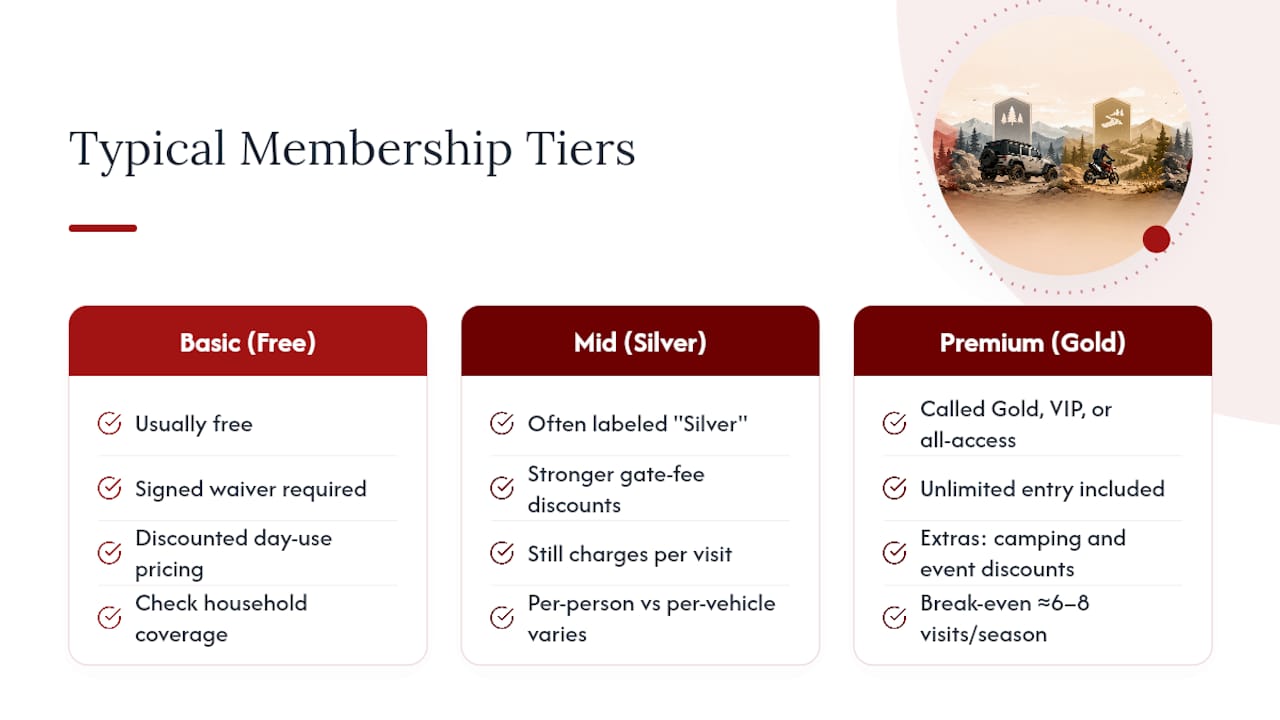
Family and group memberships add another wrinkle. Some parks price per vehicle, others per person, and household rules on how many riders one membership covers vary widely, so check that detail before assuming your whole crew is covered under one card.
Here’s a quick way to check your break-even point: take your average day-pass cost, multiply it by how many times you realistically ride per season, and compare that total against the membership price. If you clear six or eight visits a year, a seasonal or Gold-level membership usually wins.
How Do You Join and What Happens on Your First Visit?
Joining almost always follows the same sequence, whether you’re signing up online at midnight or at a park kiosk on a Saturday morning.
- Find the park’s membership page and review the tier options.
- Complete the digital waiver.
- Purchase the tier that matches your riding frequency.
- Print or save your temporary permit while your physical card is mailed or produced.
- Double-check vehicle eligibility rules before you load the trailer.
Physical membership cards can take a few weeks to arrive, so most parks issue a temporary permit or portal login you can show at the gate in the meantime. On your first visit, plan for a short check-in stop even with a membership. Bring your permit, know the guest-pass policy if you’re bringing a friend, and don’t forget helmets and other required safety gear, points our family safe-riding guide covers in more detail.
How Do You Pick the Right Membership and Spot Red Flags?
Start with your own riding habits, not the flashiest tier. How often will you actually make the drive? Is the park close enough to justify unlimited access, or would a handful of day passes cover your real usage? If you’re riding as a family, check whether the membership covers per-person or per-vehicle, and whether guest passes are generous or nickel-and-dime.
Watch for these warning signs before you commit:
- Vague or missing vehicle eligibility rules
- Hidden passenger or guest fees buried in a FAQ page
- Unclear auto-renewal or cancellation terms
- No published information on stewardship or volunteer expectations
Pro Tip: Email the park and ask for a written summary of what each tier includes, plus any events the membership doesn’t cover. A park with clear membership terms and pricing on its own site will usually answer this in one paragraph. If they can’t, that’s your answer.
How Do Real Parks Structure Their Memberships?
Seeing how actual parks handle this makes the whole system click. Famous Reading Outdoors charges separate driver and passenger yearly fees, issues a temporary permit right after online signup, and runs the whole thing on a year-to-date auto-renewal system, so you know exactly when your card resets.
Armor Ditch takes the VIP route: its all-access annual and multi-year passes email you an e-pass immediately, unlock a member portal, and bundle in camping and discounts on top of unlimited entry. Badlands Off-Road Park and similar operators list their tiers directly on e-commerce style pages, making it easy to compare discount memberships against all-access passes before you buy. Redneck Mud Park is upfront that some of its tiers are discount-only, while separate premium passes cover gate fees entirely.
The short takeaway across every example: read the fine print on event exclusions. A membership that covers every regular trail day might still charge separately for a big mud bash or race weekend.
Why Memberships Matter More Than Most Riders Realize
We’ve watched enough trail systems open and close to say this plainly: the parks that publish clear rules, transparent pricing, and real stewardship programs are the ones still standing in five years. Membership dues and volunteer hours aren’t busywork. They’re the currency that keeps land managers willing to renew access agreements at all.
Before you sign up anywhere, confirm your vehicle actually qualifies and that your waiver and insurance details are current. Our own posts on safe riding for families and off-road terminology exist because too many riders learn the rules the hard way, at the gate, after driving two hours.
Get the Right Rig Before You Buy That Membership
A membership only pays off if your vehicle actually qualifies for the park’s rules, and eligibility lists trip up more new riders than pricing ever does. Sound limits, engine displacement caps, and age-based restrictions on youth vehicles vary by park, so match your machine to the rules before you spend money on a tier you can’t fully use.

Gokartsusa carries entry-level options built with those restrictions in mind, including the gas-powered off-road kart for riders eight and up and the 110cc kids’ ATV with a parental remote start and kill switch, a feature a lot of family-friendly parks specifically look for on their vehicle checklists. Full disclosure: Gokartsusa sells powersports vehicles and safety gear, and we built this guide to help you shop smart, not just to sell you something. Browse the lineup, check it against your target park’s eligibility rules, and grab your helmet before your next membership purchase.
Where to Verify Membership Terms and Stewardship Programs
Confirm pricing, waiver steps, and stewardship commitments directly from the source before you buy:
- Hot Springs Off-Road Park for tiered pricing and waiver details
- Famous Reading Outdoors for permit and renewal processes
- Armor Ditch for VIP pass inclusions
- Redneck Mud Park for discount versus premium tier language
- RidersWest for stewardship and volunteer reporting standards
Frequently Asked Questions
What is the main role of an off-road park membership? It grants you discounted or unlimited trail access in exchange for dues, waivers, and often volunteer hours that fund maintenance and keep the park legally operating.
Are off-road park memberships worth it for occasional riders? If you ride fewer than six or eight times a season, day passes usually cost less. Run the break-even math against the membership price before committing.
Do memberships cover damage to my own vehicle? Typically no. Membership dues generally support the park’s own liability coverage, not repairs to your rig, so check your personal insurance separately.
Can one membership cover my whole family? It depends on the park. Some price per vehicle, others per person, so confirm household rules before assuming everyone is covered under a single card.
What should I check before signing up online? Look for clear vehicle eligibility rules, guest and passenger fees, cancellation and auto-renew terms, and whether stewardship or volunteer hours are required.
Sources
- Stewardship: What it takes to look after an off-road trail | RidersWest
- Trail Fees | Hot Springs Off-Road Park
- How Famous Reading Outdoors Works | Pennsylvania Off-Roading
- Armor Ditch VIP 2 year membership! Offer good until 6-15-26 at 12am th – ARMOR DITCH
- BECOME A MEMBER | Redneck Mud Park