




Soil type controls traction, rolling resistance, and sinkage, which means it should be the first thing you match to a tire’s tread, width, and pressure, not an afterthought after you’ve already picked a “cool-looking” tire. Airing down on the right terrain can grow your contact patch by roughly 30 to 50 percent, and researchers studying ATV tire behavior use tools like the bevameter to measure exactly how soil pushes back against rubber. At Gokartsusa, we’ve spent years helping riders match tires to trails, and here’s the fast version before we get into the mechanics:
- Sand: paddle or low-lug tread, run pressure low
- Mud: deep, widely spaced lugs, moderate pressure for self-cleaning
- Rock: reinforced sidewalls, higher pressure for puncture resistance
Key Takeaways
Soil type determines traction, sinkage, and rolling resistance, so tread pattern, tire width, and inflation pressure must be chosen to match your dominant terrain rather than picked at random.
| Point | Details |
|---|---|
| Match tread to terrain | Use paddle tires for sand, deep lugs for mud, dense knobs for hardpack, and reinforced sidewalls for rock. |
| Start pressure conservative | Begin at 12 to 15 PSI for sand and 22 to 30 PSI for rock, adjusting in 2 PSI steps on the trail. |
| Airing down grows traction | Lower pressure can expand your contact patch by 30 to 50 percent, boosting grip on soft surfaces. |
| Compound matters as much as tread | A stiff rubber compound can cause even aggressive mud lugs to pack up and lose self-cleaning ability. |
| Buy terrain-matched vehicles | Gokartsusa offers ATVs and off-road karts built with rim sizing and ply ratings suited to specific terrain use. |
Table of Contents
- Why Soil Type Affects Tire Choice: The Mechanics Behind It
- Matching Tire Features to Sand, Mud, Rock, and Mixed Terrain
- How Pressure and Camber Change Your Contact Patch
- Your Tire-Buying Checklist Before You Order
- Find the Right Vehicle and Tire Setup at Gokartsusa
- Frequently Asked Questions
- Sources
Why Soil Type Affects Tire Choice: The Mechanics Behind It
Every soil behaves differently under a spinning tire because of four properties: cohesion, internal friction, particle size, and how easily it compacts. Cohesive soil, like wet clay, sticks together and resists shear, so a tire needs aggressive lugs to bite through the surface crust. Loose, frictional soil, like dry sand, has almost no cohesion, so traction comes from spreading weight across a wider footprint instead of digging in.
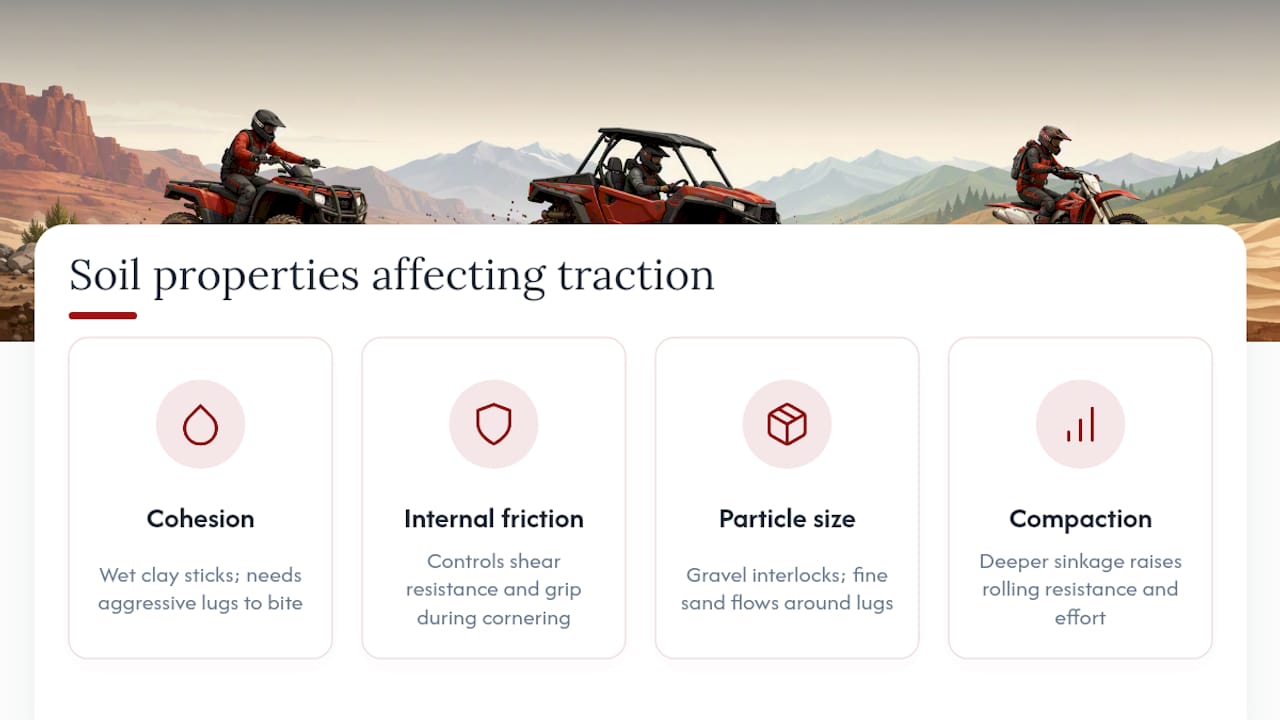
Particle size changes everything about how a tire finds grip. Coarse gravel interlocks with knobby tread and offers decent bite. Fine sand flows around lugs like a liquid, which is why narrow, deep-lug tires often bog down while wide paddle tires float. Compaction and sinkage work together too: a tire that sinks into loose soil fights rolling resistance the entire ride, burning power and rider stamina before you’ve even reached the fun part of the trail.
Research backing this up comes straight from the field. An Auburn University study on ATV tire performance used bevameter and tire-rig testing to record how inflation pressure and camber angle change lateral, longitudinal, and vertical forces across different soil types. The takeaway for you as a rider: pressure and camber aren’t just comfort settings, they’re traction settings.
Pressure changes contact area, cornering stiffness, and motion resistance all at once, according to bevameter and tire-rig data from the Auburn study — which is exactly why the same tire feels completely different on hardpack versus loose sand.
If you want to picture it, imagine a simple side-by-side diagram: one tire on hardpack showing a narrow, flat contact patch, and the same tire on sand showing a wider, deeper sinkage line. That visual difference is the whole story of soil-tire interaction in one glance. We break down more of this rubber-to-soil relationship in our guide on tires and performance.
Matching Tire Features to Sand, Mud, Rock, and Mixed Terrain
Once you understand the mechanics, picking a tire style for your terrain gets a lot less mysterious. Here’s how the major soil types line up with tire design, based on how tire families are built for terrain:
- Sand: Paddle-style tires or tires with wide, low-profile lugs work best because sand offers almost no cohesion. Width beats depth here. The pitfall: running a narrow, deep-lug mud tire in sand just digs you a hole.
- Mud: Deep, widely spaced lugs that clear debris on every rotation are the standard. The pitfall is tread pack-up. A tire with a compound that’s too stiff won’t flex enough to eject mud, so even an aggressive pattern behaves like a slick once it packs solid.
- Hardpack or packed dirt: Dense, shorter knobs with more rubber-to-ground contact give consistent grip without excess rolling resistance. Overly aggressive lugs here just add noise and wear.
- Rock: Reinforced sidewalls and dense tread patterns matter more than raw lug depth. The pitfall is running low pressure for grip and paying for it with a pinched sidewall or a puncture on a sharp edge.
- Mixed trails: All-terrain tires split the difference on lug spacing and compound stiffness, trading peak performance in any one condition for reasonable performance in all of them.
The compound itself deserves attention too. A soft rubber compound flexes and self-cleans even with modest lug spacing, while a hard compound can pack solid and act like a bald tire regardless of how aggressive the pattern looks on the shelf. That’s a detail a lot of first-time buyers miss entirely.
Pro Tip: If your riding spans multiple terrains in one outing, don’t chase a perfect tire for each one. Pick an all-terrain tread as your baseline, carry a compact air pump, and adjust pressure between sand, hardpack, and rock sections instead of swapping tires mid-ride.
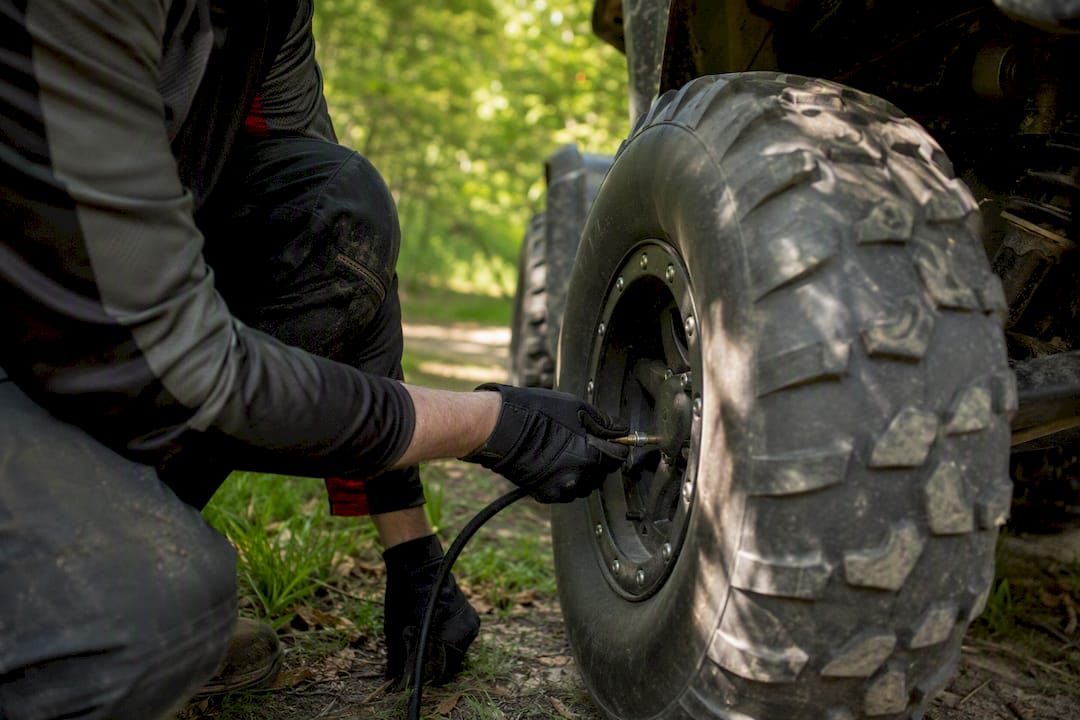
Width and profile tradeoffs matter here too. Larger-diameter wheels, like 18-inch rears versus 17-inch rears on dirt bikes, give a taller sidewall that improves pinch protection on rocky or root-covered trails, while shorter sidewalls sharpen steering response on hardpack. Neither is universally “better,” it depends entirely on what’s under your wheels most often.
How Pressure and Camber Change Your Contact Patch
Lowering tire pressure spreads your vehicle’s weight across a bigger footprint, and that footprint can grow by roughly 30 to 50 percent compared to street pressure. More contact means more traction on sand and mud. It also means more sidewall flex, more heat buildup, and a higher chance of the bead slipping off the rim if you go too low. There’s a real limit to how far you can push this before you trade traction for reliability.
Conservative starting points by terrain, based on off-road tire pressure guidance, look like this:
- Sand: 12 to 15 PSI
- Mud: 15 to 20 PSI
- Mixed dirt and gravel: 18 to 25 PSI
- Rock: 22 to 30 PSI
Camber matters on ATVs and UTVs with independent suspension, since it shifts how much tread surface actually touches the ground through a turn. Every vehicle has different camber limits built into its suspension geometry, so check your owner’s manual before adjusting anything beyond tire pressure.
On the trail, follow this routine: start at the conservative end of the range, ride for five to ten minutes, then note how steering feels and whether the bead feels secure. Adjust in 2 PSI increments and retest before committing further. Always reinflate to street pressure before hitting pavement again.
Your Tire-Buying Checklist Before You Order
Buying the right tire starts with an honest look at where you actually ride, not where you wish you rode, as explained in this fuoristrada buying guide in Albania that helps off-road buyers make smart choices. Use the 70 percent rule: identify the terrain you spend most of your time on and build your tire choice around that, accepting a compromise for the remaining 30 percent.
Before you check out, run through this list:
- What terrain do you ride 70 percent of the time or more?
- What rim size and load rating does your vehicle require?
- Do you need puncture resistance more than raw traction, or vice versa?
- Is your budget better spent on tire life or peak performance?
- Do you need beadlocks for aggressive low-pressure riding?
Then follow this simple decision flow:
- Identify your dominant terrain and vehicle’s rim size.
- Match tread style (paddle, lug, dense knob, or all-terrain) to that terrain.
- Confirm ply rating and sidewall strength against your typical hazards.
- Contact the seller with your vehicle model to confirm fitment before ordering.
For maintenance basics once you’ve picked a tire, our guide on choosing and maintaining go-kart tires walks through the upkeep side of the equation.
How We Know This: Research Behind the Recommendations
This article leans on the Auburn University bevameter and tire-rig study for the soil-tire mechanics, plus field-tested pressure guides for real-world PSI ranges. Vehicle weight and tire construction shift the exact numbers, so treat every figure here as a starting point.
At Gokartsusa, our team has spent years fitting recreational riders with the right tire for their terrain, and the pattern is consistent: riders who match tread to soil first, then tune pressure, get the best results every time.
A Retailer’s Honest Take on Tire Mistakes
The most common mistake we see is riders buying the most aggressive-looking tire instead of the one matched to their actual terrain. Carry a pressure gauge, test before a long trip, and reach out if you need help with fitment.
Find the Right Vehicle and Tire Setup at Gokartsusa
Gokartsusa gives you something a generic parts aisle can’t: vehicles matched to real terrain use from the moment you order, so you’re not guessing about rim size, ply rating, or tire compatibility after the fact.
Whether you’re shopping for a kid’s first ride or your own trail machine, our lineup covers the terrain scenarios this article just walked through. Families looking at rockier trails often start with the Mini Sport Kids ATV, built with parental remote start and sized for mixed-terrain confidence. Riders wanting a gas-powered off-road option built for varied ground should check out our gas off-road go-kart lineup, where tire size and ply rating are already matched to the vehicle’s intended use. Before you order, confirm your primary terrain and rim size, then reach out to our team to lock in the right tire and pressure setup for your first ride.
Frequently Asked Questions
Does soil type really matter more than tire brand? Yes. A premium tire with the wrong tread pattern for your soil will underperform a budget tire built specifically for that terrain, because traction comes from matching lug design to soil cohesion and particle size, not brand reputation alone.
Can I use one tire for both sand and mud? Not well. Sand rewards width and low pressure for flotation, while mud needs deep, widely spaced lugs to self-clean. An all-terrain tire is the closest compromise, but it won’t match a dedicated tire’s performance in either extreme.
How much should I lower my tire pressure for off-road riding? Start conservative: 18 to 25 PSI for mixed dirt, dropping to 12 to 15 PSI for sand, based on off-road pressure guidance. Adjust in small 2 PSI steps and always check your vehicle manual first.
Why does my aggressive mud tire still get stuck? The rubber compound may be too stiff to flex and self-clean, causing the lugs to pack solid with mud and behave like a smooth tire even though the tread pattern looks aggressive.
Sources
- Off-Road Tire Pressure Guide for Different Terrain in 2026 - Off-Road Handbook
- ATV/UTV Tire Types Guide: All-Terrain, Mud, Sand, Rock Tires