




TL;DR:
- Children love outdoor vehicles because they fulfill psychological needs for autonomy, competence, and relatedness. Playing with these toys promotes physical growth, enhances social skills, and builds confidence through active, imaginative, and shared outdoor play. Ensuring safe, age-appropriate vehicles and parental oversight encourages children’s development and lasting outdoor engagement.
There’s a reason your child begs to ride their go-kart or ATV every single day. Understanding why kids love outdoor vehicles goes far deeper than entertainment. Recent research reveals that children’s attraction to powersports toys, the broader category educators and child development specialists call “active outdoor play vehicles,” is rooted in real psychological and physical needs. This isn’t about thrill-seeking alone. It’s about autonomy, mastery, and the kind of freedom that builds confident, resilient kids. Here’s what the science says, and what you can actually do with it.
Key Takeaways
| Point | Details |
|---|---|
| More than just fun | Children’s love of outdoor vehicles is driven by developmental needs for autonomy, competence, and physical challenge. |
| Physical growth is real | Riding and steering outdoor vehicles builds muscle, coordination, and motor skills in ways unstructured play uniquely supports. |
| Psychological benefits matter | Positive risk-taking outdoors satisfies core psychological needs, improving confidence and emotional resilience. |
| Social skills develop too | Shared outdoor vehicle play builds communication, negotiation, and emotional regulation in children of all ages. |
| Safety enables freedom | Age-appropriate vehicles with proper gear and parental oversight allow kids to explore challenge safely and grow faster. |
Why kids love outdoor vehicles: the real answer
Ask most parents why their child is obsessed with go-karts or ATVs, and the answer is usually “they just love speed.” That explanation is incomplete. Children are drawn to active outdoor play vehicles because these toys satisfy three fundamental psychological needs identified in self-determination theory: autonomy, competence, and relatedness.
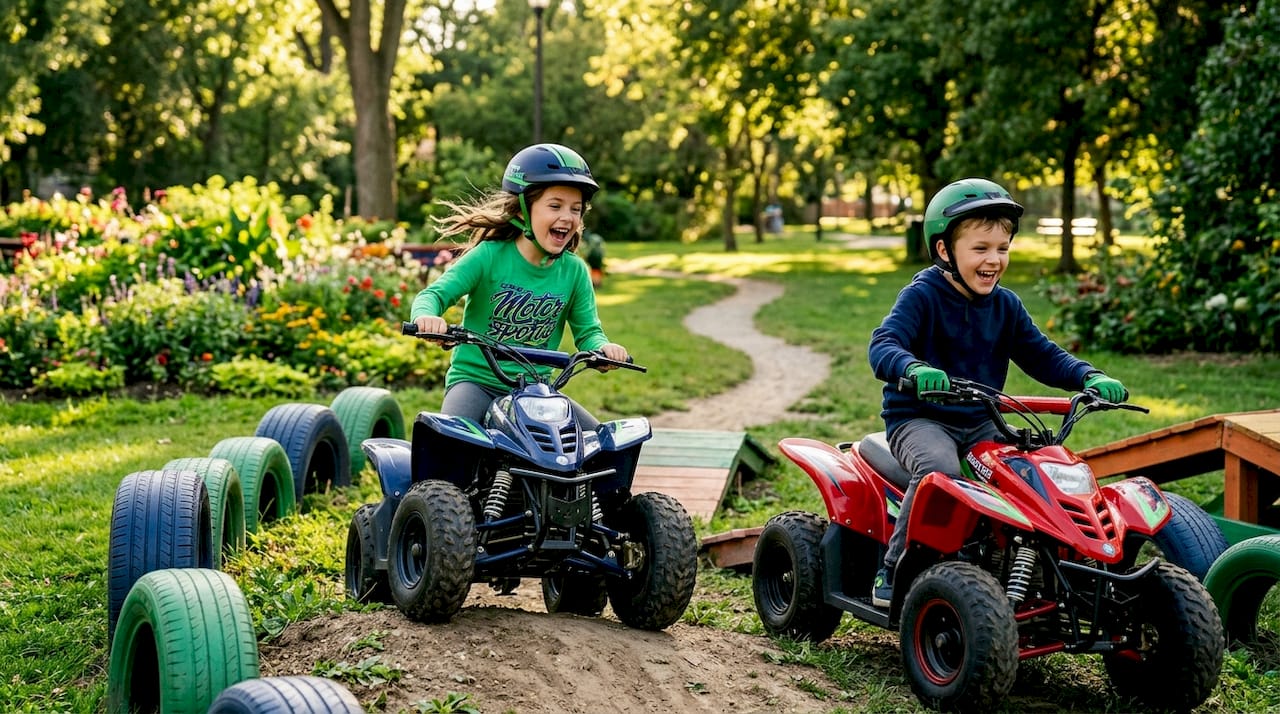
Autonomy means having real control. When a child steers their own ATV around a yard obstacle, they are not following an adult’s script. They are making genuine decisions with real consequences. That feeling is rare in childhood, and kids chase it hard.
Competence is the quiet engine behind the obsession. Every lap, every turn mastered, every new terrain conquered tells a child’s developing brain, “I did that.” Positive risk-taking outdoors satisfies psychological needs of autonomy and self-efficacy, building motivation and wellbeing in measurable ways.
Relatedness comes when siblings race side by side or a parent cheers from the driveway. The vehicle becomes the shared language of adventure.
“Outdoor adventure education engages children in risk, challenge, and autonomy, all of which are vital for wellbeing and development across multiple domains.” — MDPI, 2025
Pro Tip: Let your child choose their own route or challenge during each ride session. Child-chosen missions are more motivating than parent-directed courses, and research shows child-led tasks produce stronger gains in self-confidence.
Physical development through outdoor vehicle play
The physical benefits of outdoor vehicles for kids are not accidental. They are built into every aspect of how these toys work. Steering requires bilateral coordination. Maintaining balance at speed trains the vestibular system. Braking with a hand lever develops fine motor control. These are not side effects. They are core outcomes.
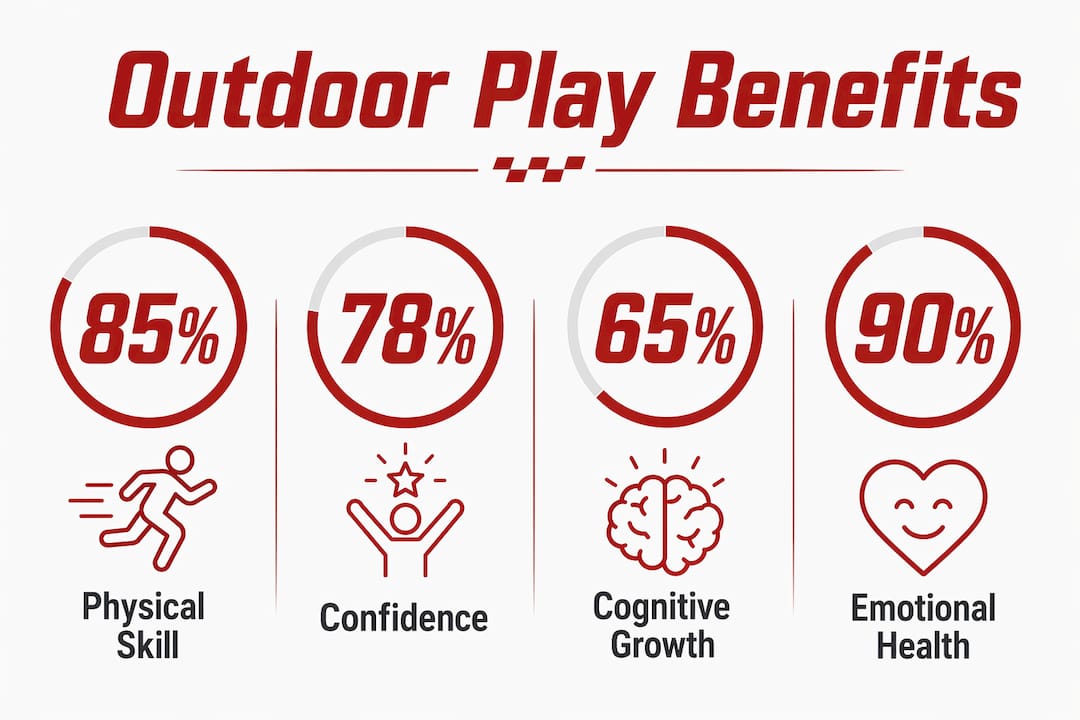
Young children’s physical activity guidelines recommend at least 3 hours of active movement per day, with at least 1 hour of energetic play. Outdoor vehicles fit naturally into that framework across multiple short sessions. A child who rides their go-kart in the morning, explores a trail on their ATV after lunch, and races around the yard before dinner has essentially completed a full physical activity day without a single structured exercise class.
Here’s what outdoor vehicle play physically develops:
- Gross motor skills: Controlling speed, direction, and stopping builds whole-body coordination.
- Core strength: Staying upright and absorbing terrain vibration engages abdominal and back muscles constantly.
- Spatial awareness: Reading distances, judging turns, and avoiding obstacles sharpens proprioception.
- Cardiovascular endurance: Extended ride sessions get hearts pumping in the healthy aerobic range.
Natural environment activity programs show statistically significant improvements in physical literacy, self-confidence, and motor competence in children who participate regularly. The outdoor vehicle is not a passive toy. It is a physical literacy machine.
Pro Tip: Unstructured, repeated outdoor vehicle play builds physical competence faster than supervised practice courses. Let kids repeat their favorite routes on their own terms. Those “practice reps” add up quickly.
The psychology behind outdoor vehicle obsession
Children are not just riding for the rush. They are solving problems, imagining worlds, and testing their limits in ways that static toys and screens cannot replicate.
Watch any group of kids with a go-kart for more than twenty minutes. They stop “just driving” and start building stories. One is a race car driver. Another is an explorer mapping new territory. A third is an emergency vehicle responding to an imaginary crisis. Interaction with real environments fosters complex, imaginative role-play that extends vehicle toy interest far beyond what any battery-powered gadget can hold.
This shift from operation to role play is where the deepest cognitive development happens. Children use the vehicle as a prop for narrative, which builds language skills, problem-solving, and emotional processing simultaneously.
An 8-week structured play intervention demonstrated large effect sizes in self-esteem, perceived physical competence, and psychological well-being, showing that consistent outdoor play is not just exercise. It is psychological nourishment.
The freedom element also matters enormously. Children spend most of their day being told what to do, where to sit, and how to behave. Outdoor vehicles give them a legal, parent-approved domain where their choices actually steer the outcome, literally. That sense of real control over a real machine is something video games simulate but never fully deliver.
Social skills and emotional benefits outdoors
The benefits of outdoor vehicles for kids extend well beyond the solo rider. Some of the richest developmental territory opens up the moment two or more children share an outdoor vehicle experience.
Regular outdoor play improves mood, reduces stress, and builds resilience across both physical and cognitive domains. When children play outside with vehicles, they negotiate turns, set rules, resolve disagreements, and celebrate each other’s wins. That is a full social skills curriculum running in the background of what looks like pure play.
Consider what happens during a typical backyard ATV session:
- Kids negotiate who rides first, learning patience and fairness.
- They create courses together, practicing collaboration and creative thinking.
- They cheer each other on, building empathy and peer connection.
- They work through frustration when a turn goes wrong, developing emotional regulation.
The physical movement itself contributes to the emotional picture. Child-led, unstructured outdoor play helps kids regulate behavior and emotions while stimulating all senses. Children who burn real physical energy outdoors consistently show calmer, more focused behavior afterward. The vehicle is not just a toy. It is an emotional regulation tool that parents can deploy every single afternoon.
Pro Tip: Set up simple group challenges like a shared obstacle course rather than competitive races to maximize social benefits. Collaborative goals encourage teamwork far more reliably than head-to-head competition at younger ages.
Practical tips for encouraging safe outdoor vehicle play
Knowing why children enjoy outdoor play with vehicles is useful. Knowing how to support it safely is what makes the difference between a great experience and a preventable accident.
Here is a practical sequence for setting up healthy, safe outdoor vehicle play:
- Choose the right vehicle for the age. A 4-year-old needs a battery-powered ride-on with low speed limits. A 9-year-old is ready for a 110cc youth ATV with parental controls. Matching the machine to the child prevents both boredom and danger.
- Gear up every single time. Helmet, knee pads, and elbow pads are non-negotiable. Make them part of the ritual so children see safety as part of the adventure, not an obstacle to it.
- Select an appropriate environment. Start with flat, open space. Introduce inclines, turns, and varied terrain gradually as skill develops.
- Use parental controls strategically. Features like remote start/kill switches let you limit speed and stop the vehicle remotely, which builds your confidence while children build theirs. Review parental controls on ATVs to understand what to look for when purchasing.
- Teach road safety concepts early. Even in the backyard, introduce stop signs, turn signals, and right-of-way. These concepts sink in through practice, and the vehicle makes them real.
Pro Tip: Consistent outdoor vehicle sessions, even short 15-minute rides several times a week, outperform infrequent long sessions for skill development. Frequency of exposure is what builds competence and confidence over time.
Comparing popular outdoor vehicles for kids
Not all outdoor vehicles serve the same developmental purpose, and the best outdoor vehicles for kids depend on your child’s age, temperament, and the skills you want to build. Here is how the most popular options compare:
| Vehicle Type | Age Range | Key Skills Developed | Parent-Friendly Features |
|---|---|---|---|
| Electric ride-ons | 1 to 5 years | Basic steering, spatial sense | Low speed, soft bumpers |
| Scooters and balance bikes | 3 to 7 years | Balance, coordination, braking | Simple mechanics, easy supervision |
| Youth go-karts | 5 to 12 years | Steering precision, speed control | Parental speed limiters, roll cages |
| Youth ATVs (110cc) | 6 to 12 years | Terrain reading, full-body coordination | Remote kill switch, throttle limiter |
| Mini bikes | 8 to 14 years | Balance, throttle control, braking | Adjustable speed settings |
Go-karts and ATVs consistently rank among kids’ favorite outdoor toys because they offer the highest level of real control at age-appropriate speeds. Youth go-karts encourage skill mastery and safe family engagement in ways that simpler ride-ons eventually outgrow.
For families deciding between options, the ATV tends to offer more terrain versatility while go-karts develop sharper steering precision. Both support outdoor adventure activities for children across different skill levels. The right call depends on your yard, your child’s age, and how much supervision you want built into the vehicle itself.
Adaptive ride-on vehicles also deserve a mention. Ride-on vehicles in pediatric settings show meaningful physical and cognitive development benefits, confirming that the core developmental logic applies across a wide spectrum of children.
My honest take on outdoor vehicles and kids
I’ve spent years around families and powersports vehicles, and here’s what I keep seeing that most parenting content misses entirely. The magic is not in the vehicle. It’s in what the vehicle gives the child: a problem that is genuinely theirs to solve.
Every time a kid figures out how to take a corner without sliding wide, they are not just learning to drive. They are learning that effort produces results. That is a lesson no classroom delivers with the same immediacy.
I’ve watched children who struggled with confidence in school light up behind the wheel of a youth ATV. I’ve seen siblings who barely spoke suddenly become a team when one needed to coach the other through a tricky turn. The vehicle creates a context where children lead, and the adults watch.
My honest advice: resist the urge to over-coach. Set the safety parameters, provide the gear, and then step back. The best thing you can do is give consistent access to outdoor vehicle play and let the repetition do its work. Competence builds confidence, and confidence builds kids who are ready for real challenges.
The research backs this up, but honestly, you’ll see it yourself after the first month of regular rides.
— Mario
Ready to fuel your child’s next adventure?
Every insight in this article points toward the same practical conclusion. Children thrive when they have access to safe, age-appropriate outdoor vehicles and the freedom to explore with them regularly.

At Gokartsusa, we’ve built our catalog around exactly this principle: real adventure, real safety, real fun. The Mini Sport Kids ATV with parental remote start/kill is one of our most parent-trusted options, offering a 110cc gas engine with a remote kill switch so you stay in control while your child builds genuine confidence. It’s the kind of vehicle that grows with your child’s skills. For families who want to maintain their vehicles long-term and keep the rides safe and enjoyable, reliable replacement carburetor parts are always available. Before your first ride, we also recommend reviewing our safe kids ATV practices guide so you start the adventure right.
FAQ
Why do kids love outdoor vehicles so much?
Children are drawn to outdoor vehicles because they satisfy core psychological needs for autonomy, competence, and positive risk-taking. The ability to steer a real machine and make real choices is uniquely empowering for developing minds.
What age is right for a kids’ outdoor vehicle?
Electric ride-ons suit children as young as 1 to 2 years, while youth ATVs and go-karts with parental controls are generally appropriate from around age 6, depending on the child’s size and motor skill development.
Are outdoor vehicles actually good for child development?
Yes. Research shows that outdoor play builds fitness, motor skills, cognitive function, mood, and emotional resilience. Outdoor vehicles specifically support coordination, spatial awareness, and self-confidence through repeated active play.
How can parents make outdoor vehicle play safer?
Always use a properly fitted helmet and protective gear, choose age-appropriate vehicles with speed limiters or remote kill switches, start on flat terrain, and increase challenge gradually as your child’s skills grow.
How do outdoor vehicles compare to screen time for kids?
Outdoor vehicles offer physical activity, real-world problem-solving, and social interaction that screens cannot replicate. Limiting device use in favor of active outdoor play consistently supports better health outcomes and emotional development in children.