




Yes, for storage of 30 days or longer, use a dedicated storage fuel stabilizer. It’s the cheapest insurance you’ll ever buy for an engine. Choose a storage-formula product over an everyday ethanol treatment, follow the label’s treat rate (commonly around 1 ounce per 2.5 to 10 gallons depending on brand), and run the engine a few minutes after dosing so the treated fuel reaches every corner of the fuel system.
TL;DR:
- Use a dedicated storage fuel stabilizer if fuel will sit for over 30 days to prevent gum, varnish, and moisture-related issues in engines.
- Match the stabilizer type and dose to your storage duration, ethanol content, and engine type for optimal protection.
- Manufacturers claim up to 24 months (STA-BIL) or 3 years (VP Racing) of fuel freshness with proper treatment, but chemical limitations mean stability declines after one to two years.
- Proper storage practices include filling tanks near capacity, mixing treated fuel thoroughly, and running the engine briefly before storage to circulate stabilizer.
- Always adhere to label treat rates, store stabilizer bottles properly, and consider replacing fuel-system components after long-term storage to ensure engine reliability.
Table of Contents
- Why Fuel Stabilizer Storage Matters for Your Powersports Fleet
- Which Fuel Stabilizer Should You Buy for Storage?
- How to Add Fuel Stabilizer Before Storage
- How Do You Choose the Right Fuel Stabilizer for Your Situation?
- How Long Does Fuel Stabilizer Keep Gas Fresh?
- Handling Fuel Stabilizer Safely
- Why Trust This Storage Guidance
- What the Storage Chemistry Actually Tells You
- Gokartsusa: Gear Up for Storage Season the Right Way
- Sources
- FAQ
Why Fuel Stabilizer Storage Matters for Your Powersports Fleet
Gasoline starts breaking down the moment it leaves the pump. Ethanol blends absorb moisture from the air, oxidation forms gum and varnish inside carburetors, and lighter hydrocarbons evaporate off, leaving behind a thicker, less combustible residue. That’s why your go-kart, mini bike, or ATV can crank and crank after a winter in the garage without firing.
A stabilizer doesn’t reverse any of that. What it does is slow the clock. Antioxidants in the formula interrupt the oxidation reaction, corrosion inhibitors coat metal fuel-system parts, and in ethanol-rated products, a demulsifier keeps water from separating out into a distinct layer at the bottom of the tank. Treat fresh fuel before it sits, and you buy your engine months of protection it wouldn’t otherwise have.
Which Fuel Stabilizer Should You Buy for Storage?
Every major brand on the shelf solves a slightly different version of the same problem. Some are built for straightforward gasoline sitting in a mower for the winter. Others are engineered around ethanol blends, high humidity, or multi-year storage windows for classic cars and seasonal toys. Matching the product to your actual storage scenario matters more than grabbing whatever bottle is closest to the register.
STA-BIL Storage Fuel Stabilizer is the one most owners already have in the garage, and for good reason. Gold Eagle’s own product page claims up to 24 months of protection at that 1 ounce per 2.5 gallon rate, and it’s sold everywhere from hardware stores to big-box retailers in bottle sizes that make quick math easy.
VP Racing Fuel Stabilizer earns its spot when ethanol is the enemy. VP’s dosing chart lays out two distinct paths: a lighter dose for fuel with minimal ethanol content aiming for two years, and a much heavier dose, 1 ounce per gallon, built specifically for high-ethanol or humid-climate storage stretching toward three years.
STP Fuel Stabilizer keeps things simple. Its product sheet leans on preventing gum formation and corrosion from moisture, with straightforward treat rates for anyone who just wants reliable starts after a season off.
Lucas Fuel Stabilizer adds a cleaning and lubricating claim on top of stabilization, which appeals to owners who want their carburetor jets and injectors cleaner, not just protected, before spring.
Sea Foam gets mentioned constantly alongside STA-BIL in owner forums because it straddles both categories: part stabilizer, part fuel-system cleaner, useful if your engine needs a tune-up along with its winter prep.
- Pick STA-BIL Storage Fuel Stabilizer for straightforward seasonal storage of go-karts, mowers, and generators.
- Pick VP Racing when your local gas station only sells high-ethanol blends or you store equipment in a humid climate.
- Pick STP or Lucas when corrosion prevention or light cleaning matters as much as raw shelf time.
- Pick Sea Foam if you want one bottle that both stabilizes and cleans in the same pass.
How to Add Fuel Stabilizer Before Storage
Treating fuel correctly takes about ten minutes, and skipping a step is usually why owners end up with a gummed carburetor come spring. Work through it in order.
- Start with fresh fuel. Don’t treat gas that’s already been sitting for weeks. Stabilizer slows future degradation; it doesn’t undo damage already done.
- Fill the tank to about 95%. Leaving a little headroom for expansion while minimizing the airspace where condensation forms is the sweet spot most manufacturers recommend.
- Measure the correct dose. Use STA-BIL’s 1 ounce per 2.5 gallons, VP Racing’s 1 ounce per 10 gallons (or 1 ounce per gallon for high-ethanol conditions), or Lucas’s matching 1 ounce per 2.5 gallon rate. Read your specific bottle. Doses vary by brand.
- Add it to the tank or a gas can, then swirl or shake gently to mix.
- Run the engine for 3 to 5 minutes. This circulates treated fuel through the carburetor, fuel lines, and injectors, not just the tank. AutoZone’s guidance confirms this step is standard across nearly every major brand’s directions.
- For 2-stroke engines with exposed cylinders, consider a fogging oil to coat internal components against rust.
- Disconnect or maintain the battery, and park the vehicle somewhere cool and dry, away from direct sunlight and temperature swings.
Our go-kart storage guide walks through the vehicle-specific side of this, from tire pressure to battery tenders, if you’re prepping a kart or mini bike specifically.
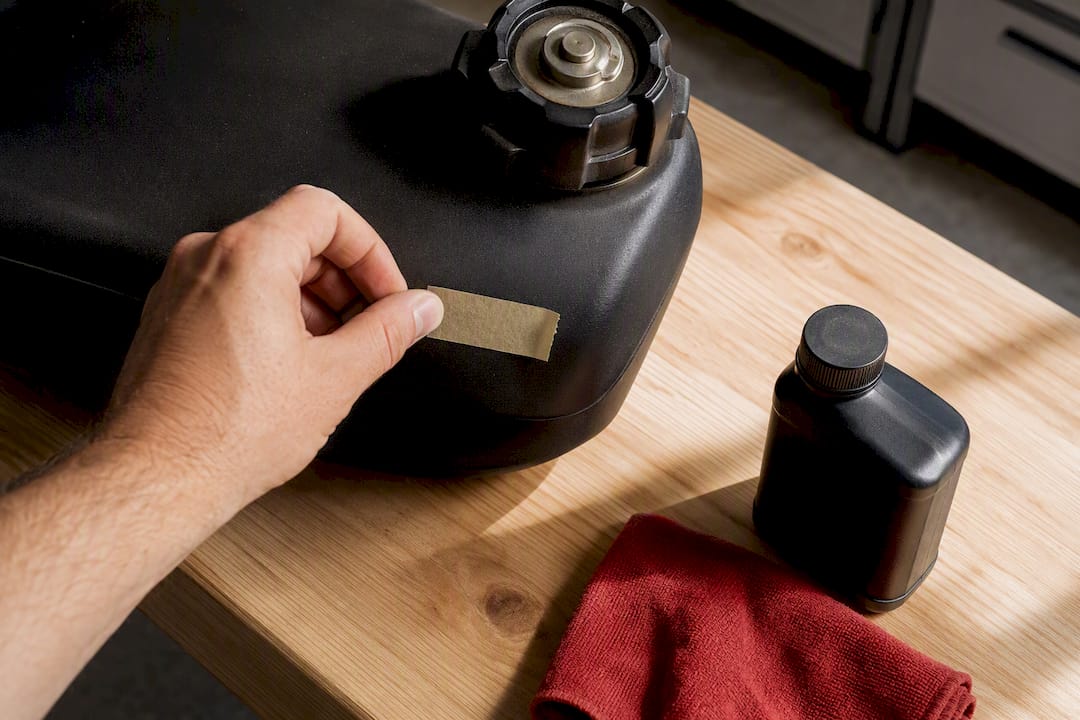
Pro Tip: Write the treatment date on a strip of tape and stick it to the tank. When you pull the vehicle out in spring, you’ll know exactly how long that fuel has been sitting instead of guessing.
How Do You Choose the Right Fuel Stabilizer for Your Situation?
The right bottle depends on three questions, not on whichever brand has the flashiest label.
How long will the fuel actually sit? Short storage of 30 to 90 days, like a mower between mowing seasons, doesn’t need the same firepower as a classic car sitting under a cover for two winters. Match the dose and formula to the real timeline instead of defaulting to the strongest option every time.
Does your local gas contain ethanol? Most US pump gas does, typically E10. If you’re in a humid region or you know your fuel sits near ethanol’s upper blend limits, pick a stabilizer that explicitly calls out demulsifier action and phase-separation prevention, like VP Racing’s high-ethanol dosing option.
What engine are you protecting? Confirm the label states compatibility with your setup, whether that’s a 2-stroke mini bike engine, a 4-stroke go-kart, or a fuel-injected ATV. Most major brands cover all three, but it’s worth the ten seconds to check rather than assume.
Run through this before checkout:
- Treat rate per ounce, and whether it matches your tank size without leftover math
- Bottle size relative to how many gallons you’re treating this season
- Shelf life printed on the bottle itself
- Availability of a manufacturer datasheet or MSDS if you want the full ingredient breakdown
How Long Does Fuel Stabilizer Keep Gas Fresh?
Manufacturer claims cluster in a fairly tight band once you line them up. STA-BIL states up to 24 months of protection for properly treated fuel, while VP Racing pushes that to 2 years for low-ethanol fuel and up to 3 years for high-ethanol or humid conditions when dosed at their higher rate.
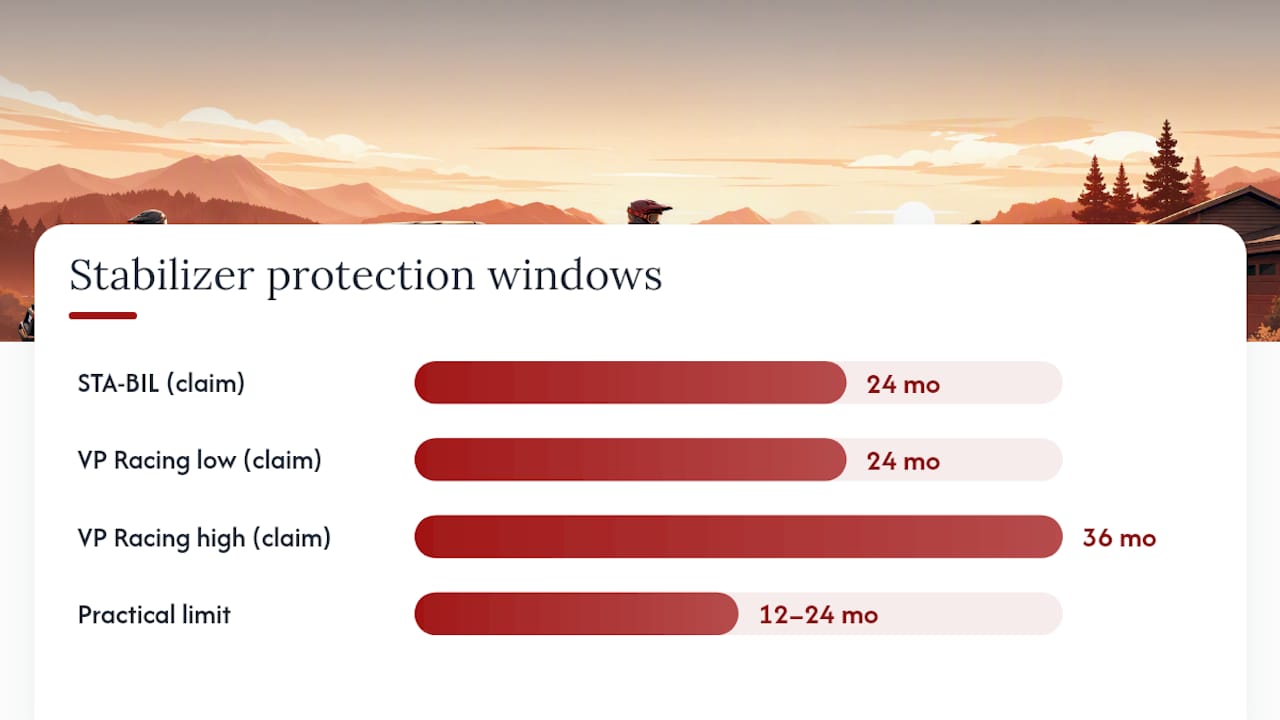
Those numbers describe the outer edge of what’s achievable, not a guarantee for every tank in every climate. Past roughly 12 to 24 months, volatility loss becomes the limiting factor no matter which bottle you used. Technical research into fuel aging chemistry confirms that additives slow the breakdown reactions but can’t restore hydrocarbons that have already evaporated off. If gas has phase-separated, meaning the ethanol and water have dropped out into a visible layer at the bottom of the tank, no amount of stabilizer added afterward will remix it. That fuel needs draining, not treating.
Store the stabilizer bottle itself properly too: capped tight, kept cool and dry, out of direct sunlight. Most brands note the product holds roughly two years unopened when stored this way, so label the cap with the date you opened it.
Handling Fuel Stabilizer Safely
Stick to the label’s treat rate. A slightly heavy pour rarely damages most formulas, but dumping in double or triple the recommended dose wastes product and doesn’t buy extra protection. It just concentrates chemicals that were already calibrated correctly.
- Keep stabilizer bottles away from open flames, pilot lights, and other heat sources.
- Avoid skin and eye contact, and wash off any splashes promptly.
- Dispose of old or contaminated fuel at a local hazardous waste facility rather than pouring it out.
- If fuel has already separated or smells sour, don’t add stabilizer and hope. Drain the tank and start clean.
- Call a mechanic or use a professional fuel-system revitalizer if the engine won’t start after stabilizer treatment and a fresh fuel fill.
Our maintenance essentials guide covers the pre-storage checks worth pairing with fuel treatment, and a partner resource on safe engine bay cleaning is worth a look if you’re prepping for a full restart after months in storage.
Why Trust This Storage Guidance
The maintenance and storage guidance here draws on manufacturer datasheets and technical fuel-chemistry research rather than guesswork or marketing copy. Experience in outfitting owners with vehicles and parts makes this advice practical, not theoretical.
Before you treat a tank, check the specific product’s own instructions and datasheet linked throughout this guide. Formulas and treat rates do shift between product revisions, and the manufacturer’s current label always wins over any general guide.
What the Storage Chemistry Actually Tells You
The conventional advice on fuel stabilizers treats every bottle as interchangeable, and that’s the part worth pushing back on. A dose built for six months of ethanol-free storage isn’t doing the same job as one built for two winters of humid-climate ethanol exposure, even if both bottles say “fuel stabilizer” on the label.
What’s overrated here is the idea that more stabilizer equals more protection. It doesn’t. The chemistry has a ceiling, and volatility loss past a year or two happens regardless of dose. What’s underrated is the run-the-engine step. Owners routinely pour stabilizer into the tank and skip circulating it through the carburetor, which means the parts most likely to gum up never actually got treated.
Prioritize matching the formula to your real storage window and ethanol exposure before you worry about brand loyalty. A $10 bottle used correctly beats a premium bottle poured in and forgotten. That’s the entire game.
— Mario
Gokartsusa: Gear Up for Storage Season the Right Way
Fuel stabilizer protects what’s in the tank, but the fuel lines, filters, and carburetor components carrying that fuel take their own beating over a season of riding. Replacement fuel-system parts that pair naturally with good stabilizer habits are available to help your kart, mini bike, or ATV start clean when storage season ends.

Whether you’re storing a Sport Kart Kids Gas Go Kart for winter or prepping a Gas Powered Mini Bike for a long stretch in the garage, having a spare carburetor or fuel line kit on hand means a sticky valve doesn’t turn into a wasted spring weekend. Browse the full lineup of go-karts, mini bikes, and dirt bikes, along with the parts that keep them running, at the Gokartsusa shop and check current seasonal offers before you gear up for storage.
FAQ
How Long Can You Store Fuel With a Stabilizer?
Most storage formulas claim 24 months of protection under proper conditions, with STA-BIL listing up to 24 months and VP Racing claiming up to 3 years for high-ethanol or humid-climate storage at its higher dose. Past that window, volatility loss limits how fresh the fuel stays regardless of the product used.
Is Sea Foam or STA-BIL Better for Storage?
Both work well, but they solve slightly different problems. STA-BIL is built primarily as a storage-duration stabilizer, while Sea Foam positions itself as a dual-purpose cleaner and stabilizer for owners who also want carbon and gum cleaned from the fuel system.
Which Fuel Stabilizer Is Best for Long-Term Storage?
For fuel sitting a year or more, VP Racing’s high-ethanol dosing option and STA-BIL Storage Fuel Stabilizer both carry the strongest manufacturer claims, up to 3 years and 24 months respectively. Match the choice to whether your local fuel is high in ethanol, since that affects which formula performs better.
Can You Use Fuel Stabilizer All the Time, Even Outside Storage?
Yes, adding stabilizer to every tank is safe for most engines and won’t cause damage at the labeled dose. It’s most useful when fuel will sit longer than a couple of weeks, so daily drivers rarely need it beyond the fuel already cycling through regular use.
How Much Fuel Stabilizer Should You Use per Gallon?
Treat rates vary by brand: STA-BIL and Lucas both use 1 ounce per 2.5 gallons, while VP Racing ranges from 1 ounce per 10 gallons for low-ethanol fuel up to 1 ounce per gallon for high-ethanol or humid storage. Always check the specific bottle’s label, since concentration differs between product lines.