




TL;DR:
- Engine size, or displacement, determines the engine’s power and torque potential in recreational vehicles. Proper matching of engine size to activity and load ensures reliability, performance, and efficiency. Modern technology like turbocharging alters traditional size considerations but reliability favors larger displacement for heavy-duty use.
Engine size, known in the industry as displacement, is the total volume inside an engine’s cylinders available for air and fuel combustion. That single number shapes everything from how fast your go-kart accelerates off the line to how well your ATV handles a steep, loaded trail. Knowing why consider engine size before you buy protects you from costly mismatches between your vehicle and your real-world adventures. At Gokartsusa, we see buyers make this decision every day, and the right engine size consistently separates a thrilling ride from a frustrating one.
Why consider engine size before buying a recreational vehicle
Engine displacement sets the theoretical ceiling for power output. A larger cylinder volume draws in more air and fuel with each combustion cycle, which means more energy released per stroke. Displacement sets the ceiling for potential power, but airflow, compression, and camshaft profiles ultimately determine how much horsepower and torque you actually get. That distinction matters because two engines with identical displacement can produce very different results depending on their internal design.
Torque is where displacement makes the biggest real-world difference. Larger displacement engines produce more torque at lower RPMs, which makes them feel effortless in power delivery. Smaller, high-revving engines require you to wind them up before the power arrives. For recreational riders pulling a trailer, climbing a hill, or carrying gear, low-RPM torque is the practical advantage that keeps the engine relaxed and the ride enjoyable.
Modern technology has complicated the picture. Turbocharging and direct injection allow smaller engines to match or exceed the output of larger naturally aspirated units. You can read more about how turbocharging works and why it changes the displacement conversation entirely. Still, for sustained, heavy-load applications, raw displacement remains the more reliable foundation.
- Larger displacement delivers more torque at lower engine speeds, reducing strain.
- Smaller engines with turbocharging can match power figures but add mechanical complexity.
- Bore and stroke ratios shape whether an engine favors torque or top-end horsepower.
- Supporting systems like injectors, exhaust, and camshafts must match displacement to realize full potential.
Pro Tip: Before focusing on horsepower numbers, check the torque curve. A flat, wide torque band at low RPM tells you the engine will feel strong in everyday recreational use, not just at full throttle.
How does engine size affect fuel efficiency and running costs?
Fuel efficiency is where engine size gets genuinely counterintuitive. The straightforward assumption is that bigger always means thirstier. That is mostly true, but the relationship is more nuanced than a simple size comparison.
Increasing displacement by 1 liter results in an average fuel consumption increase of about 1.91 L/100 km, with a smaller increase of 1.11 L/100 km specifically in urban driving. That gap between city and open-road figures tells you that driving style and load conditions matter as much as the engine itself. A large engine cruising at low throttle on a trail can be more efficient than a small engine screaming at high RPM under the same load.
Engine size correlates poorly as a single predictor of real-world fuel costs compared to factors like vehicle weight, transmission efficiency, and driving cycle. This finding should change how you shop. A heavier vehicle with a small engine often works the engine harder, burning more fuel than a lighter vehicle with a moderately larger engine running comfortably in its power band.
A small engine under strain in a heavy vehicle may use more fuel than a larger engine operating efficiently in its power band in a lighter vehicle. Matching engine size to vehicle weight and load is the real efficiency formula, not simply choosing the smallest displacement available.
The table below shows how different engine size categories typically align with fuel use and activity type.
| Engine size | Typical fuel use | Best suited for |
|---|---|---|
| Under 50cc | Very low | Light youth recreational use |
| 50cc–110cc | Low | Kids ATVs, entry-level go-karts |
| 110cc–250cc | Moderate | Teen and adult recreational riding |
| 250cc and above | Higher | Heavy-load, off-road, towing |
Running costs extend beyond fuel. Larger engines carry heavier components, require more oil, and often demand more substantial maintenance intervals. Balancing those costs against your actual riding frequency and load demands is the honest way to calculate ownership value.
Why does engine size matter for different recreational activities?
The importance of engine size shifts dramatically depending on what you plan to do with your vehicle. Matching displacement to your activity profile is the single most practical decision you can make before purchase.
-
Light recreational riding. Kids and beginners benefit from smaller engines in the 40cc–110cc range. These sizes deliver enough power for fun without overwhelming new riders. The Demon Kids Gas Dirt Bike 40cc is a real example of how a well-matched small engine creates a safe, confidence-building experience.
-
Off-road and trail riding. Uneven terrain demands torque, not just top speed. A larger engine handles obstacles without forcing constant gear changes or high-RPM strain. Towing requires 2.0 liters or larger to avoid mechanical strain, and the same principle applies to heavy off-road loads on ATVs and karts.
-
Track and sport performance. Sport riding rewards a different balance. Weight matters as much as power here. A 6.2L V8 weighs approximately 685 lbs compared to 380 lbs for a 2.0L turbocharged engine. That 305-lb difference changes handling, cornering, and rider fatigue over a long session.
-
Towing and hauling. Sustained power under load is where large displacement earns its reputation. Larger engines provide smoother operation and less stress under heavy loads, which is critical for recreational vehicles used in towing or serious off-road work.
Assessing your activity profile honestly before you buy prevents the two most common mistakes: an undersized engine that strains constantly, or an oversized engine that adds unnecessary weight and cost to a vehicle you use for light weekend fun.
Pro Tip: Test drive your shortlisted vehicle under the conditions you actually plan to use it. A kart that feels quick on flat pavement may feel sluggish on a gravel hill with a passenger. Real conditions reveal engine size fit better than spec sheets.
How do modern engine technologies change the engine size equation?
Turbocharging and electronic engine management have genuinely shifted what displacement means in practice. Advanced technology separates displacement from power output, allowing smaller turbocharged engines to outperform older, larger naturally aspirated units. For recreational buyers, this means a 110cc turbocharged engine can deliver performance that a 150cc carbureted engine could not match a decade ago.
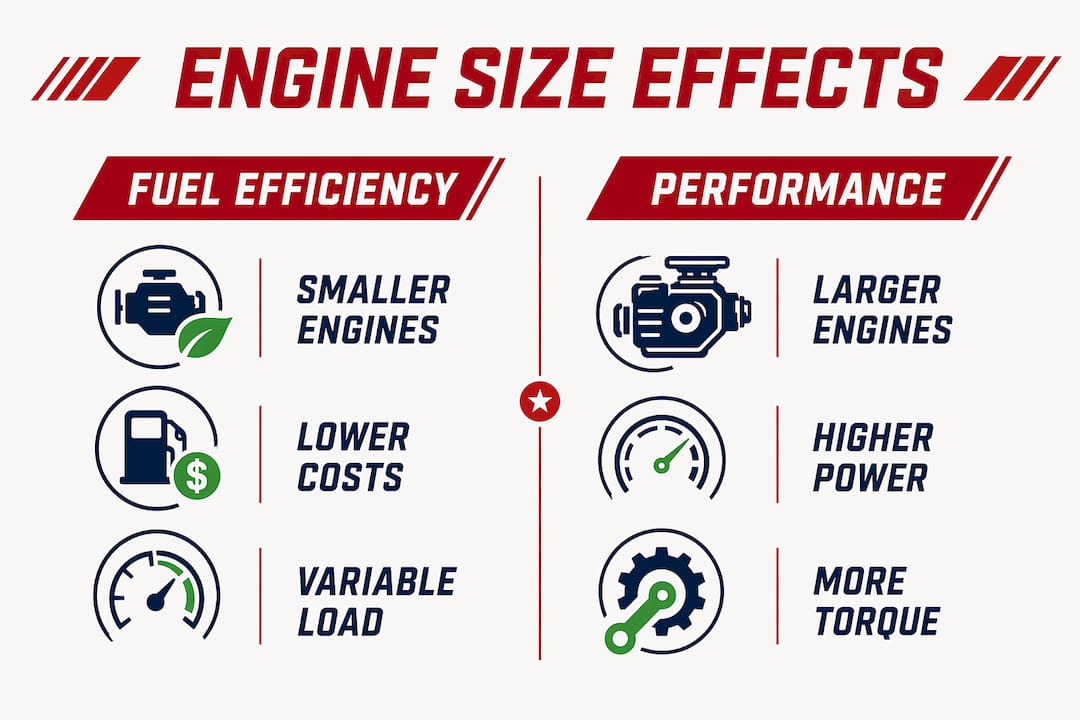
The trade-offs are real, though. Turbocharged engines can replicate the power of larger displacement with less weight and better fuel economy, but they add complexity and potential reliability concerns. More components mean more potential failure points, especially in vehicles exposed to dust, water, and rough terrain.
| Technology | Power benefit | Trade-off |
|---|---|---|
| Turbocharging | Matches larger displacement output | Added complexity, heat management |
| Direct injection | Better fuel atomization, efficiency | Higher maintenance cost |
| Variable valve timing | Broader power band | More electronic components |
| Naturally aspirated | Simpler, more reliable | Lower peak power per liter |
For heavy-duty and continuous high-load recreational use, larger displacement with simpler technology often wins on reliability. Displacement no longer guarantees power output due to technological advances, but it does guarantee a more relaxed engine under sustained stress. Buyers who ride hard and often should weigh that reliability factor heavily against the appeal of a smaller, more powerful turbocharged option.
Understanding vehicle performance factors beyond raw displacement helps you read spec sheets with confidence and ask the right questions before you commit to a purchase.
Key Takeaways
Engine size is the single most important specification to match to your actual riding conditions, not just your performance ambitions.
| Point | Details |
|---|---|
| Displacement sets the power ceiling | Airflow, compression, and camshaft design determine how much of that ceiling you actually reach. |
| Fuel efficiency depends on load, not size alone | A strained small engine often burns more fuel than a relaxed larger engine in the same vehicle. |
| Match engine size to your activity | Light riding suits 40cc–110cc; towing and off-road work demands larger displacement for reliability. |
| Modern tech changes the math | Turbocharging boosts smaller engines but adds complexity that matters in rough recreational conditions. |
| Weight is part of the equation | A heavier engine changes handling, so sport and track riders should factor mass alongside power. |
What I’ve learned watching buyers choose engine size
Most buyers walk in focused on the wrong number. They want the biggest engine they can afford, assuming more displacement always means more fun. That instinct is understandable, but it leads to real problems on the trail.
I’ve watched riders buy oversized engines for light recreational use and spend their first season fighting a vehicle that feels heavy, drinks fuel, and punishes every mistake. The engine is not the problem. The mismatch is. Experts consistently emphasize matching engine size to duty cycle over chasing the largest displacement for longevity and satisfaction. That advice holds up every time I see it tested in real riding conditions.
The opposite mistake is just as common. A parent buys a small-engine ATV for a growing teenager, and within one season the engine is running at the top of its range constantly. That kind of sustained strain shortens engine life and kills the riding experience. Larger displacement engines provide smoother operation and less stress under heavy loads, and that smoothness is not a luxury. It is what keeps a vehicle reliable for years.
My honest advice: read the spec sheet, then ignore it for a moment. Think about the actual terrain, the actual load, and the actual rider. Match those three things to an engine size, and you will almost never regret the purchase. Gokartsusa’s powersports size guides are built around exactly this kind of practical matching, and they are worth reading before you finalize any decision.
— Mario
Gokartsusa has the right engine size for your next adventure
At Gokartsusa, we stock recreational vehicles across the full engine size spectrum, from entry-level youth karts to capable adult machines built for real terrain. Whether you are shopping for a young rider’s first gas-powered experience or looking for a vehicle with enough displacement to handle serious off-road demands, we have options sized for the activity, not just the price tag.
Our Sport Kart Kids Gas Go Kart runs a 2.5hp 4-stroke engine sized perfectly for riders ages 8 and up, delivering real performance without overwhelming a young rider. For families ready to step up, our Mini Sport Kids ATV with 110cc engine includes parental remote start and kill switch, giving adults control while kids build confidence. Browse the full Gokartsusa catalog and reach out to our team. We are here to help you match the right engine to the right rider and the right adventure.
FAQ
What does engine size actually mean in a recreational vehicle?
Engine size, or displacement, is the total volume of all cylinders in an engine measured in cubic centimeters (cc) or liters. It determines how much air and fuel the engine can combust per cycle, which sets the foundation for power and torque output.
Does a bigger engine always mean better performance?
Not always. Displacement sets the power ceiling, but factors like turbocharging, valve timing, and compression ratio determine actual output. A well-tuned smaller engine can outperform a larger but less refined one in many recreational riding conditions.
How does engine size affect fuel costs for recreational vehicles?
Larger engines generally consume more fuel, but vehicle weight and load matter just as much. A small engine working hard under heavy load can use more fuel than a larger engine running relaxed in a lighter vehicle.
What engine size is right for kids’ recreational vehicles?
Entry-level youth vehicles perform best with engines in the 40cc–110cc range. This size delivers enough power for safe, enjoyable riding while keeping speed and weight appropriate for younger, developing riders.
Should I choose a turbocharged small engine or a larger naturally aspirated engine?
For light recreational use, a turbocharged small engine offers good power with lower weight. For sustained heavy-load or off-road riding, a larger naturally aspirated engine provides greater reliability and smoother power delivery under continuous stress.